

Calisthenics Workout Plan for Beginners (Free Log Template)
Quick answer: A beginner calisthenics workout plan is three full-body sessions a week on non-consecutive days, alternating two workouts that each cover a push, a pull, a leg exercise and a core hold. Work every exercise in a 6 to 12 rep range, and move to the next harder variation once all sets reach 12.
You found a calisthenics routine online. It has twelve exercises and a nice graphic, and it says nothing about where you should start.
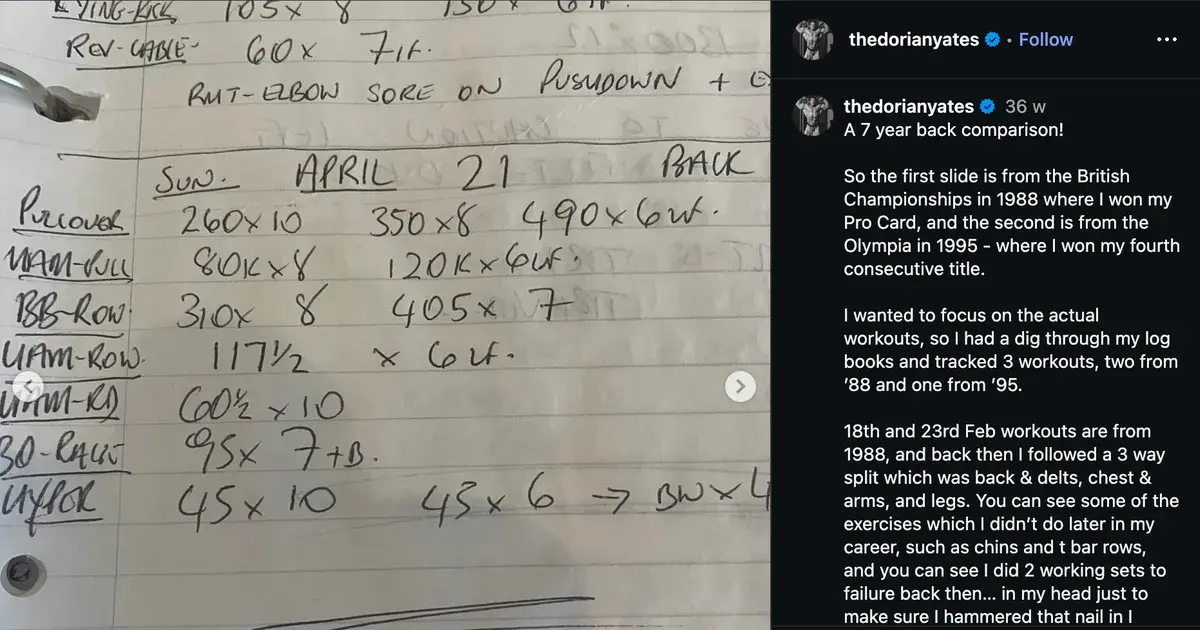
Three weeks later your notes app says pushups 3x10 on every page. You can't tell whether those were on the floor, on a bench, or on your knees, and you can't tell whether anything got harder.
What should a beginner calisthenics workout plan include?
Four movement patterns, every session: a push, a pull, a leg exercise and a core hold. That covers the major muscle groups, which matches the World Health Organization advice that muscle-strengthening work should involve the major muscle groups on two or more days a week.
Each slot is a progression. Calisthenics has no plates to add, so difficulty comes from leverage, range of motion and, later, a belt with weight on it. Every slot in the plan is a ladder of variations, and your job is to climb it.
Keep the list short. Four exercises per session, three sets each, is enough for a beginner to recover from and still progress. More exercises mostly means more things to forget to write down.
The 3-day calisthenics workout plan
This free calisthenics workout plan needs a floor, a sturdy bench or box, and a bar you can hang from (a park pull-up bar works, and a low bar or sturdy table edge covers the rows). Parallel bars help for dips, but a bench gets you started.
Train three days a week with at least one rest day between sessions, for example Monday, Wednesday and Friday. Alternate two workouts, so week one is A, B, A and week two is B, A, B.
Workout A
| Slot | Exercise | Sets | Target |
|---|---|---|---|
| Push | Push-up progression | 3 | 6 to 12 reps |
| Pull | Inverted row progression | 3 | 6 to 12 reps |
| Legs | Squat progression | 3 | 6 to 12 reps per leg once single-leg |
| Core | Plank progression | 3 | 20 to 45 seconds |
Workout B
| Slot | Exercise | Sets | Target |
|---|---|---|---|
| Pull | Pull-up progression | 3 | 3 to 8 reps |
| Push | Dip progression | 3 | 6 to 12 reps |
| Legs | Split squat progression | 3 | 6 to 12 reps per leg |
| Core | Hollow body progression | 3 | 20 to 45 seconds |
Rest one and a half to two minutes between sets. Stop each set with one or two clean reps left in the tank, not at a grinding, form-breaking failure.
The pull-up target is lower on purpose. Most beginners cannot do many strict pull-ups yet, so that slot starts with negatives or band-assisted reps, as our guide to doing your first pull-up walks through.
If you would rather do the same structure with a barbell, the 3-day full-body workout plan uses the same three-sessions-a-week shape with weights.
How do you progress calisthenics without adding weight?
Calisthenics progression means climbing a ladder of variations. Each rung is a harder version of the same movement, so moving up a rung does the job that adding 2.5 kg does on a barbell.
| Pattern | Easiest | Next | Next | Next | Hardest |
|---|---|---|---|---|---|
| Push-up | Wall push-up | Incline push-up (bench) | Floor push-up | Feet-elevated push-up | Archer push-up |
| Inverted row | High bar, feet back | Lower bar | Bar at hip height | Feet elevated | One-arm assisted |
| Pull-up | Dead hang | Negatives | Band-assisted | Strict pull-up | Weighted pull-up |
| Dip | Bench dip, bent knees | Bench dip, legs straight | Negatives on bars | Parallel bar dip | Weighted dip |
| Squat | Box squat | Bodyweight squat | Split squat | Bulgarian split squat | Pistol squat to a box |
| Core hold | Plank | Tuck hollow hold | Hollow body hold | Tuck L-sit | L-sit |
Use double progression to decide when to move up. Pick the rung where you can do at least 6 clean reps. Add reps session by session. When all three sets reach 12, move up one rung and start again near 6. Holds work the same way, with 20 and 45 seconds as the bottom and top. Our comparison of double progression vs linear progression explains why this beats adding difficulty every session.
Pull-ups and dips get a final rung: added weight. Once you can do three sets of 8 strict pull-ups or 12 dips, put a small plate on a dip belt or in a backpack. From there the plan works like any barbell lift. The push-up guide and dip guide cover form for each rung.
Does a calisthenics workout plan actually build muscle and strength?
The research says yes, with a caveat about maximal strength.
Progressive push-up variations improved bench press strength. In a 2018 study in the Journal of Strength and Conditioning Research, 23 moderately trained men trained three days a week for four weeks, either with progressively harder push-up variations or with the bench press. Both groups improved their 1RM bench press. Neither group showed a measurable change in muscle thickness over that short window.
Banded push-ups kept pace with the bench press. A 2015 study by Calatayud and colleagues had experienced lifters train either the bench press or elastic band push-ups at a 6 rep max for five weeks. Both groups improved 1RM and 6RM strength with similar gains, while the control group stayed the same.
Lighter loads can build muscle, but heavy loads build max strength. A 2017 meta-analysis by Schoenfeld and colleagues found that muscle growth was similar across low and high loads when sets went to failure, while 1RM strength gains favoured heavy loads. For calisthenics, that is the argument for taking sets close to failure, and for adding weight to pull-ups and dips once the reps get high.
How do you log a calisthenics workout in a notes app?
Write the variation into the exercise name, write reps set by set, and write holds in seconds. Here is a template you can paste into Apple Notes, Google Keep or any notes app.
Calisthenics A
Mon 20 Oct

Push-ups incline bench 12, 11, 10
Inverted rows bar hip height 9, 8, 8
Bulgarian split squats 10, 10, 9
Plank 45s, 40s, 40s
Calisthenics B
Wed 22 Oct

Pull-ups band-assisted 6, 5, 5
Dips parallel bars 8, 7, 6
Split squats 12, 12, 11
Hollow hold 25s, 20s, 20s
Once weight goes on the belt, add it to the line:
Pull-ups +5kg 6, 5, 5
Dips +10kg 9, 8, 8
Name the variation every time. Push-ups incline bench and Push-ups floor are different exercises at different difficulty. If both are logged as Push-ups, your history looks flat on the day you actually got stronger.
Write per-set reps, not 3x10. Bodyweight sets drop off fast, and 12, 11, 10 tells you how close you are to the next rung. 3x10 hides it.
One note per session, dated. Searching for Calisthenics A then pulls up every A session in order. For more on the +5kg and bodyweight shorthand, see our guide to tracking bodyweight exercises, and for a pinned-note setup the Apple Notes workout template shows how to duplicate a template each week.
Where should you keep your calisthenics log?
| Feature | Physical Notebook | Notes App | Traditional Gym App | Gym Note Plus |
|---|---|---|---|---|
| Logging speed | Fast, needs a pen | Fastest, just type | Slower, menus per set | Type it like a note |
| Variation names | Write anything | Write anything | Limited to the app's exercise list | Write anything |
| Timed holds | Write anything | Write anything | Depends on the app | Typed as seconds |
| Data visualization | None | None | Charts per exercise | Charts per exercise |
| Flexibility | Total | Total | Fixed by the app | Total |
| Searchability | Flip pages | Text search only | Filter by exercise | History by exercise |
A notebook or notes app handles calisthenics well, because the exercise names keep changing and free text never complains. The trouble starts eight weeks in, when you want to know whether your hollow hold actually went anywhere.
A simple starting plan
- Find your starting rung this week. For each pattern, pick the hardest variation you can do for 6 clean reps (or a 20 second hold). Write it down.
- Paste the template into your notes app. One note per workout, with the date at the top and the variation in every exercise name.
- Run A, B, A on non-consecutive days. Then B, A, B the following week.
- Add reps before you add difficulty. Move up a rung only when all three sets hit 12, or 45 seconds on holds.
- Review the log every four weeks. Each pattern should have climbed at least one rung or gained clear reps. If one has not, look at sleep, effort and whether you skipped sessions.
Keep the notes, get the progress charts
If your plan already lives in your notes app, you do not have to give that up. The template above is already the right format.
Gym Note Plus reads that same plain text and turns it into a tracked history:
- Variations stay separate. Gym Note Plus does not merge exercise variants, so incline and floor push-ups keep their own histories.
+5kgis read as added load on pull-ups, dips and other bodyweight exercises, not as a comment.- Holds like
45sare logged as timed sets, so a plank is tracked in seconds rather than reps. - Your heaviest added load is tracked as its own personal record on weighted pull-ups and dips.
Paste one of your calisthenics sessions into the free notes to workout translator to see how your shorthand reads before you change anything.
In calisthenics, the variation name tells you how hard the set was. Leave it out and your log cannot show you getting stronger.
Frequently Asked Questions
Is a calisthenics workout plan enough to build muscle?
A calisthenics workout plan can build muscle if sets are taken close to failure and the exercises keep getting harder. A 2017 meta-analysis by Schoenfeld and colleagues found muscle growth was similar across light and heavy loads when sets reached failure. Progressing variations and adding weight to pull-ups and dips keeps the stimulus rising.
How many days a week should a beginner do calisthenics?
Three full-body calisthenics sessions a week on non-consecutive days is a sensible starting point for a beginner. It trains every major muscle group on more days than the World Health Organization minimum of two a week, and it leaves a full rest day between sessions so you arrive fresh enough to beat the last one.
How do you progress calisthenics without weights?
Calisthenics progression works by moving to a harder variation of the same movement. Stay on one variation and add reps until every set reaches the top of the range, usually 12, then move up one rung, such as incline push-ups to floor push-ups. Pull-ups and dips can eventually take added weight on a belt.
What should a beginner calisthenics routine include?
A beginner calisthenics routine should include one push, one pull, one leg exercise and one core hold per session. Push-ups and dips cover pushing, inverted rows and pull-ups cover pulling, squats and split squats cover legs, and planks or hollow holds cover the core. Three sets of each is enough to start.
How do you track calisthenics progress?
Track calisthenics progress by logging the exact variation, the reps for each individual set, hold times in seconds, and any added weight such as +5kg on pull-ups. A line like Pull-ups band-assisted 6, 5, 5 shows both the rung you are on and how close you are to moving up.
Final Takeaways
- Three full-body sessions a week covering a push, a pull, legs and a core hold is enough for a beginner.
- Progress by climbing a ladder of variations, using 6 to 12 reps as the trigger to move up.
- Add weight to pull-ups and dips once bodyweight reps get high, since heavy loads favour max strength.
- Log the variation, per-set reps and hold times. Without the variation name, a calisthenics log cannot show progress.
- Review every four weeks. Each pattern should have climbed a rung or gained reps; if not, check sleep, effort and missed sessions.

Josh Ibbotson
Josh is the creator of Gym Note Plus, building tools that make workout tracking as simple as taking notes.
Ready to try it out?
Download Gym Note Plus and start tracking your workouts the way you want.
Download on App Store