

Mike Mentzer Heavy Duty Training: What It Is and Does It Work?
Quick answer: Heavy Duty training is Mike Mentzer's version of high intensity training (HIT). You do one or two all-out sets per exercise, taken to failure and sometimes beyond with forced reps or negatives, then rest four to seven days. It works if you get stronger every session, so you need a precise log.
Most lifters try more sets when they stall. Mentzer went the other way and cut his sets.
He argued that one brutally hard set was enough to trigger growth, and anything extra just ate into recovery. Lifters are still arguing about it decades later.
What does Mike Mentzer's Heavy Duty training actually prescribe?
Mentzer's own summary, recalled in a 2003 Iron Man retrospective, was "brief training, intense training, infrequent training."
One set to failure. Each exercise gets one or two working sets after a warm-up, taken to the point where another rep is impossible. In Iron Man's introduction to Heavy Duty, most sets fall in the 6 to 10 rep range, with calves at 12 to 20.
Pre-exhaust. You do an isolation move first and go straight into a compound lift with no rest. Pec deck into incline presses, leg extensions into leg presses. The isolation set is meant to tire the target muscle so it fails before the smaller helpers do.
Going past failure. In his own competition routine, Mentzer took sets to failure and then kept going with forced reps (a partner helps you finish the lift) and negatives (you only lower the weight). He did the negatives only once a week on each exercise. Our guide to forced reps covers how to do them safely.
Very little training. The introductory routine rotates four workouts (chest and back, legs, shoulders and arms, legs), with four days of rest between each. When a trainee stopped gaining, Mentzer and John Little did not add sets. They advised training once every seven days instead of once every four.
What were Mentzer's later "consolidated" routines?
Mentzer kept cutting. His later books, Heavy Duty II: Mind and Body and High-Intensity Training the Mike Mentzer Way, are where the consolidated routines come from: a few big compound lifts such as squats, deadlifts, dips, and pulldowns, with even longer rest between sessions.
Online versions of these templates disagree on the details, so treat any one of them as an interpretation. The rule underneath doesn't change. If you are not getting stronger, rest more and train less.
What does modern research say about Heavy Duty?
It depends on whether you want strength or size.
One set builds real strength. In a 2019 trial on trained men, 34 lifters did one, three, or five sets per exercise, three times a week, for eight weeks. Strength gains were similar across all three groups. The researchers noted the low-volume group got there in three 13-minute sessions a week.
More sets build more muscle. That same trial found greater growth in several muscles in the higher-volume groups. A meta-analysis by James Krieger found multiple sets were associated with 40% greater hypertrophy effect sizes than a single set. A later dose-response meta-analysis estimated each extra weekly set added about 0.37% to the percentage gain in muscle size. Our breakdown of how many sets per week build muscle goes deeper on this.
Failure isn't magic. A 2023 meta-analysis of 15 studies found no evidence that training to momentary failure builds more muscle than stopping short of it. Going to failure is not wrong, but the research does not support Heavy Duty's main claim that it's required. More on this in training to failure.
Pre-exhaust may backfire. A 2003 study of 17 men tested the exact pairing Mentzer used, leg extensions into leg press. Quad activity during the leg press was lower after pre-exhaust, not higher, and the men did fewer reps.
Infrequent training costs you less than people think. When weekly volume is matched, a review of 25 studies found frequency did not meaningfully change muscle growth. The catch is that Heavy Duty keeps volume low too.
How does Heavy Duty compare with typical volume training?
| What changes | Mentzer's competition routine | Heavy Duty intro routine | Typical volume training |
|---|---|---|---|
| Working sets per bodypart | 4 to 5, split over two workouts | About 1 to 3 per session | 10 or more per muscle per week |
| How hard each set is | Failure plus forced reps and negatives | One set to failure | Some sets to failure, many stopped short |
| Rest between sessions | 48 to 72 hours | Four days, then seven if you stall | Each muscle 2 or more times a week |
| Pre-exhaust | Yes, most bodyparts | Yes, chest | Optional |
| What tells you it's working | Strength up every session | Strength up every session | Volume and load trending up over weeks |
Sources: Iron Man, July 2003, Iron Man, November 2003, and Schoenfeld et al. on weekly sets and frequency.
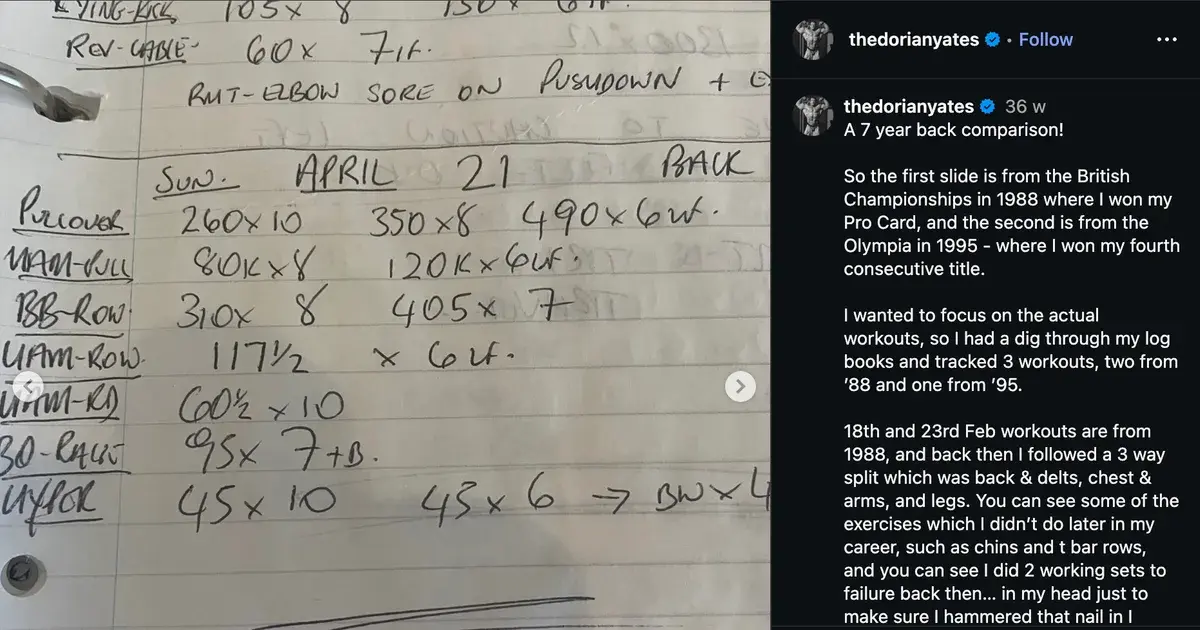
Dorian Yates took a similar low-volume path in the 1990s with his Blood and Guts approach. We cover how he tracked it in Dorian Yates's training log.
Who is Heavy Duty training good for?
Lifters short on time. Strength holds up well on low volume, so a short session every few days is a reasonable way to get stronger.
People who recover slowly. If you're older, sleep badly, or have a physical job, longer gaps between sessions may suit you better than a five-day split.
Lifters who like a clear test. Every session either beats the last one or it doesn't. Some people find that motivating.
It's a poor fit if maximum muscle is the goal, since more weekly sets grow more muscle. Beginners also struggle with it: true failure takes practice, and forced reps and negatives need a capable partner.
Why does Heavy Duty depend on a training log?
With one working set per exercise and up to a week between sessions, Heavy Duty has almost no margin for error. If that set doesn't beat the last one, you need to know.
Mentzer's standard was that you should be stronger every time you repeat a workout. Iron Man's introduction says that when training properly, "you'll be getting stronger on virtually every set of every workout." Mentzer's own closing words in that piece are shorter: "So keep a progress chart."
A week is a long time to remember a number. Was it 8 reps at 60 kg on incline presses last Thursday, or 7? Did your partner touch the bar on rep 8? Guess wrong on Heavy Duty and you pick the wrong weight for your only set.
Log what Mentzer would want to see. Write the weight, reps to failure, any forced reps or negatives on their own, and the date, so you know how long you rested. When a lift stalls, the same article says to train less often and add one or two extra rest days.
A simple starting plan
- Pick four to six compound lifts. Use one press, one pull, one squat or leg press, and one hinge. Add a pre-exhaust pair only if you want to test it.
- Warm up, then do one all-out set. Aim for 6 to 10 reps with good form, stopping at the rep you cannot complete on your own.
- Write it down straight away. Record weight, reps, and any assisted reps. Use the one rep max calculator if you want a single number to compare sessions.
- Rest four days, then repeat. Before each set, check last session's number and aim to beat it by one rep or a small jump in weight.
- When you stall, rest longer. If a lift stops moving, add a rest day or two between workouts instead of adding sets.
Tracking Heavy Duty with Gym Note Plus
If you already log in your phone's notes or a notebook, you have the right habit. The hard part is finding last Thursday's incline number while you're standing at the bench, warmed up and ready for your only set.
Gym Note Plus lets you keep typing the way you already do, like "incline 60kg 8 +2 forced," and sorts every set by exercise and date. Your strength trend becomes a chart, so you can see when a lift has stalled and you need more rest. Want to see what your current notes would look like? Paste a workout into our free notes to workout translator.
- Last session is one tap away. You don't scroll back through a week of notes.
- Each lift gets a chart. You'll see when progress stops, which is when Mentzer says to rest more.
One set leaves no room for guessing. Heavy Duty works only if you know exactly what you lifted last time and you beat it.
Frequently Asked Questions
How many sets does Mike Mentzer's Heavy Duty training use?
Mike Mentzer's Heavy Duty training uses one or two working sets per exercise after a warm-up, each taken to failure. His introductory routine has about one to three sets per bodypart per session. His own competition routine used four to five sets per bodypart, split across two workouts, with forced reps and negatives added.
How often should you train on Heavy Duty?
Mentzer's introductory Heavy Duty routine puts four days of rest between sessions, rotating chest and back, legs, shoulders and arms, then legs again. If strength stops increasing, Mentzer and John Little advised moving to one session every seven days rather than adding sets. His later consolidated routines rested even longer.
Is Mike Mentzer's one set to failure enough to build muscle?
One set to failure builds strength about as well as three or five sets, according to a 2019 trial in trained men. For muscle size, the research favours more sets: Krieger's meta-analysis found multiple sets produced about 40% larger hypertrophy effects than one set. Heavy Duty builds muscle, though probably less than higher volume.
What is pre-exhaust in Heavy Duty training?
Pre-exhaust in Heavy Duty means doing an isolation exercise, such as leg extensions, then going straight into a compound lift like the leg press with no rest. Mentzer used it to fatigue the target muscle first. A 2003 study found it lowered quadriceps activity and reps during the leg press instead.
Is Heavy Duty the same as HIT?
Heavy Duty is Mike Mentzer's branded version of high intensity training (HIT), which grew out of the ideas of Nautilus creator Arthur Jones. Both use brief workouts and sets taken to failure. Heavy Duty is known for very long rest periods, pre-exhaust supersets, and forced reps and negatives used beyond failure.
Final Takeaways
- Heavy Duty means low volume and maximum effort. One or two sets to failure, pre-exhaust pairs, and four to seven days of rest.
- The research is split. Low volume holds up well for strength, but more weekly sets build more muscle, and failure is not required.
- Pre-exhaust has weak support. The leg extension into leg press pairing reduced quad activity in a direct test.
- Progress decides your rest. If you stall, Mentzer's answer was more rest, never more sets.
- The log does the work. With one set per lift, you need last session's exact number in front of you every time.

Josh Ibbotson
Josh is the creator of Gym Note Plus, building tools that make workout tracking as simple as taking notes.
Ready to try it out?
Download Gym Note Plus and start tracking your workouts the way you want.
Download on App Store