
Dorian Yates Training Log: How He Took Workout Notes
Quick answer: Dorian Yates logged every workout from 1984 until he retired after the 1997 Mr. Olympia. He wrote down each exercise, weight and rep count, plus forced reps, meals, energy and mood. Before each session he reread his last workout for that body part, then wrote out the numbers he had to beat.
Dorian Yates won six Mr. Olympia titles in a row, from 1992 to 1997, and he wrote down every session along the way in ring-bound log books.
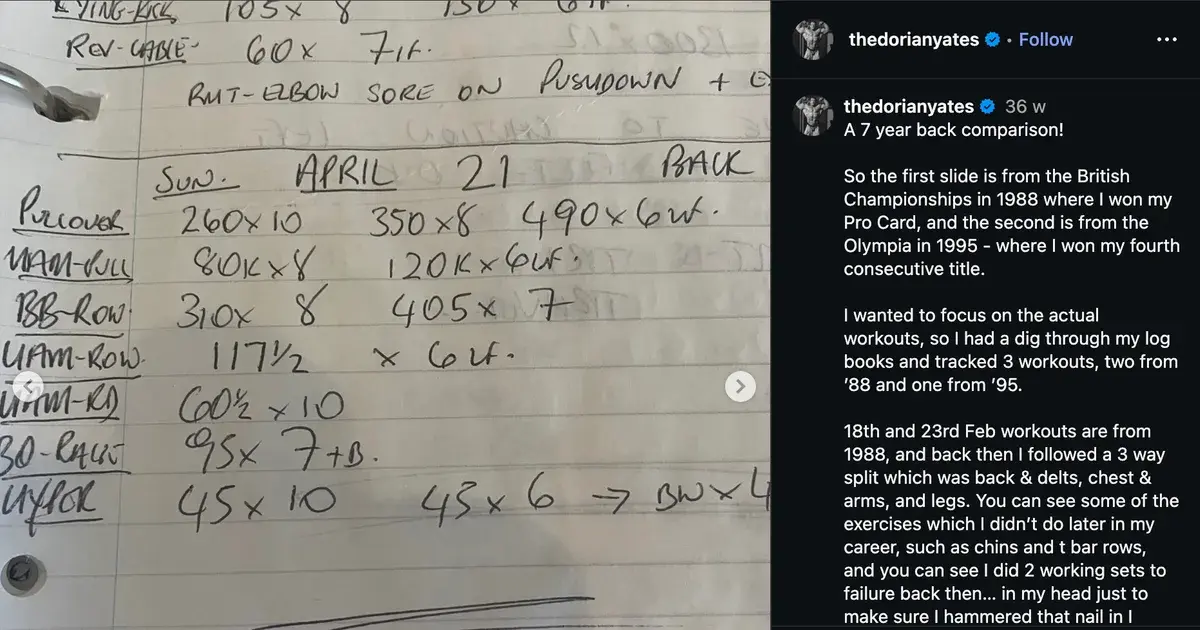
In February 2026, Yates posted pages from his old log books on his Instagram. They show a back day in his handwriting, with weights, reps and a side note about a sore elbow. If you log your training in a notebook or your phone's notes app, you already do what he did. The question is what you do with the notes afterwards.
How did Dorian Yates keep his training log?
He wrote in it every day. In a piece for Muscular Development, republished by EliteFTS, Yates described the habit in his own words:
"I used my journal to write down goals and workouts every day from when I began bodybuilding in 1984 to the day I retired after the 1997 Mr. Olympia."
He logged more than lifting. "In addition to writing down all my workouts, I entered my meals and even my energy levels and moods," he wrote in the same piece. The journal was a record of everything that might explain a good or bad session.
The pages have survived, too. The Barbell's write-up on how strong Dorian Yates was cites a journal entry from March 1, 1985, where he squatted 405 pounds for seven reps and then 425 for four.
What did Dorian Yates actually write down?
The Instagram page in the image above is a good sample. Under the heading "Sun. April 21, Back", each line has an abbreviated exercise name followed by weight x reps for every set, left to right:
- Pullover: 260x10, 350x8, then 490x6 with what looks like "1F", one forced rep
- BB Row: 310x8, then 405x7
- Hyper: 45x10, then 45x6 followed by bodyweight for 4 more reps
- A note above the session: "Rt elbow sore on pushdown"
That is the whole system: short exercise names, weight x reps, a marker for anything unusual, and a plain-English note when something felt wrong. If those abbreviations look familiar, our guide to workout shorthand covers the common ones.
Why did he mark forced reps?
Because a forced rep is not a clean rep. When Yates shared a 1993 biceps workout from his journal, Generation Iron reported a working set of incline dumbbell curls written as 70 pounds for 6 reps plus 1 forced rep. Writing "6 + 1F" instead of "7" kept next week's target honest. Our article on forced reps goes into when they are worth using.
Why do the sets climb to one heavy set?
Most lines show lighter sets building to one heavy set at the end. In a January 2025 post covering his 1990 back workout, Yates said he used two working sets to failure back then and later cut to one on Mike Mentzer's advice. Either way, the heavy set at the end of each line was the number he was trying to beat. Mentzer's own approach is in our piece on Heavy Duty training.
How did Dorian Yates use his notes before every workout?
Most people stop at recording. Yates also reread his workouts before every session. From the same Muscular Development piece:
"I would always consult my training journal immediately before leaving my home to go train."
He reviewed his last few sessions and his goals, noted what he had lifted last time for the body part he was about to train, and wrote out the workout he was about to do "with all the same details."
So he walked into the gym knowing the exact number to beat. Every set had a target, and the target came from his own history rather than a program someone else wrote.
Monthly goals on ten lifts
He also set bigger targets. "Every month in the off-season, I would choose about 10 key exercises like the incline barbell press, barbell row, leg press and so on and set a goal for how much stronger I wanted to be in a month's time," he wrote. Those ten lifts were his progress report.
Looking for trends
"Every so often I would go back and study these pages, looking for trends," Yates wrote. "If I noticed that something was producing results, I kept it." Years of entries told him what his own body responded to, which no general program could.
What are the limits of a paper training log?
Yates made paper work through sheer discipline. For most lifters, three problems show up.
Finding last week is slow. Flipping back to the last back day takes a minute. Finding the last time you did pullovers three months ago takes much longer.
Trends are hard to see. Reading a trend from handwritten numbers means doing the maths yourself. Yates sat down and studied his pages, which most people never get round to.
Notes get lost in the pile. "Rt elbow sore on pushdown" only helps if you see it again the next time you do pushdowns.
| Feature | Dorian's Notebook | Notes App | Traditional Gym App | Gym Note Plus |
|---|---|---|---|---|
| Logging speed | Fast, once the pen is out | Fast, free typing | Slow, tap per set | Fast, free typing |
| Last session's numbers | Flip back and find it | Scroll and search | Shown per exercise | Autofilled as you type |
| Progress charts | Do the maths by hand | None | Yes | Yes, per exercise |
| Side notes like "elbow sore" | Anywhere on the page | Anywhere in the note | Often a separate field | Kept under that exercise |
| Forced reps and failure | Your own marks | Your own marks | Fixed set types | Your own words, failure sets flagged |
| Paper backups | It is the backup | No | No | Photograph a page to import it |
How can you take notes like Dorian Yates in a notes app?
You do not need a new system. Keep the format Yates used and just type it:
Back
Pullover 260x10, 350x8, 490x6 +1 forced
BB Row 310x8, 405x7
Hyper 45x10, 45x6, BW x4
Right elbow sore on pushdowns
That note has everything a coach would ask for. The hard part comes later, when you need to find it again, compare it to last time and spot a trend. If you want to see how a note like this turns into structured data, paste it into our free notes to workout translator.
Our guide to what to put in your workout notes covers the rest of the format.
How does Gym Note Plus take Dorian's method further?
Writing your workouts as notes works, and Yates is the proof. Gym Note Plus keeps that habit exactly as it is and handles the parts he did by hand.
You type the way Yates wrote. One free-text box. Write "490x6 +1 forced" or "45x6, BW x4" and the app reads the weights, reps and units, and flags sets you mark as failure or drop sets.
Last session fills itself in. Start typing an exercise you have logged before and a suggestion appears with your most recent sets for it, in your own format. That is Yates's pre-workout review, done for you as you type.
The workout to beat is on your dashboard. The Workout to Beat widget follows your split order and shows the last session of the day you are about to train, so you know the target before you leave home.
Every exercise compares itself to last time. After you finish, each exercise shows what you did before ("was 80 kg x 5") and a chip like "+2.5 kg" or "+3 reps" when you beat it.
Your side notes stay with the lift. A line like "right elbow sore on pushdowns" is kept as a note under that exercise, so it shows up again when you look back at pushdowns.
The trends are charted for you. Each exercise gets charts for estimated 1RM, volume and its heaviest set, over one month up to all time. Yates's ten key lifts become ten charts you can check in seconds.
Records are spotted automatically. Personal records for heaviest weight, best set and estimated 1RM are detected and marked on the set where they happened.
Your paper log can come with you. Take a photo of a notebook page and the app turns it into a workout, so years of handwritten training do not have to be retyped.
The original note is never thrown away. Translation History keeps the exact text you wrote next to the workout it became.
Dorian Yates logged six Olympia runs with a pen and a notebook. What made his log work was reading last week's numbers before he tried to beat them.
A simple starting plan
- Write every set as weight x reps. Use the same exercise names each time, and mark anything unusual, such as forced reps or a set to failure.
- Add one line about how it felt. Sleep, energy, a sore joint. Yates logged mood and energy for a reason.
- Read your last session before you train. Know the number you are trying to beat before you walk in.
- Pick ten key lifts. Set a monthly target for each, the way Yates did in the off-season.
- Review once a month. Look for what moved and what stalled, keep what works and drop what does not.
Frequently Asked Questions
Did Dorian Yates keep a training log?
Yes. Dorian Yates kept a training journal every day from 1984 until he retired after the 1997 Mr. Olympia. He recorded each workout's exercises, weights and reps, plus monthly goals, meals, energy levels and moods. He has since shared pages from those log books on Instagram, and a selection of entries was published as an ebook.
What did Dorian Yates write in his training journal?
Dorian Yates wrote each exercise with weight x reps for every set, marked forced reps, and added short notes such as a sore elbow on pushdowns. He also wrote down goals for about ten key lifts each month in the off-season, along with his meals, energy levels and moods, so he could find trends later.
How did Dorian Yates use his log before training?
Before leaving home, Dorian Yates read his last few workouts and his goals in a quiet room. He noted what he had lifted last time for the body part he was training, then wrote out the workout he was about to do with the same details, so every set had a clear number to beat.
How many working sets did Dorian Yates do?
In 1990, Dorian Yates did two working sets to failure per exercise after his warm-up sets. He later cut this to a single working set on the advice of Mike Mentzer. His log books show this pattern: lighter sets building up to one or two heavy sets taken to failure, sometimes with a forced rep.
Can I keep a Dorian Yates style log on my phone?
Yes. A phone notes app works for the same format Dorian Yates used: exercise, weight x reps and a short note. Gym Note Plus reads that kind of note, fills in your last session as you type, compares each exercise to last time and charts your key lifts, which replaces the manual review Yates did on paper.
Final Takeaways
- The log was the method. Yates logged every workout for over a decade, and the habit mattered more than the notebook.
- Read before you train. His biggest edge was knowing last session's numbers before each set.
- Mark the extras. Forced reps, failure sets and sore joints belong in the log, written so you can read them back.
- Look for trends. A log you never review is just a diary. Check your key lifts every month.
- Keep writing, let the tool do the maths. Type your workouts the way Yates wrote them and let Gym Note Plus handle the lookups and charts.

Josh Ibbotson
Josh is the creator of Gym Note Plus, building tools that make workout tracking as simple as taking notes.
Ready to try it out?
Download Gym Note Plus and start tracking your workouts the way you want.
Download on App Store