

Volume vs Intensity: Which Builds More Muscle and Strength?
Quick answer: In the volume vs intensity debate, volume (hard sets per week) is the bigger lever for muscle growth, while intensity as load (%1RM) matters most for maximal strength. Intensity of effort, meaning how close you train to failure, matters for both. Most lifters progress best with moderate volume, heavy-enough loads, and sets taken close to failure.
Gym arguments about volume vs intensity rarely end, partly because the two sides use the same word for different things.
One lifter says "intensity" and means a heavy barbell. Another means a set so hard their vision goes grey. Both are right, and they are talking past each other.
What do volume and intensity actually mean?
Volume is how much work you do. The classic formula is sets x reps x load, often called volume load or tonnage. Most researchers now count hard sets per muscle per week instead, because it predicts growth better and is easier to track. Our guide on how to calculate training volume covers both methods.
Intensity has two meanings, and that is the whole problem.
- Intensity of load is how heavy the weight is relative to your max, written as a percentage of your one-rep max (%1RM). A set at 85% of 1RM is high intensity in this sense, even if you stop with four reps left.
- Intensity of effort is how close a set gets to failure. A set of 20 at 50% of 1RM taken to failure is high intensity in this sense, even though the weight is light.
Coaches and textbooks usually mean load. Bodybuilders, especially the high-intensity training crowd, usually mean effort. Check which one a writer means before you accept their conclusion.
What does the research say about volume?
More volume generally means more growth, with diminishing returns. A 2017 meta-analysis by Schoenfeld, Ogborn and Krieger pooled 15 studies and found that each additional weekly set was associated with a 0.37% increase in muscle growth, a graded dose-response relationship (Journal of Sports Sciences).
A much larger meta-regression by Pelland and colleagues covered 67 studies and 2,058 participants. It found that both muscle size and strength increase as weekly volume rises, but both curves flatten, and the flattening is far more pronounced for strength (Sports Medicine).
So extra sets keep paying off for size longer than they do for your one-rep max. For practical set ranges by goal, see how many sets per week to build muscle.
What does the research say about intensity?
Load matters more for strength than for size. A 2017 meta-analysis of 21 studies compared low loads (60% of 1RM or less) with high loads (above 60%), with every set taken to failure. Gains in 1RM strength were significantly greater with heavy loads, while muscle growth was similar between the two (Journal of Strength and Conditioning Research).
For hypertrophy, light and heavy weights both work if the sets are hard. For a bigger squat or bench, you need to practise heavy.
Effort matters more for size than for strength. Refalo and colleagues reviewed 15 studies and found only a trivial hypertrophy advantage for sets taken to failure versus stopping short, and no advantage when failure was strictly defined as momentary muscular failure (Sports Medicine).
A follow-up series of meta-regressions estimated reps in reserve (RIR) across studies. Muscle growth improved as sets ended closer to failure, but strength gains were similar across a wide range of RIR (Sports Medicine). The authors call the analysis exploratory, so treat it as a strong hint rather than a settled rule.
Sets need to be hard to drive growth, but they do not all need to hit failure. Our guide to training to failure goes deeper on where to draw that line.
Where did the high volume vs high intensity debate come from?
The split goes back to the golden era of bodybuilding. Arnold Schwarzenegger and many of his peers trained with lots of sets, often twice a day, and that style became the gym default for decades.
The counter-movement came from Arthur Jones and his high-intensity training ideas. Mike Mentzer took them further with Heavy Duty, built around very few sets pushed to absolute failure and beyond. You can read how that worked set by set in our breakdown of Mike Mentzer's Heavy Duty training.
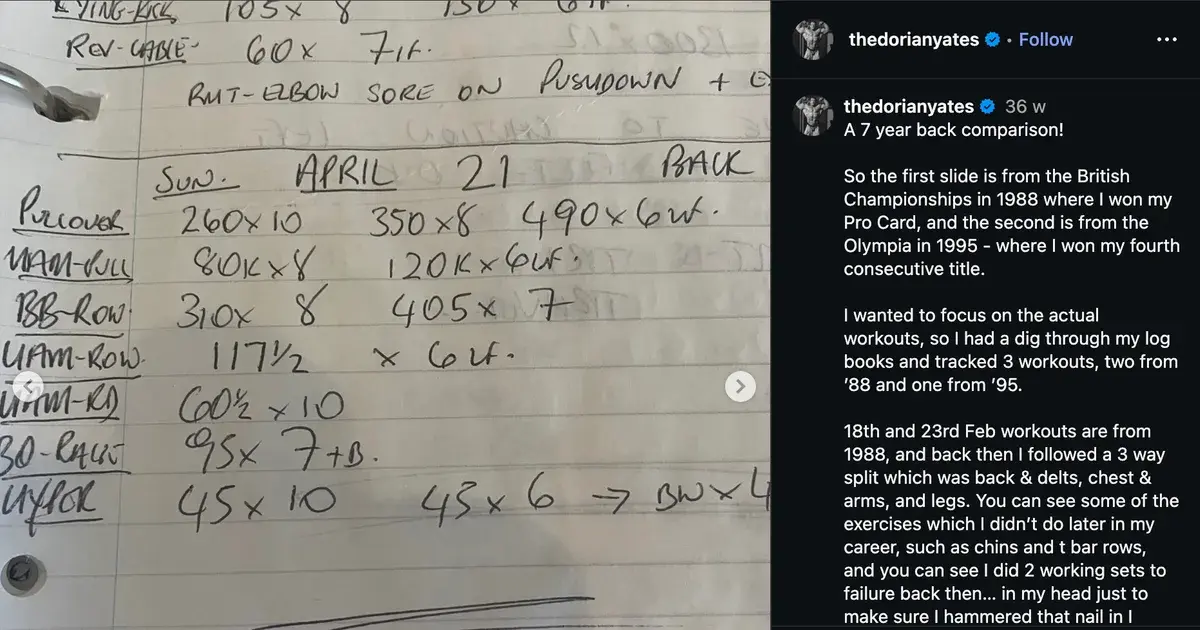
Dorian Yates later won six Mr. Olympia titles with his own low-volume, high-effort approach, usually one all-out working set per exercise after warm-ups. Our look at the Dorian Yates training log shows what that looked like on paper.
Both camps produced champions, which fits the research: hard sets build muscle across a fairly wide range of set counts.
How do volume-focused and intensity-focused training compare?
| Factor | Volume-focused training | Intensity-focused training |
|---|---|---|
| Main lever | More hard sets per muscle per week | Heavier loads or sets pushed to failure |
| Typical set count | Many working sets per muscle each week | One to a few working sets per exercise |
| Best evidence for | Muscle growth | Maximal strength (heavy load) |
| Fatigue cost | Spread across many sets, high time cost | Concentrated in each set, high joint and nervous system cost |
| Session length | Longer | Shorter |
| Main risk | Junk volume that adds fatigue but not growth | Too little total work to keep growing |
| What to log | Hard sets per muscle per week | Load, reps, and RIR or RPE per set |
How should you mix volume and intensity for your goal?
For muscle growth, lead with volume and keep effort high. Build up hard sets per muscle per week, use a wide rep range, and finish most sets within a few reps of failure.
For strength, lead with load. Spend a good share of your work above roughly 80% of 1RM on the lifts you want to improve. Volume still helps, but the Pelland data suggests the returns flatten sooner, so piling on sets is less useful than practising heavy. Our one rep max calculator turns a recent top set into an estimated 1RM, which makes percentage targets easy to set.
For both, run them side by side. A common structure is a heavy top set or two on the main lift, then lighter back-off sets and accessories for volume.
If you are short on time, raise effort before you add sets. A few hard sets beat many easy ones. When progress stalls, add a set per muscle per week before you change anything else.
How do you track both in a workout log?
Write the weight, the reps, and how hard it felt. Weight and reps cover load and volume. A quick RIR or RPE note covers effort. If you are unsure which scale to use, our comparison of RPE vs RIR explains both.
A line in your notes could look like this:
Bench 100kg 5,5,4 @1 RIR
Incline DB 30kg 10,9,8 @2 RIR
Then check two numbers every few weeks:
- Weekly hard sets per muscle. This tells you your volume.
- Your best estimated 1RM on key lifts. This tells you whether heavy work is paying off.
If sets went up and your size or reps improved, volume is probably driving progress. If your top sets got heavier while sets stayed flat, intensity is doing the work.
A simple starting plan
- Pick your main goal. Size or strength. This decides which lever you push first.
- Count your current hard sets. Tally sets within about three reps of failure for each muscle over one normal week.
- Estimate your 1RM on two or three key lifts. Use a recent top set so you can see heavy-load progress over time.
- Change one variable for four to six weeks. Add two hard sets per muscle per week, or add a heavy top set to a main lift. Not both at once.
- Review your log and decide. Keep what moved the numbers. Drop or reduce what only added fatigue.
Logging that keeps up with both
The theory is the easy part. Seeing what your own training does week to week is harder when your sets live in a long scroll of notes or notebook pages.
Gym Note Plus lets you keep logging in plain text, the way you already write in Notes. It reads those lines and turns them into per-exercise history and progress charts, so weekly volume and heavy top sets are visible without any spreadsheet work.
Research tells you what works on average. Your log tells you which lever worked for you.
Frequently Asked Questions
Is volume or intensity more important for muscle growth?
For muscle growth, volume is the bigger lever. A 2017 meta-analysis found each extra weekly set linked to more growth, and a 67-study meta-regression confirmed volume raises muscle size with diminishing returns. Intensity of effort still matters, because sets need to be close to failure to count as hard sets.
Is volume or intensity better for strength?
For maximal strength, intensity as load matters most. Heavy loads above 60% of 1RM produced greater 1RM gains than light loads in a 2017 meta-analysis of 21 studies. Volume still helps strength, but research shows its returns flatten sooner than they do for muscle size, so heavy practice is the priority.
What does intensity mean in weight training?
Intensity in weight training has two meanings. Intensity of load is the weight as a percentage of your one-rep max. Intensity of effort is how close a set gets to failure, usually tracked with RPE or RIR. Most disagreements about volume vs intensity come from mixing up these two definitions.
Can you train with high volume and high intensity at the same time?
You can combine high volume and high intensity, but not at the maximum for both. Pushing every set to failure across many sets builds fatigue fast. Most programs pair a few heavy or very hard sets with more moderate back-off work, which gets the benefit of each without wrecking recovery.
Did Mike Mentzer and Dorian Yates prove low volume works?
Mike Mentzer and Dorian Yates showed that low-volume, high-effort training can build an elite physique. Their success does not prove it is best for everyone, since they were exceptional athletes. Research today supports a middle ground: enough hard sets per week, with most taken close to failure.
Final Takeaways
- Define your terms first. Volume is hard sets or sets x reps x load. Intensity is either load (%1RM) or effort (closeness to failure).
- Volume is the main lever for size. More hard sets per week build more muscle, with diminishing returns.
- Load is the main lever for strength. Heavy sets produce larger 1RM gains than light sets.
- Effort makes sets count. Train close to failure for growth, but you do not need to hit failure on every set.
- Log weight, reps and effort. That is the only way to see which lever is actually driving your progress.

Josh Ibbotson
Josh is the creator of Gym Note Plus, building tools that make workout tracking as simple as taking notes.
Ready to try it out?
Download Gym Note Plus and start tracking your workouts the way you want.
Download on App Store