
Forced Reps: What They Are, Do They Work, and How to Log Them
Quick answer: Forced reps are extra reps a spotter helps you finish after you hit failure on your own. They make a set harder and more fatiguing, but the one training study that tested them found no extra strength gain once sets already reached failure. Use them sparingly, on the last set, and log them separately.
You grind out the eighth rep on the bench. The ninth stalls halfway. Your training partner puts two fingers under the bar and says "all you", and somehow you finish two more.
Those two are forced reps. What's less obvious is whether they build anything a hard set to failure doesn't, and how to write them down so next week's numbers still mean something.
What are forced reps?
A forced rep is a rep you couldn't finish alone. You take a set to the point where the next rep fails, then a partner gives just enough help for you to complete one, two, or three more.
The weight on the bar stays the same and you still push as hard as you can. The partner covers the gap between what you can lift and what's on the bar.
So forced reps are a way of going past failure, alongside drop sets, rest-pause, and slow negatives. Our guide to training to failure covers failure itself.
How does a spotter do forced reps properly?
The spotter should help as little as possible. Too much help turns it into the spotter's rep, and your log records strength you don't have.
On a bench press, a good spot for forced reps looks like this:
- Agree on the plan first. "Eight on my own, then help me get two" is clear. "Help if I need it" is not.
- Hands close, not on. The spotter keeps their hands under the bar without touching it until the bar stops moving.
- Light and even. Once the bar stalls, they lift only enough to get it moving again, with both hands so the bar stays level.
- Stop at the agreed number. Two forced reps means two. Then rack it together.
For the full setup, see how to spot a bench press. Forced reps also suit machines, cables, and curls, where a partner can help without much risk. Squats and deadlifts are a poor fit, because a stalled rep there is hard to rescue cleanly.
Do forced reps actually work?
They make the set harder, but there's little evidence they build more.
The best-known study is from Ahtiainen and colleagues at the University of Jyväskylä. Sixteen male athletes did leg presses, squats, and knee extensions either to plain failure or with forced reps after each failed set. The forced-rep session produced bigger rises in cortisol and growth hormone, and maximal isometric force dropped by 56.5% versus 38.3% for the failure-only session, staying lower during recovery (Ahtiainen et al., 2003).
So forced reps cost more and take longer to recover from. Whether the bigger hormone spikes help is a separate question. A 15-week McMaster University trial raised hormone levels after arm training in one arm and not the other. Both arms grew about the same: 12% in the low-hormone arm and 10% in the high-hormone arm, with no difference in strength gains either (West et al., 2010).
The most direct training study is Drinkwater and colleagues. Twenty-two basketball and volleyball players trained the bench press three times a week for six weeks, in protocols built to produce different numbers of forced reps per session (from 1.2 to 4.1 on average). Everyone got stronger, and there were no significant differences between groups (Drinkwater et al., 2007). The authors concluded that once failure was reached, extra forced reps didn't add to strength gains.
These are small studies, and none measured muscle growth from forced reps over months. They support a modest conclusion: forced reps add a lot of fatigue, and nobody has shown a payoff on top of a hard set to failure.
How do forced reps compare with drop sets and rest-pause?
All three push a set past failure. What changes after you fail is the help, the weight, or the rest.
| Method | What happens after failure | Needs a partner? | Load stays the same? | Simple way to log it |
|---|---|---|---|---|
| Straight sets | Set ends | No | Yes | 100 x 8 |
| Forced reps | Spotter helps you finish more reps | Yes | Yes | 100 x 8 + 2F |
| Drop sets | You strip weight and keep going | No | No | 100 x 8 / 80 x 6 |
| Rest-pause | You rest briefly, then continue | No | Yes | 100 x 8 + 3 + 2 |
Drop sets are the easiest to run alone, because the plates do the work a spotter would. Our full guide to drop sets covers how much to strip and when.
Rest-pause keeps the weight and gives you a short breather instead of a helping hand. A 2026 trial comparing rest-pause with drop sets for progression found the two worked about the same, which is covered in rest-pause vs drop sets.
Forced reps are the only one that needs another person, and the only one where some reps in your log weren't yours.
When should you use forced reps, and when should you skip them?
Use them rarely, on the last set, and on safe exercises. Given the extra fatigue Ahtiainen's group measured, forced reps on every set will eat into the sessions that follow.
They make the most sense with a partner who helps only as much as needed, on an exercise that's easy to assist (machine presses, cable rows, curls, a spotted bench), and on the final set so the fatigue doesn't wreck your other sets.
Skip them if you train alone, if you're new and still adding weight most weeks, or on lifts where failing is dangerous. Without a partner, a drop set or rest-pause set gives a similar push.
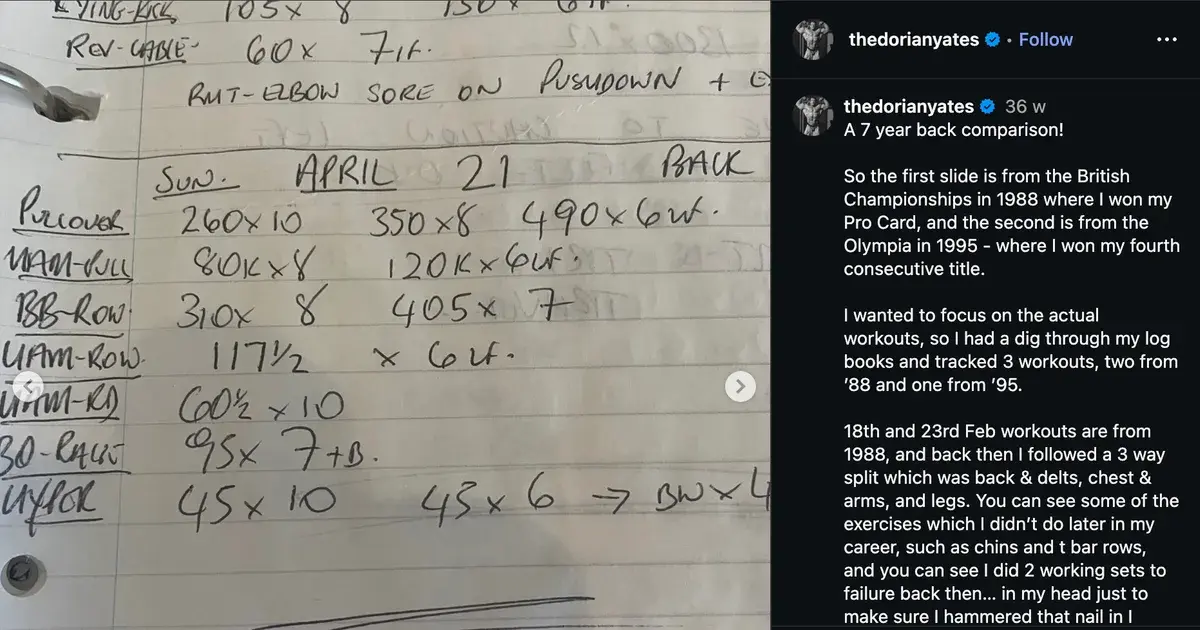
Dorian Yates shared an old biceps session from his 1993 Mr. Olympia prep that included "155 lbs for 5 reps and 1 forced rep" on standing barbell curls (FitnessVolt). The forced rep sits apart from the five he did himself. More on how he recorded sessions is in our piece on the Dorian Yates training log.
How should you log forced reps?
Write your own reps and the assisted reps as two separate numbers. The simplest shorthand is:
Bench press 100 x 8 + 2F
Eight reps were yours and two were forced, so next week the number to beat is 8, not 10.
Say you log it as 100 x 10 instead. Next week you get 9 on your own with no spotter, and your log says you went backwards when you actually got stronger.
A few rules keep the log honest:
- Only unassisted reps count toward progress. Compare 8 with 8, never 10 with 8.
- Use the same letter every time. "F" for forced is clear. Don't switch to "assisted" or "w/ help" next month.
- Track your one-rep max from unassisted sets only. If you plug
100 x 8into a one rep max calculator, you get an honest estimate. Plug in100 x 10and it flatters you.
A simple starting plan
- Pick one exercise. Choose a spot-friendly lift like a machine chest press or a spotted bench, not squats.
- Add forced reps to the last set only. Take that set to failure, then do one or two forced reps with a partner.
- Run it for three to four weeks. Keep everything else the same so you can see whether it helps.
- Log it as
weight x reps + nF. Keep progress tied to the unassisted number. - Check your unassisted reps. If they're climbing, keep going. If they stall or your next sessions feel flat, drop the forced reps.
Where does Gym Note Plus fit in?
Plain text is the fastest way to log a set like this. Typing 100 x 8 + 2F in Apple Notes takes seconds. The trouble comes months later, scrolling through hundreds of lines to see whether your bench has moved.
Gym Note Plus keeps the typing and handles the reading. You write sets the way you already do, and it turns those lines into history, charts, and personal records for each lift. Your shorthand stays in the note, so the forced reps you wrote down are still there when you look back.
If you have old sessions sitting in a notes app, paste one into the free notes to workout translator and see how your own text turns into a structured workout.
Write down what you lifted on your own, and write the help next to it. The forced rep goes in the log, but it doesn't count toward beating last week.
Frequently Asked Questions
What are forced reps in the gym?
Forced reps are extra repetitions completed with a spotter's help after you reach failure on your own. The weight stays the same, and the spotter lifts only enough to keep the bar moving. Most lifters do one to three forced reps at the end of a final set, usually on a bench press, machine, or curl.
Are forced reps better than drop sets?
There is no head-to-head study showing forced reps beat drop sets. Both push a set past failure. Drop sets need no partner because you strip the weight, while forced reps need a spotter and keep the load the same. For people who train alone, drop sets are the more practical choice for extending a set.
Do forced reps build more muscle?
Forced reps haven't been shown to build more muscle than sets taken to failure. Ahtiainen et al. found they raised fatigue and acute hormone levels, but a later McMaster trial found those hormone spikes didn't increase growth. Drinkwater et al. found extra forced reps didn't add strength over sets taken to failure alone.
How many forced reps should you do?
One or two forced reps on the last set of an exercise is enough for most lifters. In the Drinkwater bench press study, groups averaged between about one and four forced reps per session without any difference in strength gains. More forced reps add fatigue, so keeping the number low protects your next sessions.
How do you write forced reps in a workout log?
Write the reps you did alone, then the assisted reps marked with a letter, for example 100 x 8 + 2F. Compare only the unassisted number from week to week. That way a session without a spotter doesn't look like a step backwards, and your estimated one-rep max stays honest.
Final Takeaways
- Forced reps are partner-assisted reps after failure. The load stays the same, and the spotter helps only enough to finish the rep.
- They raise fatigue more than plain failure. Ahtiainen's study measured a bigger force drop and slower recovery.
- The evidence for extra gains is weak. Drinkwater's bench press study found no added strength from more forced reps.
- Use them sparingly. Last set, spot-friendly exercises, and only with a partner you trust.
- Log them apart from your own reps.
100 x 8 + 2Fkeeps next session's comparison honest.

Josh Ibbotson
Josh is the creator of Gym Note Plus, building tools that make workout tracking as simple as taking notes.
Ready to try it out?
Download Gym Note Plus and start tracking your workouts the way you want.
Download on App Store