
How to Spot Bench Press: Hand Position, Signals, and When to Help
Quick answer: To spot the bench press, agree on the rep count and liftoff before the set, stand at the head of the bench, and hold your hands in a mixed grip just inside the lifter's hands, close to the bar without touching it. Only take weight when the bar stops or starts sinking.
Someone at the gym asks, "Can you give me a spot?" and you say yes before you've thought about it.
Then you're standing behind the bench with no idea where your hands go or when you're supposed to help.
What should you agree on before the set starts?
Most bad spots happen because nobody talked first. The lifter knows what they want, and the spotter has to guess unless they ask.
Settle these before the lifter lies down:
- The rep target. "How many are you going for?" If they say eight, rep seven is where you start paying close attention.
- The liftoff. Ask if they want a hand getting the bar out of the rack, and on what count. "On three" is common.
- The help rule. Some lifters want to grind out a slow rep alone. Others want help as soon as the bar slows.
- The signal. Agree on a word like "take it" so neither of you is guessing mid-rep.
Spotting guides from Bodybuilding.com and The Art of Manliness both start with this conversation, because a spotter who doesn't know the plan helps too early or too late.
Where do you stand and where do your hands go?
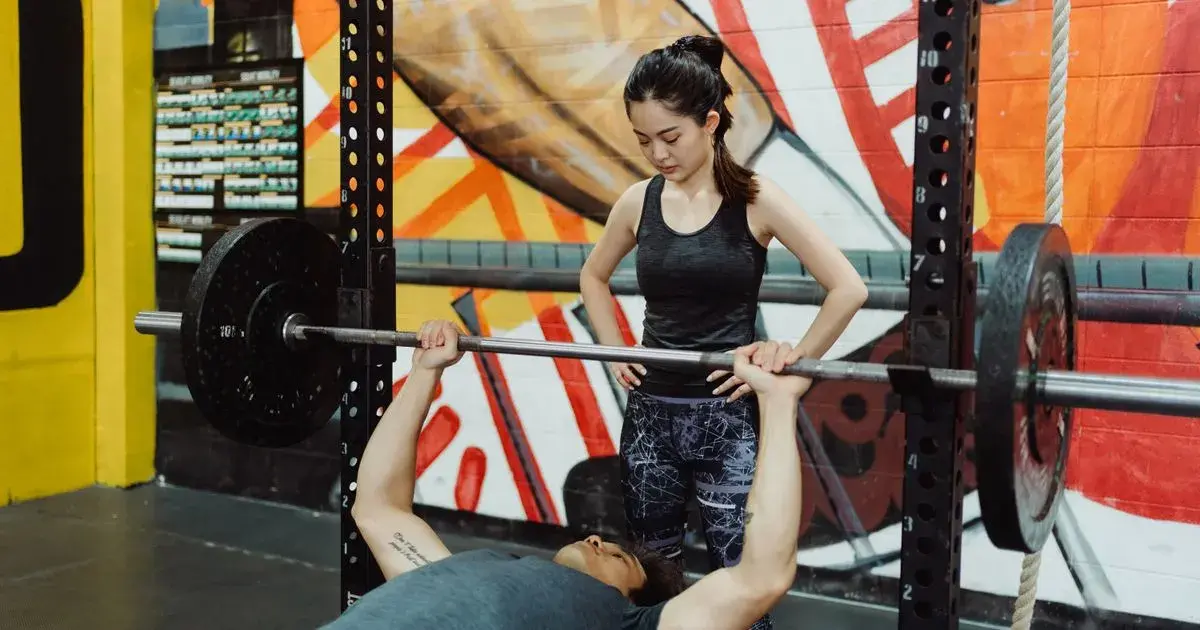
Stand at the head of the bench, close to the bar, with your feet staggered. If you have to take the weight, a staggered stance lets you lift with your legs instead of your lower back.
Use a mixed grip just inside the lifter's hands. Trainer exam material based on NSCA guidance describes the spotter using an alternated grip (one palm down, one palm up) inside the lifter's grip. That grip stops the bar rolling out of your hands if you end up holding all of it.
Hover, don't hold. Keep your hands a couple of inches under the bar and follow it down and up. If your fingers rest on it, you're lifting some of the weight, and the lifter never finds out how many reps were really theirs.
Don't lean so far over that your face is in theirs, and leave the collars off. Barbell Logic says never to collar the bench press, so the plates can slide off one end if the bar gets stuck.
When should a spotter take the bar?
Take the bar when it stops moving up, starts sinking, or the lifter gives the signal. Until then, hands off. A slow rep is still the lifter's rep.
When it does stall, give the smallest amount of help that gets the bar moving again, usually a light, steady pull. If it keeps sinking, grab it with both hands and guide it back to the hooks.
Help them rack it even after a clean last rep, since tired arms miss the hooks. Our guide on how to bench press covers the setup and bar path the lifter should be using, which makes it easier to see a rep going wrong.
How do you spot a dumbbell bench press?
Spot at the wrists, not the elbows or the dumbbells. ACE's chest press guide tells the spotter to use a split stance or half kneel with hands "as close to the most distal (wrist) joint" as possible, near the wrists but not touching unless needed.
A Fox News piece quoting an NCSF board member says dumbbell presses "should be spotted from the wrists (not at the elbows, which increases the risk of injury for both people)." Push at the elbows and the forearm can tip, bringing the dumbbell toward the lifter's face.
You'll still see advice to spot elbows on very heavy sets. The guidance above doesn't back it, so stay at the wrists.
Help with the kick-up only if asked, and stay close at the end so the lifter can lower the dumbbells under control. Our dumbbell vs barbell bench press comparison covers why dumbbells need a spotter less often than the barbell.
| Factor | Barbell spot | Dumbbell spot | Safety arms or pins |
|---|---|---|---|
| Where the help goes | Hands on the bar, mixed grip | At the lifter's wrists | Bar rests on the pins |
| Needs another person | Yes | Yes | No |
| Can save a stuck rep | Yes, with a light pull | Partly, by guiding the wrists | No, the set ends |
| Best for | Heavy sets near failure | Heavy dumbbell presses | Training alone |
| Main mistake | Riding the bar | Grabbing the elbows | Pins at the wrong height |
How do you ask a stranger for a spot?
Ask between their sets, and keep it short. "Could you give me a quick spot on bench?" is enough. Then give the same briefing as above, because a stranger can't read your mind:
- "Going for eight reps."
- "Help me lift off on three."
- "Only touch it if it stops."
That last line matters most. A spotter who doesn't know your preference usually helps early, and you finish the set with no idea what you could have done alone.
What if you train alone?
Bench inside a power rack with the safety arms set just below your chest. Barbell Logic puts them "slightly lower than where the barbell would be when touching the chest," and doesn't recommend benching alone without a power rack at all.
A national study of U.S. emergency departments estimated more than 970,000 weight training injuries from 1990 to 2007. Free weights were involved in 90 percent, and the most common cause, at 65 percent, was weights dropping on the person.
The worst outcomes are rare. A 2007 Journal of Forensic Sciences paper described two deaths from a barbell compressing the neck during the bench press, and neither lifter had safety guards or a spotter.
With the pins set right, a missed rep is simple: lower the bar onto them and slide out. Test the height with an empty bar first.
How do you log a rep the spotter helped with?
A rep the spotter touched isn't a clean rep, so log it separately. If you did seven alone and the spotter helped with the eighth, write:
Bench 80kg 7 +1 assisted
Write "8" instead and next week's solo 8 looks like no progress when it was a real gain. It cuts the other way too: you think you own 8, add weight, and stall.
Assisted reps are close cousins of forced reps, where the spotter helps on purpose to take you past failure. Either way, the clean number is the one to beat. If you run a set through the one rep max calculator, enter only the clean reps or the estimate will come out high.
A simple starting plan
- Brief before every spotted set. Rep target, liftoff count, and when to help.
- Get the spotter in position early. Head of the bench, staggered feet, mixed grip hovering just inside the lifter's hands.
- Help only when the bar stalls. Use the lightest pull that gets it moving, then guide it into the hooks.
- Use safety pins whenever you're alone. Set them just below chest height and test with an empty bar.
- Log assisted reps separately. Write "+1 assisted" after the clean reps.
Keep the clean reps and the assisted reps apart
If you already log in your phone's notes or a notebook, you're doing the hard part. Reading it back is where it falls apart: a month later, "7 +1 assisted" is buried in a wall of text, and you won't scroll through four weeks of notes before your next bench session.
Gym Note Plus lets you keep typing the way you already do, like "bench 80kg 7 +1 assisted," and sorts every set by exercise and date. Your bench history becomes a chart, and last week's clean number is one tap away.
- Type it the way you'd write it. You don't fill in a form for every set.
- See whether your solo reps are climbing on the chart for each lift.
- Find last week's set fast, because every lift is grouped by exercise.
The spotter only saves the set. Writing down which reps were yours is what tells you next week whether you got stronger.
Frequently Asked Questions
Where should a spotter put their hands on the bench press?
A bench press spotter should hold a mixed grip, one palm up and one palm down, just inside the lifter's hands. Keep your hands a couple of inches under the bar and follow it through each rep without touching it. Only grip the bar when it stops rising or the lifter asks for help.
How do you spot a dumbbell bench press safely?
Spot a dumbbell bench press at the lifter's wrists, not the elbows or the dumbbells. ACE recommends a split stance or half kneel with your hands near the wrists, touching only if needed. Pushing at the elbows can let the forearm tip and bring the dumbbell down toward the lifter's face.
Should a spotter help with the bench press liftoff?
A spotter should help with the bench press liftoff only if the lifter asks. Agree on a count, such as "on three," then lift the bar out with a mixed grip and move it over the lifter's shoulders. Let go smoothly once their arms are locked and they say they have it.
Is it safe to bench press without a spotter?
Benching without a spotter is reasonable inside a power rack with safety arms set just below chest height. Without a rack, Barbell Logic advises against benching alone. Leave the collars off when training solo, and if you miss a rep, lower the bar onto the pins and slide out from under it.
Do reps with a spotter's help count?
A rep with a spotter's help doesn't count as a clean rep when you track progress. Log it separately, for example "Bench 80kg 7 +1 assisted," so the number you try to beat next week is what you lifted alone. Use only clean reps when estimating your one rep max.
Final Takeaways
- Talk before the set. Rep target, liftoff, and when to help, every time.
- Hover with a mixed grip inside the lifter's hands. Fingers resting on the bar means you're lifting some of the weight.
- Spot dumbbells at the wrists, not the elbows.
- Alone means safety pins. Set them just below your chest and leave the collars off.
- Log assisted reps separately. "+1 assisted" keeps next week's comparison honest.

Josh Ibbotson
Josh is the creator of Gym Note Plus, building tools that make workout tracking as simple as taking notes.
Ready to try it out?
Download Gym Note Plus and start tracking your workouts the way you want.
Download on App Store