

How to Track Injuries in a Workout Log
Quick answer: To track injuries in a workout log, write one short line the moment something feels off: the body part, which side, the exercise, the set, and a pain score from 0 to 10. Log what you changed around it, keep scoring it each session, and search your notes for repeats.
A twinge on rep six. A dull ache in one elbow that's there again on Thursday. Most lifters shrug these off and forget them by the next session.
Without a note, you can't tell whether it was a one-off or the third week in a row, and that difference decides what you do next.
Why should you log injuries and niggles at all?
Because memory is bad at frequency and dates. You'll remember that your shoulder hurt "a while back". You won't remember that it hurt on incline press three Mondays running and never on flat bench.
Niggles also cluster in predictable places. A systematic review by Keogh and Winwood in Sports Medicine found the shoulder, lower back, knee, elbow, and wrist/hand were generally the most commonly injured sites across the weight-training sports. Strains, tendinitis, and sprains were the most common injury types.
The same review reported low overall rates. Bodybuilding sat at 0.24 to 1 injury per 1,000 hours of training, while strongman ran at 4.5 to 6.1. So most of what you'll log will be minor. The point of an injury log is to catch the minor ones before they turn into the other kind.
A dated note is also useful if you end up seeing someone. Saying "left knee, worse on lunges since the 3rd, 4/10 dropping to 2/10" gives a physio more to go on than "my knee's been weird".
What should you write when something feels off?
Write it during the session, between sets, while the detail is fresh. One line is enough. Aim to capture five things:
- What: the body part and what it feels like (ache, pinch, sharp, tight).
- Which side: left, right, or both. This is the detail people most often forget.
- Which exercise and set: "pushdowns, set 3" is far more useful than "arms".
- Pain score: a number from 0 (nothing) to 10 (worst imaginable). Be consistent rather than precise.
- What you did about it: stopped, dropped the weight, swapped the movement, or carried on.
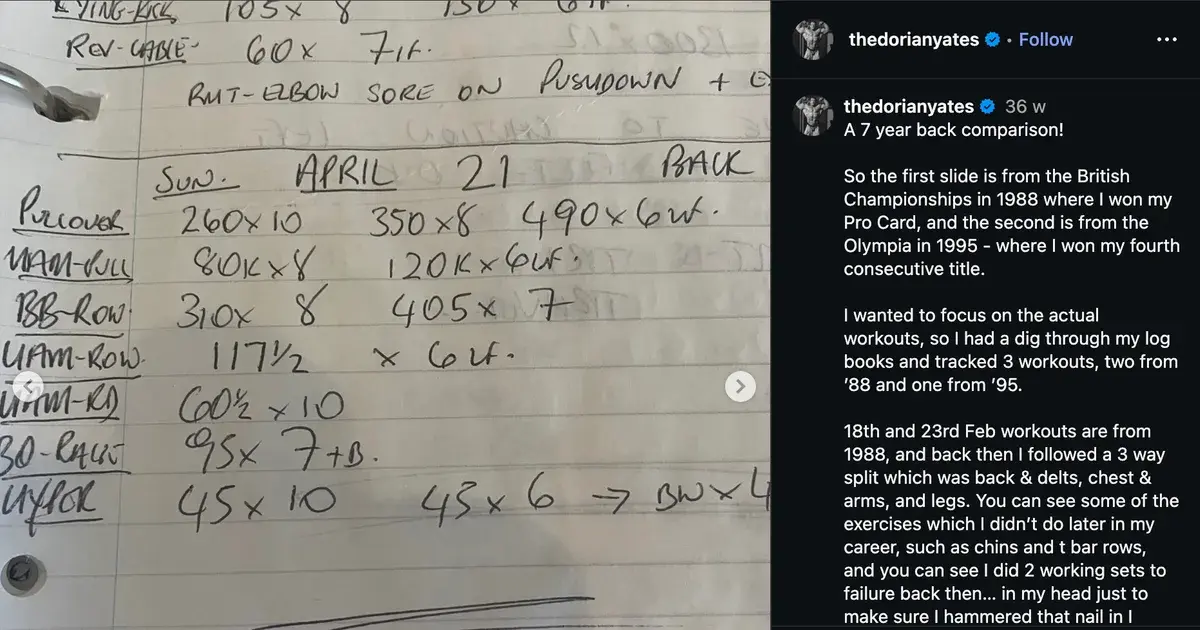
A real example of this style comes from Dorian Yates. A handwritten page from his training log, which he shared on Instagram, includes the note "Rt elbow sore on pushdown". We look at that log in more detail in our piece on Dorian Yates's training log. That one line covers the side, the joint, and the exercise.
A full entry in a notes app might look like this:
Rope pushdown 3x12 @ 30kg
R elbow sore set 3, 4/10, sharp at lockout
Stopped at 10 reps, switched to overhead extension, 0/10
For more on the short comments that make a log useful, see our guide to workout notes.
How do you tell normal soreness from an injury signal?
Note when it started, where it is, how it feels, and whether it's changing. The American Physical Therapy Association's ChoosePT guidance says normal muscle soreness peaks between 24 and 72 hours after a hard session. Pain that signals a problem tends to start during exercise or within 24 hours, and can involve tendons or joints as well as muscle.
- When it starts. Soreness usually arrives a day or two after training. Flag anything that starts during a set or the same day.
- Where it is. Soreness spreads across the muscle you trained. Flag one specific spot, or anything in a joint or tendon.
- How it feels. Soreness feels tender and stiff. Flag pain that's sharp, pinching, or there at rest.
- How it changes. Soreness fades over a few days. Flag pain that lingers or gets worse each session.
The same APTA page advises seeing a doctor or physical therapist if pain hasn't gone after seven to ten days, and sooner if it's severe.
Some signs need help straight away rather than a log entry. The NHS page on sprains and strains lists hearing a crack at the time of injury, a body part that has changed shape, or numbness and pins and needles as reasons to go to A&E. If you see those, stop training and get checked.
A log won't diagnose anything. Its job is to make the pattern visible so you know when to stop guessing and ask a professional. Our post on whether muscle soreness means growth covers the normal kind in more depth.
How do you train and log around a niggle?
Change one thing, write down what you changed, and score the pain again. This is general training practice, not treatment, so follow any advice you've been given by a clinician first.
- Swap the exercise. If pushdowns bother the elbow, try a different triceps movement and note whether it scores lower.
- Reduce the load. Drop the weight and keep the reps, then log both the new weight and the pain score.
- Shorten the range. Note the change ("box squat to parallel") so you don't mistake it for a strength drop later.
- Track the trend. Score it every session, even when it's 0/10. A run of 3, 2, 1, 0 tells you it's settling. A 2, 3, 4 tells you the change didn't work.
The zero scores matter. Without them, your log only shows the bad days, and you can't see when something actually cleared up.
If several niggles show up together alongside stalled lifts, it may be a sign of accumulated fatigue. A planned deload week is one common response.
How does a searchable log show patterns?
Searching turns scattered notes into a timeline. Type "elbow" into your log and you might find the same line three weeks in a row, always on the same exercise. You'd rarely spot that by flicking through pages.
Patterns worth looking for:
- Same joint, same exercise. This usually points at the movement or your setup.
- Same joint, different exercises. Look at the total load on that area.
- Same day of the week. It may follow a heavy session the day before.
- After a jump in weight or volume. Check your numbers in the weeks before the first note.
This is where a paper notebook struggles. The notes are all there, but finding every mention of "knee" across six months means reading every page.
Which way of logging injury notes works best?
| Feature | Physical Notebook | Notes App | Traditional Gym App | Gym Note Plus |
|---|---|---|---|---|
| Logging speed | Fast once the pen is out | Fast, free typing | Slower, menus and fields | Fast, free typing |
| Searchability for past notes | None, manual flicking | Text search across notes | Varies, notes often hidden per set | Notes kept under each exercise in every past workout |
| Spotting patterns | Only by rereading | Search works, no charts | Charts for numbers, notes rarely | Charts for numbers, notes beside the sets |
| Flexibility | Total | Total | Limited to the app's fields | Plain text, write what you like |
| Linking a note to the lift | Same page, if you're tidy | Same note, no structure | Depends on the app | Note sits next to the sets it refers to |
A simple starting plan
- Pick one place for notes. Keep pain notes in the same log as your sets, not a separate file you'll forget.
- Use the same five details every time. Body part, side, exercise and set, 0 to 10 score, what you changed.
- Score it every session until it's at 0. Write the zeros too, so the log shows when it cleared.
- Search once a week. Look up the joint names you've written and check for repeats on the same exercise.
- Set your own threshold for getting help. For example, anything still there after seven to ten days, or any red-flag sign from the NHS list, goes to a professional.
Where does Gym Note Plus fit in?
If you already log in a notes app or notebook, you don't need to change how you write. Gym Note Plus lets you type workouts as plain text notes, the same way you do now, and turns them into structured data with charts for each exercise.
Your free-text comments stay with the sets they belong to, so "R elbow 4/10 set 3" sits next to the pushdown numbers from that day. Every past workout in your History shows those notes under the exercise, next to that day's sets and a comparison with the session before, so checking whether a niggle lines up with a weight jump takes a few seconds rather than an evening with a notebook.
To see how your current notes would look, paste your last session into the free notes to workout translator.
A niggle you wrote down once is a memory. The same niggle written down three weeks running is a pattern you can act on.
Frequently Asked Questions
What is an injury log in a workout journal?
An injury log is a set of short, dated notes inside your workout journal that record any pain or niggle: the body part, the side, the exercise and set, a 0 to 10 pain score, and what you changed. Keeping it alongside your sets lets you link pain to specific lifts and loads.
How do you log pain in a workout log?
Log pain with one line during the session. Name the body part and side, the exercise and set where it appeared, and score it from 0 to 10. Then note what you did, such as dropping the weight or swapping the exercise. Keep scoring it every session, including zeros, until it clears.
How long does normal muscle soreness last after lifting?
According to the American Physical Therapy Association, normal muscle soreness peaks between 24 and 72 hours after a hard session and fades within a few days. The APTA advises seeing a doctor or physical therapist if pain hasn't gone after seven to ten days, or sooner if it's severe.
Should you train through pain in the gym?
Sharp pain, pain in a joint or tendon, or pain that gets worse each session is a reason to stop that exercise and get it assessed rather than push on. Mild soreness spread across a muscle a day or two after training is usually normal. When unsure, ask a physiotherapist or doctor.
Can a training injury journal help prevent injuries?
A training injury journal can't prevent injuries on its own, but it helps you spot early warning signs. Repeated notes about the same joint on the same exercise, or pain that follows a jump in weight, show you where to adjust before a minor niggle becomes something that stops you training.
Final Takeaways
- Write it down on the day. Body part, side, exercise and set, 0 to 10, and what you changed.
- Log the zeros. A pain trend only works if you record the sessions where it's gone.
- Know the difference. Spread-out soreness a day or two later is normal; sharp, joint, or worsening pain is worth flagging.
- Red flags go to a professional. A crack, a change in shape, or numbness means stop and get checked.
- Search for repeats. The same joint on the same exercise three weeks running is the pattern to catch.

Josh Ibbotson
Josh is the creator of Gym Note Plus, building tools that make workout tracking as simple as taking notes.
Ready to try it out?
Download Gym Note Plus and start tracking your workouts the way you want.
Download on App Store