
How to Do Pull-Ups: From Zero to Your First Rep
Quick answer: To do a pull-up, hang from a bar with hands just outside shoulder width, palms facing away. Pull your shoulder blades down, drive your elbows to your ribs, and lift until your chin clears the bar. Lower under control. No reps yet? Build them with dead hangs, scapular pulls, negatives, and band-assisted reps.
You can bench and squat, but the bar still wins. You jump, kick, and stall halfway up, then drop off before your chin gets close.
Almost everyone starts here. The first pull-up is a strength problem you solve on purpose, not a talent you either have or you don't.
What muscles do pull-ups work?
Pull-ups are a back and arm builder first, everything else second. The pull comes mostly from your lats, the wide fan of muscle down the sides of your back, with your biceps and upper back finishing the job.
Surface EMG makes the hierarchy clear. In a 2010 study in the Journal of Strength and Conditioning Research, the latissimus dorsi fired at 117 to 130 percent of its maximum voluntary contraction during pull-ups and chin-ups, while the biceps brachii reached 78 to 96 percent. That is a serious dose of stimulus for two muscles at once.
Here is the short list of what does the work:
- Latissimus dorsi. The prime mover. Pulls your upper arms down and back toward your torso.
- Biceps and brachialis. Bend the elbow and take more load on chin-ups.
- Upper back. Lower traps, rhomboids, and rear delts pull your shoulder blades down and together.
- Grip and forearms. They hold you on the bar, and they often fail before your back does.
- Core. Braces so you rise in a straight line instead of swinging.
If the bar-based version feels a long way off, the lat pulldown trains the same pattern with adjustable load, which makes it a useful bridge while you build strength.
Pull-up vs chin-up: which grip should beginners use?
A pull-up uses an overhand grip, a chin-up uses an underhand grip, and the difference changes which muscles lead. Neither is wrong. They just bias the work differently.
- Pull-up (palms away). More lat and upper-back emphasis, slightly harder for most people.
- Chin-up (palms toward you). More biceps involvement, and in the same EMG study the biceps and chest showed higher activation than on the pull-up.
- Neutral grip (palms facing each other). Often the most shoulder-friendly and a common starting point.
Most beginners get their first rep faster with a chin-up. The extra biceps recruitment gives you more total pulling muscle, so if you just want off the ground, start underhand and add pull-ups later.
How do you set up and perform a clean rep?
Good form is mostly about starting from the shoulders, not the arms. A rep that begins with a shrug and a swing wastes half your strength.
The setup
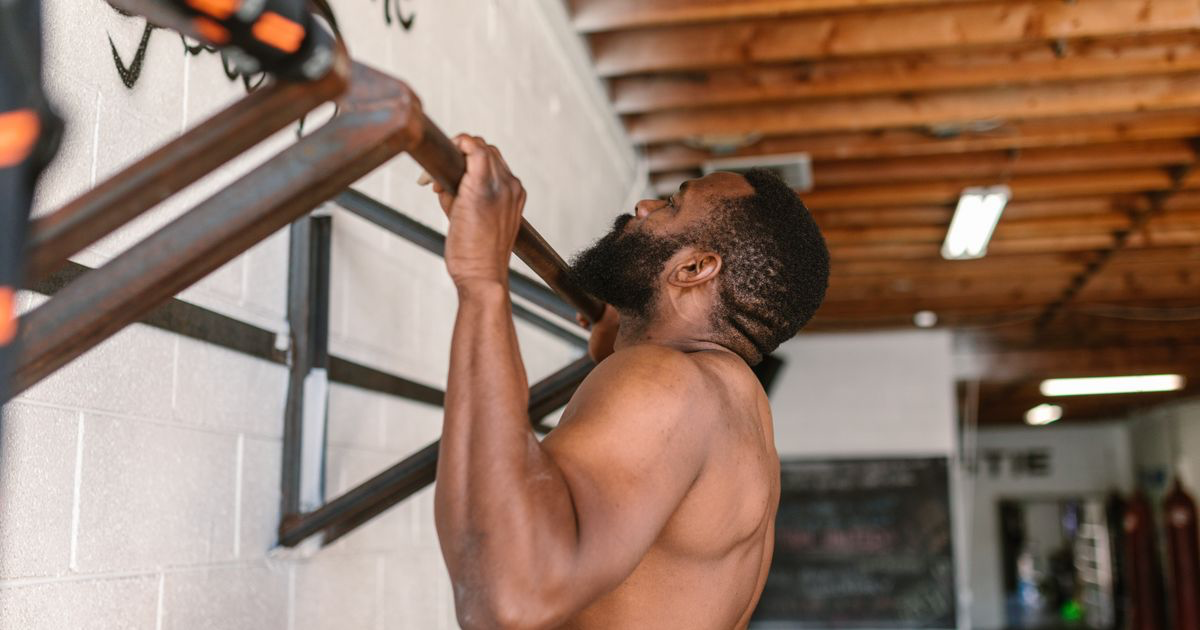
Grip the bar just outside shoulder width. Wrap your thumbs around it. Hang with straight arms, then set your shoulders by pulling your blades down away from your ears. This "active hang" is the real start position.
The pull
Drive your elbows down toward your ribs and think about pulling the bar to your collarbone. Keep a slight hollow-body position, ribs down, glutes and abs tight, legs still. Rise until your chin clears the bar.
The descent
Lower all the way to straight arms under control. The lowering phase is where a lot of the muscle-building tension lives, so do not just drop. A full rep is chin over bar at the top and full extension at the bottom.
What are the most common pull-up mistakes?
Most stalled pull-ups come from four fixable errors. None of them require more strength to fix, just attention.
- Kipping and swinging. Using momentum feels like progress but skips the muscle you are trying to build. Keep the body still.
- Half reps. Stopping short at the top or not extending at the bottom shortens the range and hides your real strength.
- No scapular set. Starting from a dead, shrugged hang loads your joints instead of your back. Set the shoulders first.
- Flared elbows and craning the neck. Leading with the chin instead of the chest strains your neck and shortens the pull.
How do you get your first pull-up? A real progression
You earn the first rep by training the pull in easier versions until the full one is just the next step. Run these in order, two or three sessions a week, and only move on when the current stage feels solid.
Step 1: Dead hangs
Just hang from the bar with straight arms and a braced core. Build grip and shoulder tolerance. Work up to 30 to 40 seconds across a few sets.
Step 2: Scapular pulls
From a hang, pull your shoulder blades down without bending your elbows. Your body rises an inch or two. This teaches the exact start of every rep. Aim for 8 to 10 controlled reps.
Step 3: Negatives
Jump or step to the top position, chin over bar, then lower as slowly as you can. Eccentric-only work is the fastest route to your first rep because you are strong in the lowering phase before you can lift. Fight for a 3 to 5 second descent, 3 to 5 reps.
Step 4: Band-assisted reps
Loop a resistance band over the bar and put a foot or knee in it. The band helps most at the bottom where you are weakest. Do full reps for 5 to 8, then switch to a lighter band as you strengthen.
Step 5: Full reps and beyond
Once band reps feel easy on a light band, test a clean bodyweight rep. Then chase a second and a third. From there you add reps, then add weight with a belt or dumbbell between your feet.
Rowing strength carries straight over to this progression, so pairing it with the barbell row builds the same pulling muscles from a different angle.
How should you log pull-ups when the reps keep changing?
The awkward part of pull-up progress is that the "weight" keeps shifting shape. One week you log a band color, the next a negative's tempo, the next actual reps. A rigid app with fixed fields fights you the whole way.
That is why so many lifters track this in their phone notes: you just write what happened. Here is how the usual options compare for a moving target like this:
| Feature | Physical Notebook | Notes App | Traditional Gym App | Gym Note Plus |
|---|---|---|---|---|
| Logging speed | Fast | Very fast | Slow (menus and taps) | Very fast (plain text) |
| Data visualization | None | None | Charts | Charts from plain text |
| Flexibility | Total | Total | Rigid templates | Total (free-form text) |
| Searchability | Flick through pages | Text search only | Good | Good |
| Handles bands and negatives | Yes | Yes | Often no field for it | Yes, just write it |
The notebook and notes app win on flexibility but give nothing back. You can write "green band, 5 reps" but cannot see whether that beats last month's blue-band-8. Traditional apps flip it: charts, but rarely a place to put "3s negatives."
A simple starting plan
- Test where you are this week. Try a dead hang and one negative. That is your baseline, and it is completely fine if it is low.
- Pick two or three days to train the pull. Add it to the start of any upper-body session while you are fresh.
- Work the current progression step for 3 to 4 sets. Hangs, then scapular pulls, then negatives, then band reps, in that order over the weeks.
- Add rowing or pulldowns for volume. Extra back work speeds the whole thing up. More weekly sets means more growth, up to a point: a 2016 meta-analysis in the Journal of Sports Sciences found muscle gains rose with weekly volume, favoring roughly 10 or more hard sets per muscle per week.
- Log every session in plain text. Band color, negative tempo, reps. You cannot progress what you did not write down. If you are new to structuring this, our guide to sets and reps for beginners covers the basics.
Keep logging in plain text, but make it count
You already log workouts the fast way, in your notes app or a notebook, and for something as fiddly as pull-up progression that instinct is right. Fixed-field apps genuinely cannot hold "blue band, 3s negatives, 4 reps."
Gym Note Plus keeps that speed and adds the part your notes are missing. You type your set as plain text and it becomes structured, trackable data.
- Write it however you already do.
pull-up green band 5,5,4just works, no template to configure. - See the progression, not just the entry. Band-assisted reps, negatives, and full reps line up on one timeline so the trend is visible.
- Never guess last session. What band or how many negatives you did last week is right there.
- Your notes stay yours. Plain text in, charts out, nothing to relearn.
Paste a week of your own pull-up notes into the free notes to workout translator and watch band-assisted reps and negatives turn into a progress chart before you install anything.
The first pull-up is not a gift some people are born with. It is the visible result of a few weeks of hangs, negatives, and band reps that you were disciplined enough to log.
Frequently Asked Questions
How long does it take to get your first pull-up?
Most beginners get their first pull-up in about 4 to 12 weeks of consistent training, though the range is wide. Body weight, starting strength, and training frequency all matter. Working the pull-up progression of dead hangs, scapular pulls, negatives, and band-assisted reps two or three times a week is the fastest reliable route for someone starting from zero.
What muscles do pull-ups work the most?
Pull-ups work the latissimus dorsi most, the large muscles along the sides of the back, which act as the prime mover. The biceps, brachialis, and upper-back muscles like the lower trapezius and rhomboids assist, while the forearms grip and the core stabilizes. EMG research shows the lats reach 117 to 130 percent of maximum contraction during a pull-up.
Are chin-ups easier than pull-ups?
Chin-ups are easier than pull-ups for most beginners because the underhand grip recruits more biceps, giving you additional pulling muscle. Pull-ups use an overhand grip that shifts more load onto the lats and upper back. Both are excellent, so beginners often start with chin-ups to earn a first rep, then add pull-ups as strength develops.
Do band-assisted pull-ups actually build strength?
Band-assisted pull-ups build real strength because you perform the full movement pattern through a complete range of motion while the band offsets part of your body weight. The band helps most at the bottom, where beginners are weakest. As you progress to lighter bands, band-assisted pull-ups transfer directly to your first unassisted repetition.
How many pull-ups should a beginner aim for?
A beginner should first aim for a single clean, full-range pull-up, then build toward sets of 5. Progress by adding reps before adding weight. Once you can complete three sets of 8 to 10 strict reps, weighted pull-ups become the next step. Quality full reps matter more than a high number of partial or kipping reps.
Are negatives good for building pull-ups?
Negatives are one of the most effective tools for building your first pull-up. You are stronger lowering than lifting, so you can train the movement before you can pull yourself up. Jumping to the top and lowering slowly for 3 to 5 seconds builds the exact strength needed, making negatives a core part of any beginner progression.
Final Takeaways
- Pull-ups are a lat and biceps builder. EMG confirms the lats do the most work, with the arms and upper back assisting.
- Set your shoulders before you pull. Every clean rep starts from an active hang, not a dead, shrugged one.
- Chin-ups get most beginners their first rep faster. The underhand grip adds biceps to the effort.
- Follow the progression in order. Dead hangs, scapular pulls, negatives, then band-assisted reps.
- Full reps beat half reps and swinging. Range of motion and control are the whole point.
- Log every session in plain text. Band color, tempo, and reps are what turn scattered effort into visible progress.

Josh Ibbotson
Josh is the creator of Gym Note Plus, building tools that make workout tracking as simple as taking notes.
Ready to try it out?
Download Gym Note Plus and start tracking your workouts the way you want.
Download on App Store