
How to Do Push-Ups: Form, Progressions and Tracking
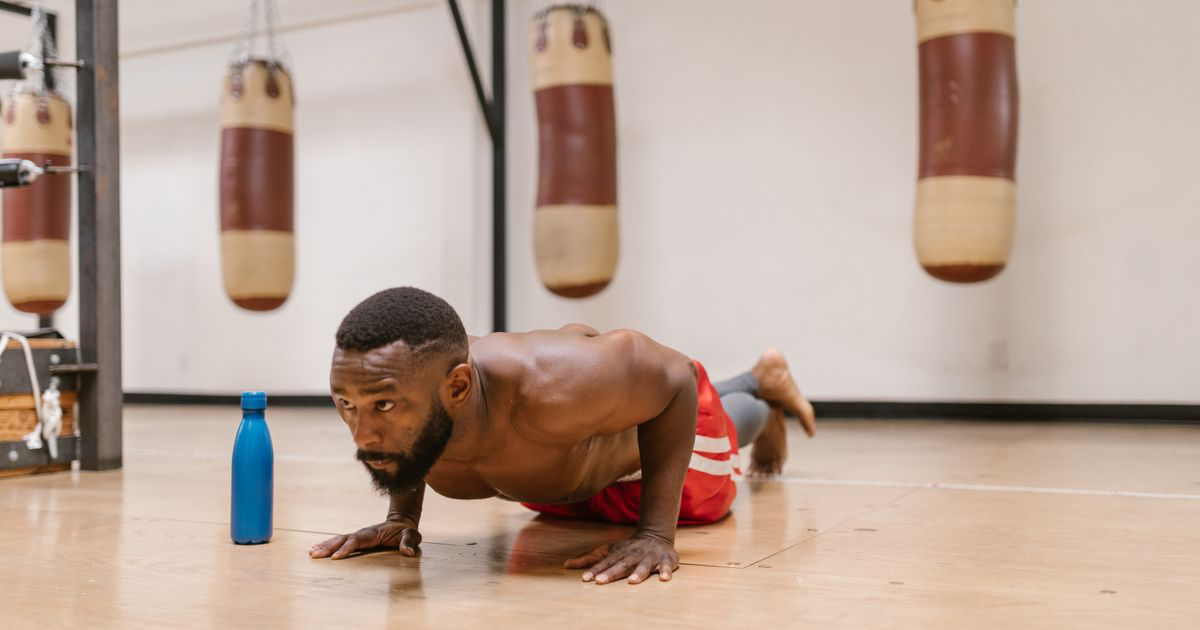
Quick answer: Start in a high plank with hands under your shoulders, squeeze your glutes and brace your core so your body forms one straight line. Lower until your chest is a fist off the floor, keeping your elbows around 45 degrees from your torso. Press back up without letting your hips sag.
A push-up looks like the simplest exercise in the gym, which is exactly why almost nobody treats it as a real lift.
You would never squat for three months without knowing what was on the bar. Yet most people do push-ups for years with no idea how much weight they are actually moving, no plan for making them harder, and no record of whether anything changed.
That is a shame, because the load is knowable. Researchers have measured it, and it changes in predictable amounts every time you move your hands or your feet.
What muscles do push-ups work?
The triceps do more work than the chest. Most people assume the opposite.
In a 2013 study in the Journal of Human Kinetics, researchers put EMG sensors on 21 participants performing traditional push-ups. The triceps brachii fired at 74.3 percent of maximum voluntary contraction, the pectoralis major at 63.6 percent, and the anterior deltoid at 58.9 percent.
So the ranking is triceps, then chest, then front delts. Your core and glutes work too, but as stabilisers holding the plank rather than movers.
There is one more muscle worth naming. The serratus anterior, the fan-shaped muscle along your ribs, drives the shoulder blades apart at the very top of the rep. A 2016 study in the Journal of Physical Therapy Science found serratus anterior activity was significantly higher during the "plus" phase, the extra push at the top where you let your shoulder blades spread, than during the push-up itself.
If you never finish the rep, you never train it.
How much weight is a push-up actually lifting?
Roughly two thirds of your body weight. That two-thirds figure is what turns a push-up into a trackable lift.
Three independent force-plate studies landed in the same place. A 2005 study in the Journal of Strength and Conditioning Research measured 66.4 percent of body weight in a standard push-up and 52.9 percent on the knees. A 2020 study in the Journal of Human Kinetics measured 62.6 percent. A conference paper from the same research group measured 63.2 percent.
Call it 62 to 66 percent. If you weigh 80kg, a push-up is about 50kg on your hands.
The variation ladder, in percentages
This is where it gets useful. A kinetic analysis of push-up variations put 23 recreationally fit adults on a force platform and measured peak ground reaction force for six different setups, expressed as a fraction of body mass:
| Push-up variation | Share of body weight |
|---|---|
| Feet elevated 24 inches | 0.74 |
| Feet elevated 12 inches | 0.70 |
| Standard, on the floor | 0.64 |
| Hands elevated 12 inches | 0.55 |
| On your knees | 0.49 |
| Hands elevated 24 inches | 0.41 |
Read that table twice, because it contains a genuinely counterintuitive result.
Hands elevated on a 24 inch box is easier than a knee push-up. 41 percent against 49 percent. Yet almost every beginner gets sent to their knees, which teaches a different body position, instead of onto an incline, which is the same movement with less load.
The incline is the better on-ramp, and now you can pick your height by the number rather than by feel.
How do you actually perform a clean rep?
The setup
Hands under your shoulders, or barely wider. Wrists stacked beneath the shoulder joint. Spread your fingers and grip the floor slightly, which helps distribute pressure across the hand rather than the wrist alone.
Set your feet together or a few inches apart. Wider is more stable, which makes the rep marginally easier.
Now build the plank. Squeeze your glutes, brace your abs as if you were about to be poked in the stomach, and tuck your ribs down. Your head, hips and heels should form one line.
The descent
Lower under control until your chest is about a fist off the floor. Two to three seconds down is plenty.
Keep your elbows at roughly 45 degrees from your torso. The American Council on Exercise cues this as rotating your elbows to point back toward your feet, since flaring them to 90 degrees puts the shoulder in a weaker position for no extra benefit.
The press
Push the floor away and finish the rep. Elbows lock out, then let your shoulder blades spread apart at the top for that serratus contribution.
Do not let the hips lead. If your lower back arches or your bum rises first, the set is over.
What are the most common push-up mistakes?
- Sagging hips. Named first by nearly every coaching source. The Cleveland Clinic points out that people squeeze their quads and forget to brace the core and glutes, so the middle drops.
- Flared elbows. Elbows at 90 degrees to the torso, which stresses the shoulder and cuts the chest's contribution.
- Half reps. Stopping six inches off the floor. If you shorten the range as you fatigue, your rep count stops meaning anything week to week.
- Hands too far forward. Reaching the hands up past the shoulders turns the push-up into a much harder lever and hammers the shoulders.
- Rushing the descent. Dropping fast and bouncing off the bottom skips the part of the rep that builds the most tension.
Do push-ups build muscle like the bench press?
In untrained lifters, yes. A 2017 trial in the Journal of Exercise Science and Fitness randomised 18 untrained men to eight weeks of either bench press at 40 percent of their one rep max or push-ups adjusted to the same load, twice a week.
Both groups improved, and they improved by almost identical amounts:
- Bench group: 1RM rose from 60.0kg to 65.0kg, pectoralis major thickness from 17.0mm to 20.8mm.
- Push-up group: 1RM rose from 61.1kg to 64.2kg, pectoralis major thickness from 17.0mm to 20.8mm.
Both changes were statistically significant. The one difference was the biceps, which grew only in the bench group.
The 2017 trial used untrained men and a light load, so do not read it as "push-ups replace benching forever". Read it as: a push-up loaded appropriately is real training, not a warm-up.
One thing you have probably read that is wrong
You may have seen that men who can do 40 push-ups have a 96 percent lower risk of heart disease. The underlying study is real: a 2019 study in JAMA Network Open followed 1,104 male firefighters for ten years and found higher push-up capacity linked to fewer cardiovascular events.
But the 96 percent figure comes from a group whose confidence interval ran from 0.02 to 1.22. Because that range spans 1.0, the data are compatible with no benefit at all, so the result was not statistically significant. The finding that held up was the 21 to 30 push-up group, with a hazard ratio of 0.31 and a confidence interval of 0.11 to 0.89.
Push-up capacity does track with cardiovascular health. The headline number just was not the reliable part.
How do you track a bodyweight exercise that has no weight?
Push-up logs fall apart as a tracking tool, and the fault is the logging habit rather than the exercise.
Your squat log is a column of numbers that obviously goes up. Your push-up log, if it exists, says "push-ups, 3 sets" and nothing else. Six months later you cannot tell whether you got stronger or just less honest about the depth.
Log three things and the problem disappears: the variation, the reps, and the height if there is an incline.
Push-up (hands on 12in bench) 3x10
Push-up (floor) 3x8
Push-up (feet on 12in box) 3x6
Those three lines are a progression, and the percentages from the table above tell you exactly how much of one. Going from a 12 inch incline to the floor at the same rep count is a jump from 55 to 64 percent of body weight, which is the bodyweight equivalent of adding plates.
| Where your log lives | Logging speed | Handles variations | Shows progress over time | Searchable later |
|---|---|---|---|---|
| Physical notebook | Fast to write | Yes, write anything | Manual, you do the maths | No |
| Notes app | Fastest, no menus | Yes, it is just text | None, it is just text | Text search only |
| Traditional gym app | Slow, menus per set | Often one fixed "push-up" entry | Charts, if the variation fits | Within the app |
| Gym Note Plus | Type it like a note | Yes, variations kept separate | Automatic per-exercise trends | Yes, whole history |
The trap is the third column. Many gym apps have a single "Push-up" exercise with a rep field, so an incline push-up, a floor push-up and a decline push-up all collapse into one line on one chart. The chart then shows your reps falling every time you make the exercise harder, which is precisely backwards.
A simple starting plan
- Test where you are. Do one set of push-ups on the floor to a clean chest-to-fist depth and stop when form breaks. That number, not your maximum grind, is your working level.
- Pick your variation from the table. Fewer than 5 clean floor reps, start with hands elevated. More than 12, put your feet up. Write the height down.
- Run 3 sets, three times a week, leaving one or two reps in reserve on the first two sets.
- Add reps before you add difficulty. Work each set to 12 clean reps, then drop the incline height (or raise your feet) and start again at 6 to 8.
- Log the variation every single time. "Push-ups 3x10" is a note to nobody. "Push-up (hands on 12in bench) 3x10" is data.
If you are training the other bodyweight staples alongside these, our guides to pull-ups and dips use the same progression logic.
Keeping the log without slowing down the set
If you already type your sessions into a notes app, you are doing the hard part. Writing Push-up (12in incline) 3x10 between sets takes three seconds and no menu-diving.
The gap shows up months later. Everything you need to see your push-up strength curve is sitting in that note, but pulling it out means scrolling back through weeks of text and doing percentage arithmetic by hand.
Gym Note Plus reads the plain text you already write and does that part for you:
- Variations stay separate, so an incline push-up and a floor push-up get their own trend lines instead of being averaged into nonsense.
- Per-exercise history you can pull up mid-set, so you know what you did last time without scrolling.
- No fixed exercise list. If you write it, it logs it, including the bracketed height.
Paste a week of your own notes into the free notes to workout translator and see what your format turns into.
A push-up is a barbell lift where the plates are invisible. Write down the variation and they stop being invisible.
Frequently Asked Questions
How do beginners do push-ups?
Beginners should start with hands elevated on a bench, box or wall rather than dropping to their knees. Force-plate research shows a 24 inch hands-elevated push-up loads about 41 percent of body weight against 49 percent for a knee push-up, so the incline is both easier and closer to the real movement pattern. Lower the height as you get stronger.
Why can't I do a push-up yet?
Most people who cannot do a floor push-up lack the trunk stiffness to hold a rigid plank, not chest strength. A standard push-up asks you to press roughly two thirds of your body weight while keeping your hips from sagging. Building the plank first, then working down an incline ladder, fixes both problems in the right order.
How many push-ups should I do a day?
Rather than a daily target, run three sets three times a week at a variation where 8 to 12 clean reps is genuinely hard. Doing 100 easy push-ups daily gives you endurance at a load you have already mastered. Progressing to a harder variation is what continues to build strength and muscle.
Do push-ups build chest or triceps more?
Push-ups train the triceps hardest. EMG measurements in a 2013 Journal of Human Kinetics study recorded the triceps brachii at 74.3 percent of maximum voluntary contraction during a traditional push-up, against 63.6 percent for the pectoralis major and 58.9 percent for the anterior deltoid. Narrower hand positions push the triceps share higher still.
Are push-ups as good as bench press?
For untrained lifters, a 2017 Journal of Exercise Science and Fitness trial found eight weeks of push-ups matched bench press at 40 percent of one rep max for both pectoral thickness and strength gains. Only the biceps grew more in the bench group. For advanced lifters the barbell wins on loadability.
Final Takeaways
- A push-up is about two thirds of your body weight. Three separate force-plate studies put it at 62 to 66 percent.
- Use inclines, not knees. Hands on a 24 inch box is 41 percent of body weight, genuinely easier than the 49 percent of a knee push-up, and it keeps the real movement pattern.
- The triceps work hardest, not the chest, so treat push-ups as a pressing lift rather than a chest-only exercise.
- Reps alone are not progress. Without the variation written next to them, a rep count tells you nothing about whether you got stronger.
- If you already log in plain text, our guides to tracking bodyweight exercises and how to write down your workouts cover the rest of the entry.

Josh Ibbotson
Josh is the creator of Gym Note Plus, building tools that make workout tracking as simple as taking notes.
Ready to try it out?
Download Gym Note Plus and start tracking your workouts the way you want.
Download on App Store