
Powerbuilding Program: What It Is and a 4-Day Plan
Quick answer: A powerbuilding program combines powerlifting and bodybuilding in one week. Each session opens with a heavy compound lift for 3 to 5 reps to build strength, then moves to moderate-weight accessories for 8 to 15 reps to build muscle. Most lifters run it four days a week, one main lift per day.
Your notes app holds two kinds of workout. Some pages are squat triples you were proud of. Others are pump sessions full of curls and lateral raises. You keep switching between them every few months, because you want to be strong and look it.
A powerbuilding program puts both kinds of training in the same week, so you no longer have to pick one for the next block.
What is powerbuilding?
Powerbuilding is a training style that chases strength and muscle size at the same time. It borrows the heavy, low-rep work of powerlifting and the higher-rep, muscle-focused work of bodybuilding.
A typical session has two parts:
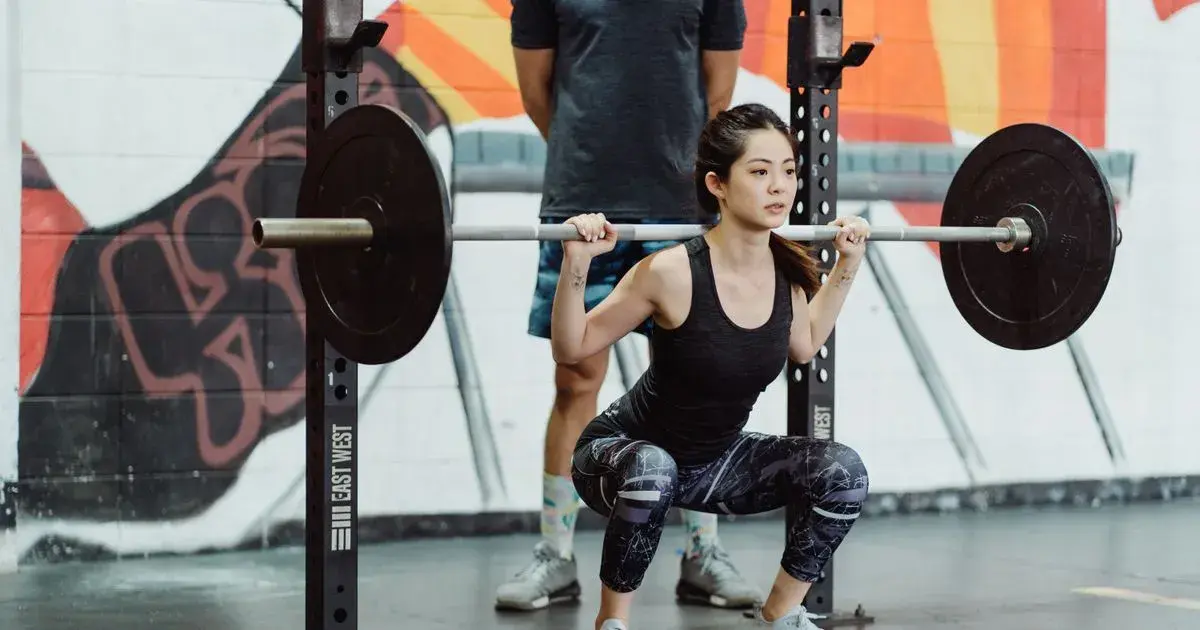
- The main lift. One of the big barbell movements (squat, bench press, deadlift or overhead press) for a few heavy sets of 3 to 5 reps.
- The accessories. Three to five exercises for 8 to 15 reps, chosen to build the muscles that move the main lift and the ones that make a physique look finished.
You get regular practice with heavy loads, and enough moderate-load volume to keep adding muscle.
How is powerbuilding different from bodybuilding and powerlifting?
Powerlifting trains for a one-rep max and bodybuilding trains for size. Powerbuilding trains for both. You can see the difference in the rep ranges each one spends most of its time in.
There is a research reason to mix them. In a 2016 study in the Journal of Sports Science and Medicine, Schoenfeld and colleagues randomly assigned 19 resistance-trained men to train with 2 to 4 reps per set or 8 to 12 reps per set. Both groups did 3 sets of 7 exercises, 3 days a week, for 8 weeks.
The heavy group gained significantly more squat strength. The moderate group gained significantly more lateral thigh muscle thickness. The authors concluded that heavy loads suit maximal strength goals and moderate loads suit muscle growth when the number of sets is the same.
Powerbuilding uses both rep ranges in the same week, so neither goal gets neglected.
| Powerlifting | Bodybuilding | Powerbuilding | |
|---|---|---|---|
| Main goal | Max squat, bench, deadlift | Muscle size and shape | Strength and size |
| Typical reps | 1 to 5 | 8 to 15 | 3 to 5 on main lifts, 8 to 15 after |
| Exercise choice | The three competition lifts and close variations | Wide variety, many isolation moves | Big lifts first, isolation after |
| How progress is measured | Heavier top sets | Size, measurements, more reps | Both |
How should a powerbuilding split be structured?
Build each day around one heavy compound lift, then fill the rest of the session with hypertrophy work. Four days a week is the most common setup, and an upper/lower layout gives each muscle two sessions.
You have probably come across the named programs already:
- PHUL runs four days, with two power days and two hypertrophy days.
- PHAT runs five days and adds more hypertrophy work per muscle.
- 5/3/1 with extra assistance work is often set up as powerbuilding, since every session starts with a heavy percentage-based lift.
The plan below is laid out differently. Every session starts heavy on one main lift, so you train heavy on all four days instead of two.
What does a 4-day powerbuilding program look like?
Train Monday, Tuesday, Thursday and Friday, with one main lift per day. Main lifts use 3 to 5 reps. Accessories use 8 to 15.
| Day | Main lift (heavy) | Accessories (moderate) |
|---|---|---|
| Mon: Upper A | Bench press 4 x 3-5 | Barbell row 3 x 6-8, incline dumbbell press 3 x 8-12, lat pulldown 3 x 10-12, lateral raise 3 x 12-15, triceps pushdown 3 x 10-15 |
| Tue: Lower A | Back squat 4 x 3-5 | Romanian deadlift 3 x 6-8, leg press 3 x 10-12, leg curl 3 x 10-15, calf raise 3 x 12-15 |
| Thu: Upper B | Overhead press 4 x 3-5 | Pull-up 3 x 6-10, flat dumbbell press 3 x 8-12, seated cable row 3 x 10-12, curl 3 x 10-15, face pull 3 x 15 |
| Fri: Lower B | Deadlift 3 x 3-5 | Bulgarian split squat 3 x 8-10, hip thrust 3 x 8-12, leg extension 3 x 12-15, hanging leg raise 3 x 10-15 |
How heavy should the main lifts be?
Start your heavy sets at about 80% of your estimated one-rep max. If you have never tested a max, plug a recent hard set into the one rep max calculator and work from the estimate it gives you.
That starting weight should leave you about two reps short of failure on the last set. Keep the accessories honest too: stop each set one to three reps before failure, with clean form.
What does one day look like in your notes?
Here is Upper A written the way most people already log a session. Copy it into your notes and swap in your own weights.
Upper A
Mon 9 Nov

Bench Press 80kg 5, 5, 4, 4
Barbell Row 70kg 8, 8, 7
Incline Dumbbell Press 26kg 12, 10, 9
Lat Pulldown 60kg 12, 11, 10
Lateral Raise 10kg 15, 14, 12
Triceps Pushdown 30kg 14, 12, 11
How do you progress on a powerbuilding program?
Use two progression rules: one for the main lift, one for the accessories.
- Main lift. When you get 5 reps on every set, add weight next session: about 2.5 kg on upper-body lifts and 5 kg on squats and deadlifts. If you miss the bottom of the range (3 reps) twice in a row, drop the weight by 10% and build back up.
- Accessories. Use double progression. Stay at the same weight until every set hits the top of the rep range, then add the smallest jump available and start again at the bottom of the range.
Every four to eight weeks, or when the main lifts stall for two sessions running, take a lighter week. Cut the sets in half and keep the weights moderate.
Both rules need last week's numbers in front of you. A powerbuilding week runs them across about 20 exercises, which is more than most people can keep in their head.
How should you log a powerbuilding program?
Log the heavy sets and the accessories in the same session note, with weight and reps for every set. The main lift tells you whether you are getting stronger, and the accessories tell you whether you are adding the volume that builds muscle.
| Physical Notebook | Notes App | Traditional Gym App | Gym Note Plus | |
|---|---|---|---|---|
| Logging speed | Fast | Fast | Slow (menus and taps) | Fast (plain text) |
| Heavy sets and volume sets together | Easy to write, hard to compare | Easy to write, hard to compare | Supported | Supported, from typed lines |
| Data visualization | None | None | Charts | Charts from your notes |
| Flexibility | Total | Total | Fixed exercise lists | Total |
| Searchability | Flip through pages | Text search only | Good | Good |
A simple starting plan
- Estimate your maxes. Run a recent hard set for the bench, squat, overhead press and deadlift through a 1RM calculator, and set heavy sets at about 80%.
- Run the four days as written for six weeks. Keep exercise selection the same so the numbers are comparable.
- Log every set, heavy and light. Weight and reps on each line, one note per session.
- Apply the two progression rules each session. Add weight to the main lift at 5 reps per set, and to accessories at the top of the range.
- Review at week six. If the main lifts rose and accessory reps climbed, take a lighter week and run another block.
Keep logging powerbuilding in the notes you already use
If you already write your sessions in a notes app or a notebook, keep doing it. Typing Bench Press 80kg 5, 5, 4, 4 between sets takes a few seconds, and you already have the habit.
What a plain note cannot do is tell you whether your bench is trending up across eight weeks, or whether your accessory volume dropped while you chased a squat PR.
Gym Note Plus reads the same plain-text lines and turns them into tracked progress:
- Type your sets the way you already do and they become structured data.
- See the heavy lifts and the accessories charted separately over time.
- Import your old notes so past blocks still count.
To see what that looks like, paste the Upper A note above into the free notes to workout translator.
Powerbuilding works when both halves of the week keep moving: heavier top sets on the main lift and more reps on the accessories. You only know whether both are moving if you write them down.
Frequently Asked Questions
What is a powerbuilding program?
A powerbuilding program is a weekly training plan that trains for strength and muscle size together. Each session starts with a heavy compound lift such as the squat, bench press or deadlift for 3 to 5 reps, then moves to accessory exercises for 8 to 15 reps to build muscle. Most powerbuilding programs run four or five days a week.
Is powerbuilding good for beginners?
Powerbuilding can suit beginners who already know how to squat, bench and deadlift safely. Complete beginners usually gain strength fast on a simpler linear program first. Once weekly weight increases on the main lifts slow down, a four-day powerbuilding program adds the accessory volume that keeps muscle growth going alongside strength.
How many days a week should a powerbuilding split be?
A powerbuilding split usually runs four days a week, often as an upper/lower layout that trains each muscle twice. Four days leaves room for one heavy main lift per session plus three to five accessories. Five-day programs such as PHAT add more hypertrophy work but need more recovery and time.
Can you build muscle on a powerbuilding program?
A powerbuilding program builds muscle as long as the accessory volume is there. A 2016 Journal of Sports Science and Medicine study by Schoenfeld and colleagues found 8 to 12 reps per set grew lateral thigh thickness more than 2 to 4 reps with equal sets. Powerbuilding keeps that moderate-rep work alongside the heavy lifts.
Is powerbuilding better than bodybuilding?
Powerbuilding and bodybuilding have different goals, so neither is better overall. Bodybuilding prioritises muscle size and spends most sets in moderate rep ranges, while powerbuilding gives up some of that volume to practise heavy lifts. If you care about your one-rep max as well as how you look, powerbuilding is the better fit.
Final Takeaways
- Powerbuilding trains strength and size in the same week, with heavy main lifts first and moderate-rep accessories after.
- Use one main lift per day: bench, squat, overhead press and deadlift across four sessions.
- Start heavy sets at about 80% of your estimated max, leaving about two reps in reserve.
- Run two progression rules: add weight to the main lift at 5 reps per set, and double progression on accessories.
- Log every set, heavy and light, so you can tell which half of the program is moving.

Josh Ibbotson
Josh is the creator of Gym Note Plus, building tools that make workout tracking as simple as taking notes.
Ready to try it out?
Download Gym Note Plus and start tracking your workouts the way you want.
Download on App Store