
How to Do Dips: Form, Muscles Worked, and Progressions
Quick answer: Dips are a bodyweight pressing exercise performed on parallel bars. Grip the bars, straighten your arms, lower under control until your upper arms are roughly parallel to the floor, then press back up to a locked-out position. Leaning your torso forward shifts the work toward the chest; staying upright shifts it toward the triceps.
Your notes app says Dips 3x8. It does not say whether that was bodyweight, bodyweight plus a 10kg plate on a belt, or the assisted machine set to minus 20kg.
Three weeks later you have no idea whether you got stronger. Dips are one of the few lifts where the load is partly you, and most logs never account for that.
How do you do a dip with good form?
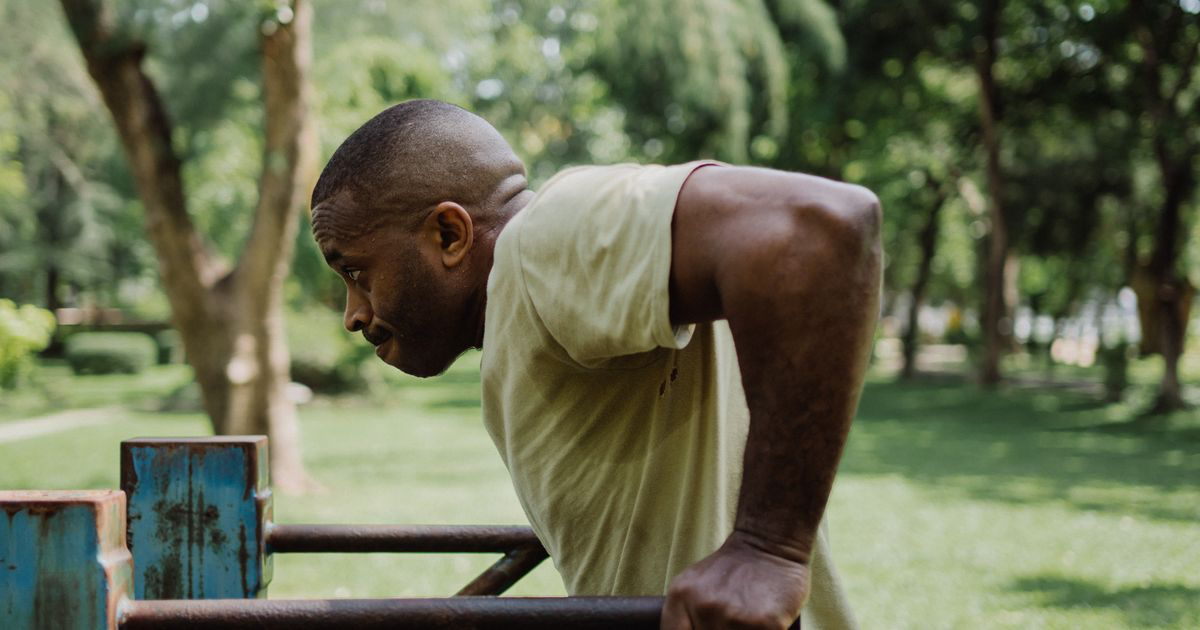
Get set before you leave the ground. Grip the parallel bars with your palms facing in, arms straight, shoulders pulled down away from your ears. Cross your ankles behind you or hold your legs straight and slightly forward. Brace your abs so your ribs do not flare.
Lower slowly, elbows tracking back. Take two to three seconds on the way down. Your elbows should travel backward and stay reasonably close to your body rather than fanning out to the sides.
Stop when your upper arms reach roughly parallel to the floor, then press back up by driving through your palms until your elbows lock. Do not let your shoulders shrug toward your ears at the top; that is where the shoulder blades quietly give up control.
One cue covers the whole rep: pretend you are pushing the bars down and slightly together. It keeps the shoulder blades set and stops the descent from turning into a fall.
How far down should you go on a dip?
Deep enough to load the muscle, not so deep that the shoulder takes over. Upper arms at or just below parallel is the standard target. Below that, extra range comes mostly from the shoulder capsule rather than from the chest and triceps.
This is measurable. When researchers put motion capture on trained lifters performing bar dips, the bottom position averaged about 68 degrees of shoulder extension and 115 degrees of elbow flexion, according to a 2022 study in the International Journal of Environmental Research and Public Health.
Compare that with the bench dip, the version where your hands sit behind you on a bench. In a companion study from the same group, peak shoulder extension during the bench dip reached 101 percent of the lifter's available range, against 88 percent for the bar dip. The authors flagged the repeated strain that puts on the anterior shoulder capsule.
If your shoulders feel pinched at the bottom, raise your stopping point before you blame the exercise. A little less depth on a lift you can keep doing beats full range on one you have to abandon.
What muscles do dips work?
The main dips muscles worked are the chest and triceps, with the shoulders and upper back doing real supporting work.
- Pectoralis major, especially the lower and sternal portion, drives the press as your arm moves down and forward.
- Triceps brachii extends the elbow. This is the muscle that finishes the rep at lockout.
- Anterior deltoid assists at the front of the shoulder, though it is a supporting player rather than the target.
- Scapular stabilizers, including serratus anterior, lower trapezius, and lats, hold the shoulder blades in position so the joint has something solid to press against.
That stabilizer list is not filler. In the bar dip fatigue study above, serratus anterior, lower trapezius, and latissimus dorsi all showed significantly higher peak activation as lifters tired. Your upper back works hard on every rep, which is part of why dips feel harder than a press machine at the same effort.
Chest dips vs tricep dips: what the lean actually changes
Torso angle moves the emphasis, it does not switch muscles on and off. Lean your chest forward over the bars, let the elbows travel a little wider, and the pecs take more of the load. Stay stacked upright with elbows tucked, and the triceps carry more.
Worth knowing: even an ordinary bar dip involves a forward thoracic lean of roughly 37 degrees at the bottom, per the same motion capture data. Some lean is already built into the movement, and a "chest dip" exaggerates what is there.
If chest is your priority, lean and program dips near your bench press work. If triceps are the goal, stay tall and keep the elbows in.
What are the most common dip mistakes?
Partial reps. Bending the elbows 30 degrees and calling it a rep is the most common one, usually because the weight (your body) is too heavy. Shorten the load rather than the range: use assistance and do full reps.
Shrugging into the shoulders. If your traps ride up toward your ears at the bottom, the shoulder blades have stopped holding position and the joint is absorbing the load. Reset your shoulders down before every set.
Uncontrolled flare. Elbows that swing wide as you fatigue put the shoulder in a weaker position. They should move back on a fixed path.
Bouncing at the bottom. Dropping fast and rebounding out of the hole is where most shoulder complaints come from. Pause for a half beat instead, which looks less impressive and works better.
What is a good dip progression for beginners?
Most people cannot do a clean bodyweight dip on day one, and that is normal. Here is a dip progression for beginners that actually gets you there:
- Assisted dip machine. Set the pad to remove enough weight that you get 8 clean reps, then reduce the assistance over the following weeks. Note that on this machine a higher number means easier.
- Band-assisted dips. Loop a band across the bars and kneel or stand in it. Thinner band each time you can hit 3 sets of 8.
- Negatives. Jump or step to the top position, then take five seconds to lower. Three to five reps per set. This builds the strength that assistance alone does not.
- Support holds. Just hold the locked-out top position for 20 to 30 seconds. Boring, and it teaches your shoulder blades what "set" feels like.
- Bench dips, with a caveat. Fine as a stopgap when nothing else is available, but they put the shoulder at the very end of its extension range, so keep the depth modest.
Bodyweight work is not lesser training. In an 8-week trial published in the Journal of Exercise Science and Fitness, a push-up group and a low-load bench press group both gained significant chest and triceps thickness and 1RM strength, with no significant difference between them.
If pull-ups are on the same wish list, the logic is nearly identical, and how to do pull-ups walks the same ladder from the other direction.
How do you add weight once bodyweight dips get easy?
Once you can do 3 sets of 10 to 12 clean reps, start adding load. Two ways:
- Dip belt. A belt with a chain that hangs plates between your legs. Start at 5kg (10lb) and add 2.5kg (5lb) at a time. Buy one if you plan to keep dipping.
- Dumbbell between the feet. Free, awkward, and fine up to about 15kg (35lb). Squeeze the dumbbell head between crossed ankles or pinch it between your knees.
Sets and reps: 3 to 4 sets of 6 to 12 reps works for most goals. Weighted dips in the 5 to 8 range build strength well, and bodyweight sets of 10 to 15 are fine for volume. Add load using the same rule as any other lift, covered in when to increase weight lifting.
Your log now has to hold two numbers. Dips 3x8 meant something when you were doing bodyweight. The moment a belt appears, Dips 3x8 and Dips +15kg 3x8 are entirely different sessions, and a log that cannot tell them apart cannot show you progress.
| Physical Notebook | Notes App | Traditional Gym App | Gym Note Plus | |
|---|---|---|---|---|
| Logging speed | Fast | Fast | Slow (menus and forms) | Fast (plain text) |
| Bodyweight + added load | You write it, you decode it | You write it, you decode it | Often forced into one weight field | Parsed as separate values |
| Data visualization | None | None | Charts | Charts from your own notes |
| Flexibility | Total | Total | Low | Total |
| Searchability | Poor | Decent | Good | Good |
A simple starting plan
- Test where you are. Do one honest set of dips to technical failure, full range, and write the number down. Zero is a valid answer and gives you a starting point.
- Pick your entry rung. Zero reps: negatives and support holds. One to four reps: band or machine assistance. Five or more: straight sets.
- Program them twice a week, 3 sets, on your push or upper days. Leave one or two reps in reserve on every set while you are learning the movement.
- Log bodyweight reps and added load separately from the very first session.
Dips BW 8,7,6now,Dips +10kg 8,8,6later. - Review after four weeks. Reps rising at bodyweight, or load rising at fixed reps, both count as progress. That is progressive overload in its plainest form.
Where does Gym Note Plus fit in?
Your notes app is not the problem. Typing Dips 3x8 into Apple Notes between sets takes four seconds and beats fiddling with an app's exercise picker while your forearms are still burning. Keep that.
What plain text cannot do is read itself back. It will not tell you that you were doing bodyweight sets of six in March and belted sets of eight with 15kg in June, or plot the line between them.
Gym Note Plus keeps the typing and adds the reading back:
- Type
Dips BW 3x8and it logs three bodyweight sets of eight. - Type
Dips +15kg 8,8,6and it records the added load separately, so bodyweight and weighted sessions sit on one progression instead of two unrelated piles. - Charts build themselves from lines you were already writing, including the jump from assisted to bodyweight to weighted.
- Assisted sets log honestly too:
Dips assisted -20kg 3x8keeps your early weeks in the same history.
You can see what this looks like without signing up. Paste your last few sessions into the free notes to workout translator and watch the plain text turn into sets, reps, and charts.
A dip is the one lift where you are the weight. If your log does not record what you weighed plus what you hung off a belt, it is not recording the lift.
Frequently Asked Questions
Are dips better for chest or triceps?
Dips train both. Leaning the torso forward with elbows slightly wider puts more demand on the chest, while an upright torso with tucked elbows shifts more to the triceps. Neither version isolates one muscle. Pick the emphasis that matches your goal, then keep it consistent so your logged numbers stay comparable week to week.
Are dips bad for your shoulders?
Dips are not inherently bad for shoulders, but depth and control matter. Motion capture research shows the bench dip variation drives the shoulder to roughly 100 percent of its available extension range, which repeatedly strains the front of the joint. Stop at upper arms parallel to the floor, keep the shoulder blades pulled down, and avoid bouncing out of the bottom.
How many dips should a beginner be able to do?
Many beginners start at zero full-range dips, which is a normal starting point rather than a red flag. A reasonable first milestone is 3 sets of 5 clean reps, reached over four to eight weeks using assisted machine work, band assistance, and slow negatives. From there, 3 sets of 10 to 12 is the usual signal to start adding external load.
Are bench dips as good as parallel bar dips?
Bench dips are a weaker substitute. A 2022 comparison found six muscles, including the pectoralis major, anterior deltoid, and triceps, produced significantly higher peak activation on bar dips than bench dips, while the bench version placed the shoulder at the extreme end of its extension range. Use bench dips as a temporary option, then move to bars.
How do you log weighted dips?
Log weighted dips as your bodyweight reps plus the added load, kept as separate values. Writing Dips +15kg 8,8,6 records the belt weight and the reps, while Dips BW 10,9,8 records an unloaded session. Recording both means an assisted week, a bodyweight week, and a belted week all sit on one comparable progression line.
Should you do dips before or after bench press?
Do dips first when they are your priority lift, since fresh triceps and shoulders let you use full range and more load. Do them after bench press when bench is your main strength focus and dips serve as accessory chest and triceps volume. Whichever order you pick, keep it stable so session-to-session numbers mean something.
Final Takeaways
- Stop at upper arms parallel. Depth past that comes from the shoulder capsule rather than the chest and triceps, and the bench dip variation already sits at the end of most people's range.
- Lean forward for chest, stay upright for triceps. Torso angle is an emphasis dial on one exercise rather than a switch between two lifts.
- Dips are a chest and triceps builder with a big stabilizer bill. Serratus, lower traps, and lats all work hard, which is why the movement feels harder than a machine press.
- Progress in rungs, not leaps. Support holds, negatives, band or machine assistance, bodyweight, then a dip belt at 2.5kg (5lb) jumps.
- Log bodyweight and added load separately.
Dips BW 8,7,6andDips +10kg 8,8,6tell different stories, and only a log that keeps both, whether paper, notes app, or Gym Note Plus, can show you the line between them.

Josh Ibbotson
Josh is the creator of Gym Note Plus, building tools that make workout tracking as simple as taking notes.
Ready to try it out?
Download Gym Note Plus and start tracking your workouts the way you want.
Download on App Store