
Split Squat Form: How to Do a Stationary Split Squat
Quick answer: A split squat is a stationary lunge. Stand with one foot forward and one back, both on the floor, then lower straight down until your back knee is just above the ground and drive back up through the front heel. It trains the quads and glutes one leg at a time without the balance demand of a Bulgarian split squat.
The split squat is the exercise everyone skips on the way to the Bulgarian version, which is a shame, because it is the one that teaches you the position in the first place.
It also happens to be the single-leg exercise you can actually load. No wobbling on a bench, no bailing out of the set because your foot slipped.
What is a split squat?
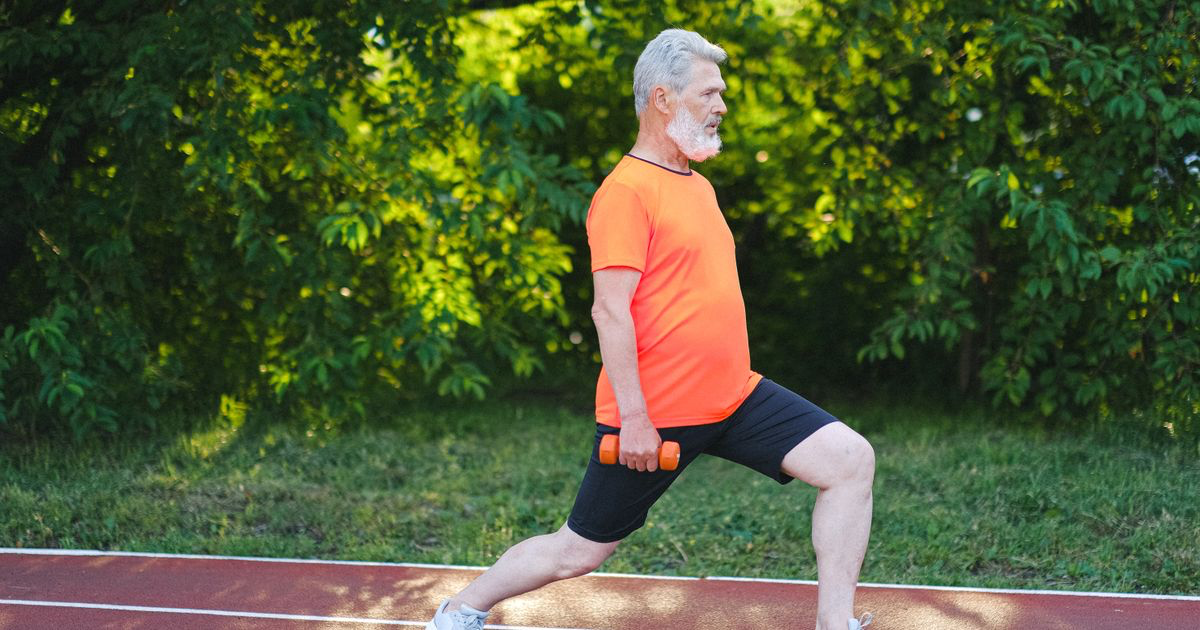
Both feet stay on the ground. You set your feet in a staggered stance, roughly the length of a comfortable stride apart, and then move straight up and down without stepping anywhere.
That last bit is what separates it from a lunge. A lunge travels: you step out, or step back, or walk forwards. A split squat stays put, which means every rep starts from the same position and you can add real weight without thinking about your footing.
It is also the parent movement of the Bulgarian split squat, where the rear foot goes up on a bench. Same lower body, much less balance required.
How do you do a split squat with correct form?
Set your stance
Step one foot forward into a stride that leaves both knees at roughly 90 degrees at the bottom. Too short and your front knee jams forward; too long and you cannot get the back knee down without straining the hip flexor.
Your feet should be about hip width apart side to side, not on a tightrope. This is the most common setup error and it makes the whole thing feel wobblier than it is.
Set your torso
Stand tall with your ribs down and your weight roughly 70 percent on the front foot. A slight forward lean is fine and often more comfortable. Folding over is not.
Descend
Drop straight down. Not forwards. Your back knee travels toward the floor and should end an inch or two above it, with your front shin close to vertical or leaning forward slightly, depending on your leverages.
Let the back heel lift. It is supposed to.
Drive up
Push through the whole front foot, with emphasis on the heel, and stand back up without letting the front knee cave inward. Finish tall, then go again.
Complete all reps on one side before switching. Alternating turns it into a different exercise and makes the sets harder to compare.
What muscles does a split squat work?
The front leg does most of the work: quadriceps, gluteus maximus, and the adductors helping to stabilise. The hamstrings assist at the hip. The rear leg contributes some drive and gets a stretch through the hip flexor.
The interesting part is how the load splits. Research comparing the rear-foot-elevated version to the barbell back squat at matched relative intensity found that hip extension moments were 44 percent higher at the bottom position and 47 percent higher at peak in the split squat, despite the lighter absolute load. Per leg, the hip works harder than the bar weight suggests.
The flat split squat sits slightly below that, since the rear leg carries more of the load, but the principle holds: the number on the dumbbells understates what the front leg is doing.
Split squat vs Bulgarian split squat: which should you use?
The difference is one detail with a lot of downstream effects.
| Split Squat | Bulgarian Split Squat | |
|---|---|---|
| Rear foot | On the floor | Elevated on a bench |
| Load on front leg | Roughly 60 to 75 percent | Roughly 75 to 85 percent |
| Balance demand | Moderate | High |
| Range of motion | Good | Greater |
| Easy to load heavy | Yes | Harder, balance limits you first |
| Best for | Learning the pattern, adding volume, heavier loading | Maximum front-leg stimulus per rep |
Use the split squat when you want to load the pattern and stop the set because your legs are done rather than because you fell over. Use the Bulgarian version when you want the most stimulus per rep and you have the balance to earn it. Our Bulgarian split squat guide covers that one properly, and if you want the full head-to-head on stimulus, loading and balance, see Bulgarian split squat vs split squat.
Can a split squat replace barbell squats?
For general lower body strength, more than most people expect.
A five-week study of 18 academy rugby players had one group train only the rear-foot-elevated split squat and the other only the barbell back squat. Both groups significantly improved their back squat one-rep max, their split squat one-rep max, 40 metre sprint and agility times, and the researchers found no significant differences between the groups on any measure.
Two caveats worth keeping. That was a five-week block in trained athletes, not a career, and if your goal is a bigger competition squat you still need to squat. But the idea that single-leg work is only an accessory does not really survive contact with the data.
Most sensible programmes run both. If you want the barbell version dialled in, our guide on how to squat covers setup and depth.
How do you progress a split squat?
Start with bodyweight and earn the range. Five sets of controlled reps with the back knee genuinely touching down is a better first month than loading a half rep.
Then add load, not reps forever. Two dumbbells at your sides is the simplest option. A goblet hold in front is more comfortable for some people and forces a more upright torso. A barbell on the back works but demands more balance.
Then increase the range. Once the flat version is easy, elevate the front foot on a small plate or step. This gets you a deeper stretch without the balance tax of going Bulgarian.
Then go Bulgarian. Rear foot on a bench, and you are back to being humbled by an exercise you thought you had mastered.
The trap at every stage is that single-leg progress is slow and easy to lose track of. You did 20kg for 8 on the left leg six weeks ago and 22.5kg for 6 last week, and without a log there is genuinely no way to know which was better.
A simple starting plan
- Test your stance length this week. Bodyweight only, adjust until both knees hit 90 degrees at the bottom and it feels stable. Note the setup.
- Do 3 sets of 8 to 10 per leg, twice a week. Bodyweight or light dumbbells. Full range every rep, back knee touching down.
- Log each leg separately.
Split squat L 20x8, R 20x8. Side asymmetries are the whole reason to do this exercise and you will miss them otherwise. - Add load when you hit the top of the rep range on both sides. Small jumps. 2.5kg per dumbbell is plenty.
- Reassess at six weeks. If one side is consistently lagging, run an extra set on it rather than dropping the exercise.
Keeping track of two legs at once
Single-leg work is where notes-app logging quietly wins, because you are recording twice as many numbers and no dropdown menu makes that faster than typing a line.
Most people write something like Split squat 22.5 L 8 R 7 and move on. That is the right instinct. The problem shows up months later when you want to know whether the left side ever caught up and all you have is a scroll of undifferentiated text.
Gym Note Plus keeps the typing and fixes the rest:
- Write your sets in plain language, no exercise picker and no per-set forms
- Left and right stay as separate tracked entries instead of one blurred line
- Every exercise gets its own chart, so a lagging side is visible rather than remembered
- Personal records are detected automatically, including on single-leg lifts
- Your existing notes import, so nothing you have already written is lost
If you want to see what that looks like with your own data, paste a session into the free notes to workout translator and watch a few lines become a structured workout.
The split squat is not a warm-up for the Bulgarian version. It is the variation you can actually load, and for most people that makes it the more useful of the two.
Frequently Asked Questions
What is a stationary split squat?
A stationary split squat is the standard split squat. Both feet stay planted in a staggered stance and you lower straight down, rather than stepping in and out of position. Stationary distinguishes it from walking, forward and reverse lunges, where the feet reset every repetition and the load is harder to compare week to week.
What is the difference between a split squat and a lunge?
A split squat is stationary: both feet stay planted in a staggered stance and you move straight up and down. A lunge involves stepping, either forward, backward or walking, and resetting the feet each rep. The split squat is easier to load heavily and easier to track, because every repetition starts from an identical position.
How low should you go in a split squat?
Lower until your rear knee is roughly one to two inches above the floor, with your front thigh at or slightly below parallel. If you cannot reach that depth, your stance is probably too short or too long. Adjust the stride length until both knees sit near 90 degrees at the bottom position rather than cutting the range short.
Are split squats better than Bulgarian split squats?
Neither is universally better. The split squat keeps the rear foot on the floor, which lowers the balance demand and lets you load heavier, making it better for building volume and strength. The Bulgarian split squat elevates the rear foot, shifting roughly 75 to 85 percent of the load onto the front leg for more stimulus per repetition.
Can split squats build muscle without a barbell?
Yes. Two dumbbells or a single goblet-held weight provide enough load for most lifters, because each leg is handling the resistance alone. A pair of 24kg dumbbells in a split squat places demands on the front leg comparable to a much heavier bilateral squat, so barbell access is not a requirement for progress.
How many split squats should you do?
Three to four sets of 8 to 12 repetitions per leg, performed once or twice a week, suits most lifters using split squats as a main lower body movement. Complete every repetition on one side before switching legs, and record each side separately so you can spot strength differences between them.
Final Takeaways
- A split squat is a stationary lunge. Both feet planted, straight up and down, same position every rep.
- Stance length is the whole setup. Both knees near 90 degrees at the bottom, feet hip width apart side to side.
- It holds up as a main lift. Trained athletes improved back squat strength, sprint and agility from split squat training alone in a five-week trial.
- The front leg works harder than the load suggests. Hip extension demand per leg exceeds a matched-intensity back squat.
- Log each leg separately. Asymmetries are the reason to do single-leg work, and you cannot fix what you never wrote down.

Josh Ibbotson
Josh is the creator of Gym Note Plus, building tools that make workout tracking as simple as taking notes.
Ready to try it out?
Download Gym Note Plus and start tracking your workouts the way you want.
Download on App Store