
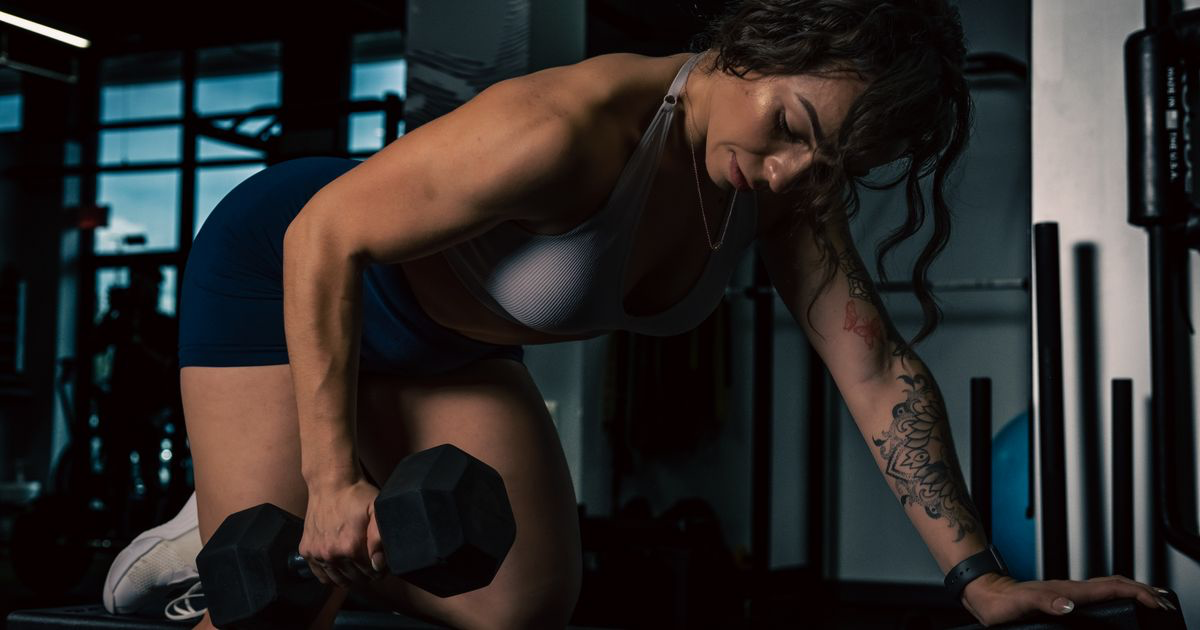
Is Unilateral Training Better Than Bilateral Training?
Quick answer: For strength, probably not. In a 10 week trial by Saeterbakken and colleagues, published 8 June 2026 in the Journal of Functional Morphology and Kinesiology, 34 untrained women trained one arm at a time or both arms together and finished with the same strength. A third group loaded one side 10% heavier and did worse.
Someone in your gym swears by single-arm work. Your weak side stops hiding behind your strong side, the story goes, and the imbalance quietly corrects itself.
Someone else points out that you will never press as much with one arm as with two, so all you have really done is turn one exercise into two and doubled how long the session takes. Both arguments sound reasonable. Until this June, almost nobody had run the experiment.
What the researchers actually did
Forty-one untrained women were recruited in Norway and randomly sorted into three groups. Seven dropped out for reasons unrelated to the study, leaving 34.
Every group did the same five upper-body exercises: seated chest press, seated row, shoulder press, biceps curl and overhead triceps extension. Same sets, same rep targets, same progression, twice or three times a week for 10 weeks. Attendance averaged 23.2 of the 24 sessions.
The only thing that changed was how the load was split:
- Bilateral (BIL). Both arms, same weight each side. The normal way.
- Unilateral (UNI). One arm at a time, the other arm resting with no counterweight.
- Asymmetric (ASY). Both arms at once, but the machine's independent weight stacks were set 10% of total load heavier on the non-dominant side and correspondingly lighter on the dominant side.
Before and after, the researchers tested one-rep max (the heaviest single rep you can do) in chest press and seated row, with both arms and with each arm separately. They also measured isometric peak force, meaning how hard you can push against something that will not move, plus a pallof press for trunk strength.
What did they find?
The two normal approaches came out level. The clever one came out behind.
One arm at a time matched both arms together on chest press
- Bilateral
- Unilateral
- Asymmetric (10% heavier one side)
View the data
| Group | Both arms | Dominant arm | Non-dominant arm |
|---|---|---|---|
| Bilateral | 22.9% | 26% | 33.4% |
| Unilateral | 22.3% | 34.8% | 29.7% |
| Asymmetric (10% heavier one side) | 12.7% | 22.7% | 25.4% |
Read the first cluster of bars and the argument mostly evaporates. Training one arm at a time gained 22.3% on the two-arm chest press. Training both arms gained 22.9%. The gap between them was nowhere near big enough to call (p = 0.481).
The asymmetric group is the interesting one. Their two-arm chest press went up 12.7%, about half of what the other two managed, and that gap was reliable (p = 0.017).
Then the seated row refused to cooperate with any of it.
Seated row gains were the same whichever way the load was split
- Bilateral
- Unilateral
- Asymmetric (10% heavier one side)
View the data
| Group | Both arms | Dominant arm | Non-dominant arm |
|---|---|---|---|
| Bilateral | 26.5% | 26.5% | 30.4% |
| Unilateral | 15% | 18.9% | 17.9% |
| Asymmetric (10% heavier one side) | 28.5% | 29.9% | 29% |
Those unilateral bars are visibly shorter and the authors still could not call it. The closest any row comparison got was p = 0.091 on the two-arm test, which is a way of saying the data were too noisy to separate a real difference from luck. With 11 or 12 people per group, that happens a lot.
Isometric strength told the same flat story. No group beat any other on peak force in the chest press, the row, or the pallof press.
Why did the asymmetric group fall behind?
Not because of anything clever about asymmetry. Because they lifted less.
The asymmetric group moved about 30% less weight over the 10 weeks
- Bilateral
- Unilateral
- Asymmetric (10% heavier one side)
View the data
| Group | Total load lifted across 24 sessions |
|---|---|
| Bilateral | 99642 kg |
| Unilateral | 94857 kg |
| Asymmetric (10% heavier one side) | 76256 kg |
Sets were taken to a rep target, and with an asymmetric load the heavier side hits that target first. The set ends when the loaded arm is done, which the authors estimate left the lighter arm with roughly three to five reps still in the tank.
Every set, on every exercise, for 24 sessions. The de-loaded arm was never really pushed, and total work fell by 30% against the bilateral group. Volume drives strength, so the group that did less got less.
That is the researchers' proposed explanation rather than something they measured directly, and they are honest that it only accounts for the chest press result. The seated row numbers do not fit the story, which is part of why they call this a pilot study.
| Training approach | How each set ran | Total load over 10 weeks | Two-arm chest press gain |
|---|---|---|---|
| Bilateral | Both arms, equal load, one set per exercise | 99,642 kg | 22.9% |
| Unilateral | One arm at a time, two sets per exercise | 94,857 kg | 22.3% |
| Asymmetric | Both arms, 10% of total load shifted to the weaker side | 76,256 kg | 12.7% |
What this study doesn't prove
- These women had never trained properly. Untrained people improve on almost anything, which flattens differences between methods. The authors say so directly and call for the same trial in trained lifters. Your fifth year of lifting will not behave like their first 10 weeks.
- The sample was tiny and the study says so. Eleven or twelve women per group after dropouts. For the two-arm chest press comparison between unilateral and bilateral, the authors calculated their statistical power at 7.2%, meaning the study had almost no chance of spotting a moderate difference even if one existed. "No difference found" is not the same as "no difference".
- It was upper body, on machines. Chest press, row and shoulder press were all seated machines with back support. The stability demand that people credit unilateral work with was largely designed out. Nothing here tells you about single-leg work, and the authors flag free weights as the obvious next test.
- Ten weeks is short for a strength question. Long enough for the neural gains, not long enough to say much about muscle growth, which this study did not measure at all.
- Only one asymmetric dose was tested. Ten percent of total load, on machines with independent stacks. A smaller shift, or a shift applied to only one exercise, might not cost the same volume.
- Funding was clean. The authors report no company funding and no conflicts of interest, which is worth noting given how often training-method studies carry equipment ties.
How to test this in your own training
The study reports group averages over 10 weeks. It cannot tell you what your left shoulder does. That part you have to run yourself.
- Pick one exercise, not your whole program. Take a single pressing or pulling movement and swap it to single-arm for eight weeks. Leave everything else alone, or you will never know what caused what.
- Log both sides separately from day one. "DB row 30kg 3x10" hides the whole question. "DB row L 30x10, R 30x10" answers it. Sides logged as one number cannot be compared later.
- Match the reps, not the feeling. Take both sides to the same rep target with the same load. If the weaker side cannot hit it, that gap is your baseline, and it is the number you are trying to close.
- Budget the extra time honestly. Single-arm work roughly doubles the working sets for that exercise. If your sessions are already tight, that time comes out of something else, and the study found no strength payoff to buy it with.
- Compare after eight weeks, not after two. Estimate a working one-rep max per side using the one rep max calculator at the start and the end. If the sides converged, keep going. If they did not, you have learned something the group average could not tell you.
Tracking left and right without changing how you log
That test only works if you record each arm as its own entry. Most people do not, because in a notes app it means twice the typing and twice the mess.
Gym Note Plus is built for people who want to keep logging in plain text. Write your session the way you already write it, sides and all, and it turns that text into per-exercise trends, so left and right become two lines on a chart instead of a wall of numbers you never reread. If you want to see what that looks like before installing anything, paste a session into the free notes to workout translator.
The study can tell you what 34 women averaged over 10 weeks. Only your own log can tell you whether your weak side is catching up.
Frequently Asked Questions
What did the 2026 study on unilateral vs bilateral training find?
Saeterbakken and colleagues, publishing on 8 June 2026 in the Journal of Functional Morphology and Kinesiology, trained 34 untrained women for 10 weeks. Unilateral and bilateral upper-body training produced the same one-rep max and isometric strength gains. Loading one side 10% heavier produced the smallest chest press improvement of the three groups.
Does unilateral training fix strength imbalances between your arms?
This study found no evidence that it does over 10 weeks. Neither the unilateral nor the bilateral group ended with a measurable difference between their dominant and non-dominant arms in chest press or seated row. Both sides improved at similar rates regardless of how the training load was split.
Is one arm at a time better for building muscle?
The Saeterbakken study did not measure muscle size, only strength and force output, so it cannot answer that. What it does show is that total load lifted tracked closely with strength gains, and single-arm training took two sets to do what one bilateral set did, without accumulating any more volume.
Should you load one side of the barbell heavier to fix an imbalance?
The evidence here points the other way. The asymmetric group in this trial gained 12.7% on the two-arm chest press against 22.9% for standard bilateral training. Because sets ended when the loaded side fatigued, the weaker side finished each set with roughly three to five reps left unused.
Does unilateral training take longer than bilateral training?
Yes, and the authors call bilateral training the more time-efficient option for that reason. Every set becomes two, so a five-exercise session doubles its working sets. Given that this study found no strength advantage, the extra time has to be justified by something else, such as sport-specific demands or rehab.
Does this study apply to squats and single-leg work?
No. Every exercise tested was seated upper body on machines with back support, and the authors list lower-body training as an open question. Bilateral force deficits also behave differently in the legs than the arms, so single-leg findings cannot be inferred from these results.
Final Takeaways
- One arm at a time is not a strength shortcut. After 10 weeks, unilateral and bilateral training landed in the same place on every measure this study took.
- Deliberate asymmetric loading backfired. Shifting 10% of the load to the weaker side cut total training volume by about 30% and halved the chest press gain.
- Volume is still the thing that moves. The group that lifted the most weight over 10 weeks gained the most, which is the least surprising sentence in the paper.
- This is a pilot in untrained women. Small groups, low statistical power, upper body only, machines only. Treat it as a reason not to bother switching, not proof that unilateral work is useless.
- Your own log settles it for you. Track left and right as separate entries for eight weeks and you will have data the study could never give you. Pair it with progressive overload on the exercises you keep bilateral, and read our guide to the seated cable row if you want to try the single-arm version properly.

Josh Ibbotson
Josh is the creator of Gym Note Plus, building tools that make workout tracking as simple as taking notes.
Ready to try it out?
Download Gym Note Plus and start tracking your workouts the way you want.
Download on App Store