
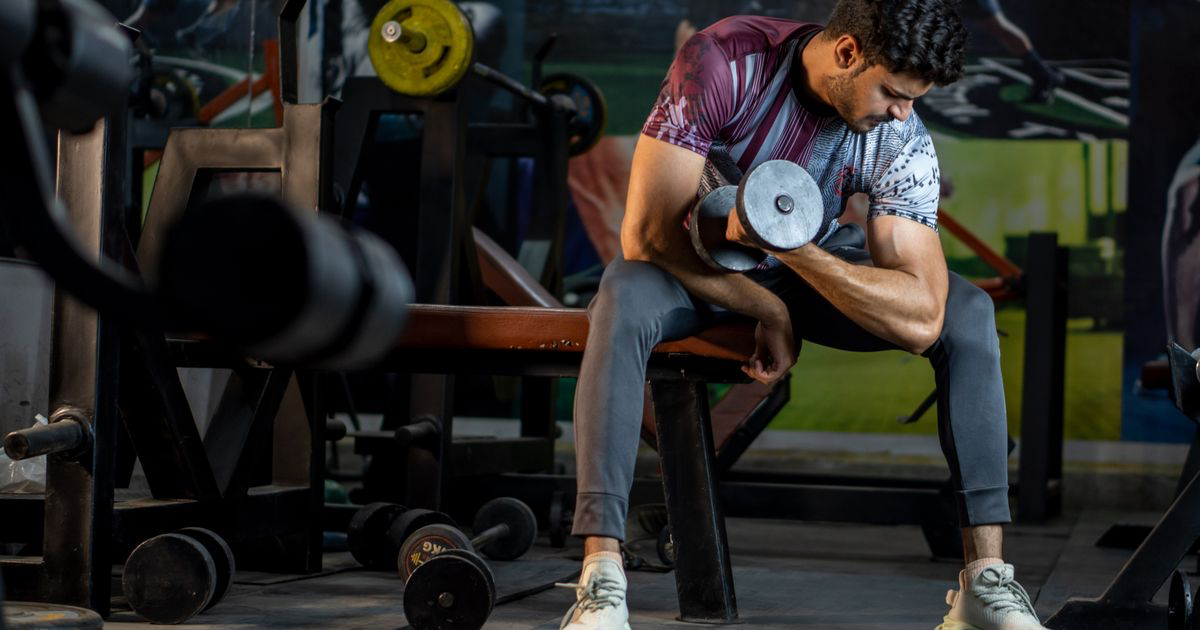
How to Preacher Curl: Form, Muscles Worked and What It Actually Builds
Quick answer: Set the pad so its top edge sits under your armpits, keep your upper arms flat against it throughout, and curl from a near-straight elbow to just short of vertical. The preacher curl locks your shoulders in place, which removes the swing and loads the bottom of the curl hardest.
The preacher bench is the most honest piece of equipment in the gym.
You cannot cheat on it. There is no hip drive, no lean back, no shoulder swing to rescue a rep. Whatever weight you put on the bar is the weight your biceps move, which is exactly why the numbers are humbling and exactly why the exercise is worth doing.
What muscles does the preacher curl work?
Three muscles bend your elbow, and the preacher curl hits all of them with a specific bias.
Biceps brachii. The two-headed muscle on the front of your upper arm. It crosses both the shoulder and the elbow, which is why arm position changes what it does. On a preacher bench your shoulders are flexed forward, so the biceps starts the rep already shortened.
Brachialis. Sits underneath the biceps and originates on the lower half of the humerus. It only crosses the elbow, so shoulder position does not affect it at all. It is a bigger contributor to elbow flexion than most people realise, and pushing it up is what makes an arm look thicker from the side.
Brachioradialis. The forearm muscle running from the elbow toward the thumb. It takes more of the load as your grip rotates toward neutral.
The preacher position matters because of the first two. With the shoulders flexed, the biceps cannot use its full length, but the brachialis is unaffected. That difference shows up in the research.
What does the research say about preacher curls?
A 2025 randomised trial in the International Journal of Sports Medicine by Kassiano and colleagues put 63 young women through eight weeks of twice-weekly training on either the preacher curl or the incline curl, then measured elbow flexor thickness at three points along the arm.
The two exercises grew different parts of the arm.
The preacher curl grew the lower arm more. Distal elbow flexor thickness increased more with preacher curls, by a mean difference of 0.10 cm (95% confidence interval 0.04 to 0.15 cm) over the incline curl.
The incline curl grew the upper arm more. Proximal thickness increased more with incline curls, by 0.08 cm (95% CI 0.02 to 0.13 cm).
Strength followed the exercise you trained. The preacher group added more to their preacher curl three-rep max, by 1.88 kg. The incline group added more to their incline curl, by 0.86 kg. Nobody got better at the movement they did not practise.
The likely explanation, and this is the authors' interpretation rather than something the study measured directly, is anatomical. The distal measurement site captures brachialis as well as biceps, and the brachialis does not care what your shoulder is doing. The preacher position loads the shortened biceps hard at the bottom of the range, which is where the brachialis carries more of the work.
The practical read: preacher and incline curls are not interchangeable. They build different regions. Running both is a reasonable answer.
How do you set up a preacher curl?
Set the pad height first. The top edge of the pad should sit under your armpits when you are seated. Too low and your shoulders round forward and you lose the point of the exercise. Too high and you cannot reach the bar without shrugging.
Sit with your chest against the pad. Not perched off the back of the seat. Your torso should be supported, so the only thing moving is your forearms.
Get your upper arms flat. The whole back of your upper arm, elbow to armpit, in contact with the pad. If your elbows lift off during the set, the weight is too heavy.
Choose your grip. Straight bar for maximum biceps involvement. EZ bar if your wrists complain, which they often do at the bottom of a preacher curl. Dumbbells one arm at a time if you want to work on a side imbalance.
How do you actually perform the rep?
- Start with the elbow nearly straight. Not locked out hard, but close. The bottom of the range is where this exercise earns its keep, and cutting it short turns the preacher curl into a shorter, easier exercise.
- Curl up under control. Two seconds is plenty. The bar should travel in an arc, not get thrown.
- Stop short of vertical. Once your forearms pass roughly 45 degrees, the resistance drops off and you can rest at the top. Stopping a bit early keeps tension on.
- Lower slowly. Three seconds down. The eccentric is where most of the stimulus lives on this movement, and it is also where the injury risk sits.
- Do not bounce out of the bottom. A hard bounce with a straight elbow is how people strain a biceps tendon.
The last point deserves emphasis. The preacher curl puts your biceps in its weakest mechanical position at the point where the load is highest. That combination is productive and it is also the one that hurts people. Control the bottom.
What are the most common preacher curl mistakes?
Elbows lifting off the pad. The single most common one. It turns the movement into a front raise with a curl attached and removes exactly the constraint you came for. Fix it by dropping the weight.
Half reps at the bottom. Stopping at 90 degrees skips the hardest and most useful part of the range. If you cannot straighten out, the weight is wrong.
Pad too low. Rounds the shoulders and shifts the work into your front delts. Check the height every time, because the last person moved it.
Shrugging at the top. A tell that you are pulling with your traps to finish the rep.
Standing up out of the seat. Same problem as elbows lifting. If your hips leave the bench, the set is over.
Going too heavy on principle. Preacher curl numbers are lower than standing curl numbers, by a lot, and that is correct. You removed the cheating. Nobody is watching.
Preacher curl vs other curl variations
| Preacher Curl | Incline Curl | Standing Barbell Curl | Hammer Curl | |
|---|---|---|---|---|
| Shoulder position | Flexed forward | Extended behind | Neutral | Neutral |
| Hardest point of range | Bottom, arms extended | Bottom, biceps stretched | Middle | Middle |
| Biased toward | Distal arm, brachialis | Proximal biceps | Whole movement | Brachialis, brachioradialis |
| Cheating possible | Almost none | Very little | Easy | Moderate |
| Loadable | Moderate | Light | Heavy | Moderate |
The takeaway from that table is that preacher and incline curls are complementary rather than competing. Our guides to the standing bicep curl and the hammer curl cover the other two columns properly.
If you want more on why the stretched positions matter, stretch-mediated hypertrophy covers which muscles respond to being loaded at length, and the biceps is one of the interesting cases.
A simple starting plan
- Start at half your standing curl weight. Genuinely. If you curl 40 kg standing, start at 20 kg on the preacher bench and expect it to be hard.
- Run 3 sets of 8 to 12 reps, twice a week. That is the protocol from the Kassiano trial, and it is a reasonable place to begin.
- Add reps before you add weight. Get all three sets to 12 with clean form, then add the smallest increment available and start again at 8.
- Pair it with an incline or standing curl. The research says they build different regions, so covering both is the low-risk choice.
- Log the weight and reps every set. Preacher curl progress is slow and small. Without a record you will not notice it happening.
Once you have a solid top set, the one rep max calculator turns it into a single number you can watch across months rather than sessions.
Where should you record your curl numbers?
| Physical Notebook | Notes App | Traditional Gym App | Gym Note Plus | |
|---|---|---|---|---|
| Logging speed | Fast | Fast | Slow, form-based | Fast, type a line |
| Data visualization | None | None | Charts | Charts from plain text |
| Accessory lifts included | Yes | Yes | Often skipped | Yes |
| Searchability | None | Text search only | Structured | Structured |
| Flexibility | Total | Total | Limited to presets | Total |
Notebooks and notes apps are quick enough that you actually record the arm work. What neither can do is answer "has my preacher curl gone up since March", which is the only question that matters on a lift that moves in 1.25 kg increments.
Logging arm work without it becoming admin
Arm accessories are the sets most people stop recording. They are at the end of the session, the weights are small, and tapping through an app's exercise picker for the fourth time feels absurd.
So they go untracked, and six months later you cannot say whether your preacher curl has moved at all.
Gym Note Plus takes the other route: type the line, get the data.
- Write
Preacher Curl 25kg - 12, 10, 9and it parses into sets, reps and weight - Per-exercise history, so this month's curls sit next to last month's
- Automatic personal record detection on accessory lifts as well as the big three
- Handles drop sets and to-failure notes without a special mode
Try it with an old session in the free notes to workout translator before installing anything.
The preacher curl is not a heavier curl. It is an honest one, and the number it gives you is the number your biceps actually moved.
Frequently Asked Questions
What muscles does the preacher curl work?
The preacher curl trains the elbow flexors: biceps brachii, brachialis and brachioradialis. Because the preacher bench holds the shoulders flexed forward, the biceps works from a shortened position, and research suggests the exercise biases growth toward the distal, lower portion of the arm where the brachialis sits.
Is the preacher curl better than the standing barbell curl?
Neither is better overall. The preacher curl removes body English and loads the bottom of the range hardest, so it is more honest and easier to progress cleanly. The standing barbell curl allows heavier loads and more total work. Most lifters benefit from having one of each.
Preacher curl or incline curl for bigger biceps?
Both, if you can. A 2025 trial by Kassiano and colleagues found preacher curls grew the distal elbow flexors more while incline curls grew the proximal region more, over eight weeks in 63 participants. They develop different parts of the arm, so running both covers more ground.
Why is my preacher curl so much weaker than my normal curl?
Because the preacher bench removes every way of cheating. There is no hip drive, no lean back and no shoulder swing, and the hardest point of the range sits where your biceps has the least leverage. Expect roughly half your standing curl weight, and treat that as correct rather than a problem.
Should you go all the way down on a preacher curl?
Yes, but under control. The bottom of the range is where the preacher curl produces most of its stimulus, so stopping at 90 degrees wastes the exercise. Never bounce out of a straight-arm position, since that combination of full stretch and high load is where biceps tendon strains happen.
How many sets of preacher curls should I do?
Three sets of 8 to 12 reps, twice a week, is a sensible starting point and matches the protocol used in the 2025 preacher curl trial. Count those sets toward your weekly total for biceps rather than adding them on top of an already high arm volume.
Final Takeaways
- Set the pad under your armpits and keep your upper arms flat. Elbows lifting off means the weight is too heavy.
- The bottom of the range is the point. Full extension under control, no bouncing.
- Preacher and incline curls build different regions. Research found distal growth from preacher curls and proximal growth from incline curls.
- Expect a low number. Roughly half your standing curl, because nothing is helping you.
- Log the small lifts too. Arm progress is slow enough that only a record will show it.

Josh Ibbotson
Josh is the creator of Gym Note Plus, building tools that make workout tracking as simple as taking notes.
Ready to try it out?
Download Gym Note Plus and start tracking your workouts the way you want.
Download on App Store