
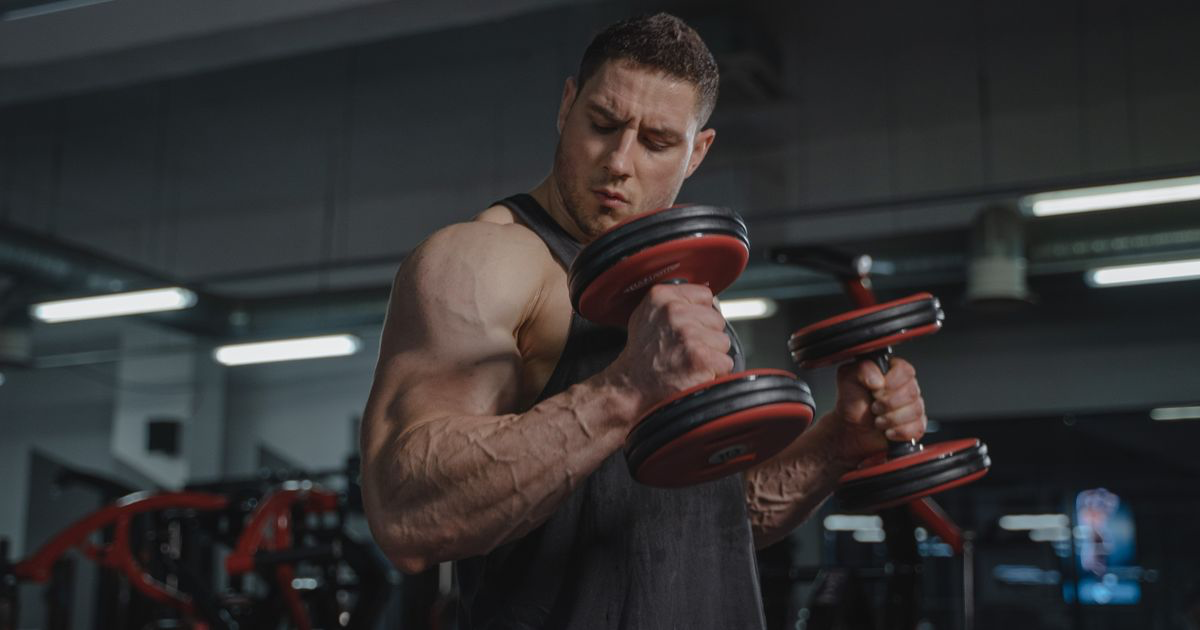
How to Do a Bicep Curl Properly
Quick answer: Stand tall with dumbbells at your sides, palms forward, elbows tucked against your ribs. Curl the weight up by bending only at the elbow, pause briefly at the top, then lower under control over two to three seconds. Keep your upper arms still throughout. Three sets of 8 to 12 reps is a sensible default.
The bicep curl is the most performed and most butchered exercise in any gym. Swinging hips, shrugging shoulders, elbows drifting forward, weight that lands the moment it starts descending.
Almost none of that is a strength problem. It is usually a weight-selection problem wearing a disguise.
How do you perform a bicep curl with good form?
The whole movement happens at one joint. If your shoulders, hips or lower back are contributing, the biceps are getting less work, not more.
- Set up. Stand with feet hip-width apart, a dumbbell in each hand, arms hanging at your sides, palms facing forward. Brace your midsection lightly.
- Pin your elbows. Tuck them against your ribs. They stay there for the entire set.
- Curl up. Bend at the elbow and bring the dumbbell toward your shoulder. Take roughly one second going up.
- Pause at the top. A brief squeeze, with the elbow fully bent but the upper arm still vertical.
- Lower slowly. Take two to three seconds on the way down until the arm is fully straight. This half of the rep matters as much as the lift.
- Reset and repeat. No bouncing out of the bottom.
Full range means full range at both ends. Straighten the arm completely at the bottom. Stopping short is the most common way lifters quietly reduce the effectiveness of every rep they do.
What muscles does a bicep curl work?
Three elbow flexors, not one. The biceps brachii gets the credit, but it is doing the job with help.
- Biceps brachii. The two-headed muscle on the front of the upper arm. It crosses both the elbow and the shoulder, which is why arm position changes what a curl does.
- Brachialis. Sits underneath the biceps. Developing it pushes the biceps up and adds visible arm thickness.
- Brachioradialis. The forearm muscle running from elbow to wrist, most involved in hammer and reverse curls.
Grip changes the mix. Palms-up (supinated) curls emphasise the biceps, neutral-grip hammer curls shift work toward the brachialis and brachioradialis, and palms-down reverse curls load the forearm hardest.
Curls are isolation work by definition, which affects where they belong in a session. Our guide to compound vs isolation exercises explains why they go at the end.
What are the most common bicep curl mistakes?
Most of them trace back to lifting a weight you cannot actually curl.
- Swinging the hips. If your torso rocks to start the rep, momentum is doing the first third of the lift. Drop the weight by 20 percent.
- Elbows drifting forward. Once your elbow travels ahead of your ribs, the front delt takes over the top half of the movement.
- Dropping the negative. Letting the weight fall discards the lowering phase, which is where a large share of the growth stimulus lives.
- Half reps at the bottom. Stopping at a 45-degree elbow angle keeps constant tension on, but it also trains a fraction of the muscle's range.
- Shrugging at the top. Traps joining in means the weight is winning.
- Too much volume, too little effort. Twelve easy sets of curls do less than four hard ones. See junk volume for the wider version of this problem.
A simple test: if you cannot pause the weight halfway down for a full second, it is too heavy for the version of the exercise you are trying to do.
Which bicep curl variation should you use?
More than one, because arm position changes what grows. The biceps crosses the shoulder as well as the elbow, so where your upper arm sits determines how stretched the muscle is during the set.
That distinction is not theoretical. A 2025 study in the International Journal of Sports Medicine had 63 women train either the preacher curl (shoulder flexed, biceps shortened) or the incline curl (shoulder extended, biceps lengthened) twice a week for eight weeks. The two produced distinct regional results: the incline curl grew the proximal (upper) portion of the elbow flexors more, while the preacher curl grew the distal (lower) portion more.
| Variation | Arm position | Best for |
|---|---|---|
| Standing dumbbell curl | Neutral | General default, easy to load |
| Incline dumbbell curl | Shoulder extended, biceps stretched | Upper biceps development |
| Preacher curl | Shoulder flexed, biceps shortened | Lower biceps, strict form |
| Hammer curl | Neutral grip | Brachialis and brachioradialis, arm thickness |
| Cable curl | Neutral, constant tension | Even resistance through the range |
Pick two and run them for a couple of months. One stretched-position variation (incline or cable behind the body) plus one hammer variation covers the bases without turning arm day into a menu.
The stretched-position finding fits a wider pattern in recent training research, covered in stretch-mediated hypertrophy.
How many sets and reps should you do?
Three to four hard sets of 8 to 15 reps, twice a week. Curls respond well to moderate loads, and the small joint involved means very heavy triples are more risk than reward.
Some practical numbers:
- Reps: 8 to 15. Heavy enough to matter, light enough for strict form. Rep ranges explained has the reasoning.
- Sets: 3 to 4 per session for direct biceps work, on top of what rows and pulldowns already provide.
- Frequency: twice a week. Biceps recover quickly.
- Effort: 0 to 1 reps in reserve on the last set. Isolation work is where taking a set close to failure is safe and worthwhile. See what RIR means in the gym.
- Rest: 60 to 90 seconds. Long enough that the later sets do not collapse.
Remember your pull days already train biceps. Every row and pulldown loads the elbow flexors, so direct curls are supplementary volume rather than your entire arm budget. How many sets per week to build muscle covers the accounting.
How should you track your curls?
Write the weight and the reps you actually got. Curls stall more often than any other lift, mostly because the jumps between dumbbells are large and nobody keeps records precise enough to notice.
Going from 12kg to 14kg is a 17 percent increase, which you will not manage by simply trying harder. Rep progression is how you bridge it: 12x10,9,8 becomes 12x12,11,10 over a few weeks, and then 14kg is achievable. Without a log you cannot see that bridge being built.
| Physical Notebook | Notes App | Traditional Gym App | Gym Note Plus | |
|---|---|---|---|---|
| Logging speed | Fast | Fast | Slow (menus and forms) | Fast (plain text) |
| Recalls last curl weight | Flip back and hunt | Scroll and hunt | Yes | Yes, automatically |
| Data visualization | None | None | Charts | Charts from your own notes |
| Flexibility | Total | Total | Low | Total |
| Searchability | Poor | Decent | Good | Good |
If you already type sets into your phone, paste a session into the free notes to workout translator and see the text become structured sets and charts.
A simple starting plan
- Pick two variations for the next eight weeks: one stretched position (incline or cable) and one hammer curl.
- Choose a weight you can pause mid-rep. If you cannot stop it halfway down, go lighter.
- Do 3 sets of 10 to 12 on each, with the last set taken close to failure.
- Log real numbers every session, for example
Incline curl 12x12,10,9. - Progress by reps first, weight second. Hit 12 on all three sets, then move up a dumbbell and rebuild from 8, following when to increase weight lifting.
Where does Gym Note Plus fit in?
Your notes app already handles the writing. Curl 12x12,10,9 takes five seconds to type, and no gym app's exercise picker will ever beat that.
The problem is that curls are exactly the lift where you need history. Dumbbell jumps are big, progress is measured in single reps, and "was I on 12 or 14?" is a question people answer wrong every week.
Gym Note Plus keeps the typing and adds the memory:
- Type
Curl 12 3x10and it logs three sets of ten at 12kg without a single dropdown. - Last session's curl weight appears when you start the exercise.
- Charts show rep progress at a fixed weight, which is how curl progress actually happens.
- Variations stay separate, so incline and hammer curls track independently.
Curling is easy. Curling strictly, with a weight you have actually earned, and keeping records good enough to know when you have earned the next one, is the hard part.
Frequently Asked Questions
What muscles do bicep curls work?
Bicep curls train the three elbow flexors: the biceps brachii on the front of the upper arm, the brachialis underneath it, and the brachioradialis in the forearm. Grip determines the emphasis. A palms-up curl loads the biceps most, a neutral-grip hammer curl shifts work to the brachialis and brachioradialis.
How many bicep curls should I do per workout?
Three to four working sets of direct curl work per session is sufficient for most lifters, performed twice a week. Rows and pulldowns already train the biceps heavily, so direct curls act as supplementary volume. Adding many more sets tends to add fatigue without adding growth.
Should I go heavy or light on bicep curls?
Moderate loads in the 8 to 15 rep range work best for bicep curls. The elbow is a small joint and very heavy curls almost always recruit momentum from the hips and shoulders. A useful test of an appropriate weight is whether you can pause the dumbbell halfway through the lowering phase for one full second.
Are hammer curls better than regular curls?
Neither is better; they train different muscles. Regular supinated curls emphasise the biceps brachii, while hammer curls use a neutral grip that loads the brachialis and brachioradialis more. Because the brachialis sits beneath the biceps, developing it adds arm thickness, so most programs include both variations rather than choosing.
Why are my biceps not growing from curls?
The usual causes are momentum, partial range of motion, and insufficient effort. Swinging the weight up transfers work away from the biceps, stopping short of a straight arm trains only part of the range, and sets stopped several reps shy of failure provide a weak stimulus. Logging your sets reveals whether load is actually progressing.
Is the incline curl or preacher curl better?
They produce different regional growth. Research comparing eight weeks of preacher curls against incline curls found the incline curl, which trains the biceps in a stretched position, produced greater growth in the upper portion of the elbow flexors, while the preacher curl produced greater growth in the lower portion. Including both covers the whole muscle.
How long does it take to see bigger arms from curls?
Visible arm growth typically takes two to three months of consistent training with progressive overload, and measurable strength gains appear sooner. Progress on curls is usually gradual because dumbbell increments are large, so rep increases at a fixed weight are the more reliable early indicator that training is working.
Final Takeaways
- Only the elbow should move. Pin the upper arms to your ribs and eliminate hip swing entirely.
- The lowering phase counts. Take two to three seconds down and straighten the arm fully at the bottom.
- Arm position changes what grows. Stretched-position curls like the incline curl and shortened-position curls like the preacher curl produce different regional development, so use both.
- 3 to 4 hard sets of 8 to 15 reps, twice a week is plenty on top of your pulling work.
- Progress by reps before weight. Dumbbell jumps are large, so keep a record precise enough to see rep progress, whether on paper, in notes, or in Gym Note Plus.

Josh Ibbotson
Josh is the creator of Gym Note Plus, building tools that make workout tracking as simple as taking notes.
Ready to try it out?
Download Gym Note Plus and start tracking your workouts the way you want.
Download on App Store