
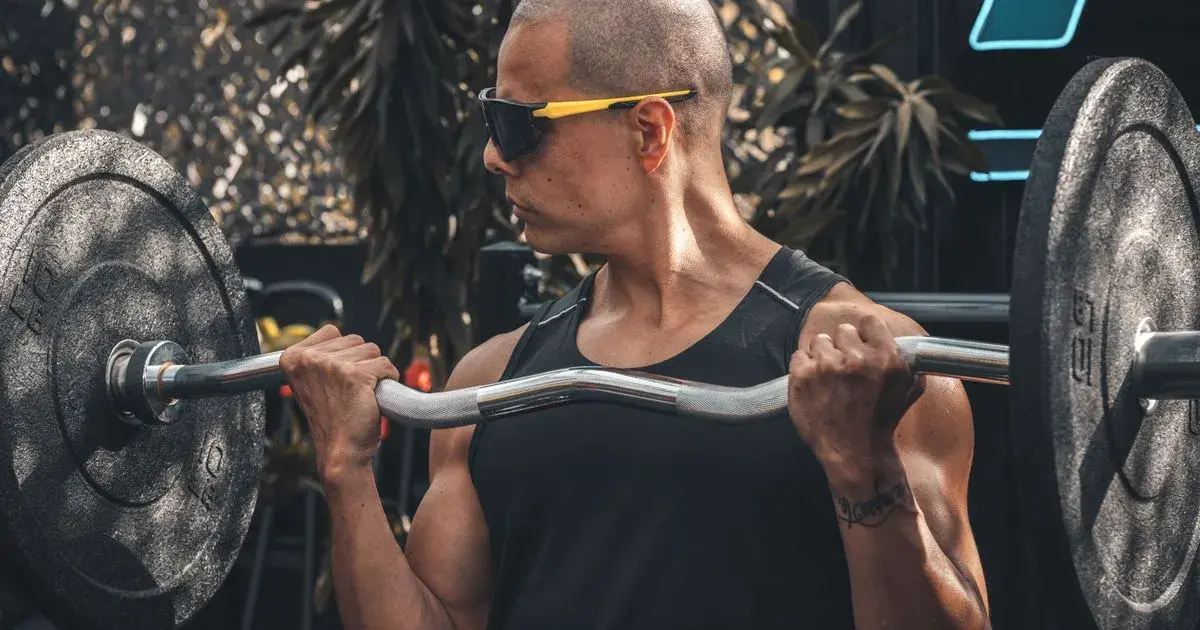
Cheat Reps: When They Help and When They Hurt Your Gains
Quick answer: A cheat rep is a rep finished with momentum from muscles the exercise is not meant to train, like swinging your hips on a curl. In a 2025 trial, cheated curls and pushdowns built similar arm muscle to strict ones. Cheat reps work as a finisher on isolation lifts, but not as cover for a weight that is too heavy.
The curl was 12.5kg dumbbells for ten clean reps last month. This week you wrote 15kg for ten. The weight went up, but you also leaned back on the last four reps and swung the dumbbells up off your hips.
Are you stronger, or did you just start counting a different kind of rep? Your notes can't tell you, because they don't say.
What is a cheat rep?
A cheat rep is a rep completed with help from momentum or muscles outside the target. Researchers call this "external momentum": force put into the weight by body parts the exercise is not meant to train.
Common examples:
- Cheat curls. Leaning back and driving with the hips to swing the bar past the sticking point.
- Cheat lateral raises. A small knee bend and shrug to kick the dumbbells up.
- Cheat rows. Jerking the torso upright to yank the weight to your stomach.
- Cheat pushdowns. Leaning over the bar and pushing down with bodyweight.
A cheat rep is not the same as a forced rep. With forced reps, a spotter gives you the extra push after failure. With cheat reps you give yourself the push, using your own hips, legs or torso.
Do cheat reps build muscle?
Cheat reps built about the same muscle as strict reps in the only direct trial so far. The research is thin. Two studies make up most of it.
The first was a computer simulation. In a paper published online in 2012, Ognjen Arandjelović modelled the shoulder lateral raise in the European Journal of Applied Physiology. In his model, a moderate swing at the start of the rep increased torque on the target muscles even when the load stayed the same. Excessive momentum did the opposite and reduced the demand on the target muscles.
The second tested real people. In a 2025 study in the International Journal of Exercise Science, Augustin and colleagues (including Brad Schoenfeld and Jeff Nippard) had 30 untrained young adults train one arm strict and the other arm with momentum. Each arm did four sets of 8 to 12 reps of curls and triceps pushdowns to failure, twice a week, for eight weeks.
The result: muscle thickness and arm circumference grew by similar amounts on both arms. The cheating arm moved markedly more total weight every week, but it grew no more.
The authors were clear about the limits:
- The lifters were untrained. Experienced lifters may respond differently.
- The cheat arm cheated on every rep. Nobody tested the bodybuilder style of strict reps first and cheat reps after failure. The authors flagged that as worth studying.
- Cheat form was hard to standardise, because each person swung a little differently.
In short, cheat reps neither hurt nor helped growth in one eight-week study of beginners doing arm isolation work.
When do cheat reps actually help?
Cheat reps help most at the end of a set of an isolation exercise, after the strict reps are done. Used that way, a cheat rep works like an extension of the set past the point where strict form fails.
Places where a little cheating is reasonable:
- Barbell or EZ-bar curls, for the last one or two reps of a set.
- Dumbbell lateral raises, with a small knee dip to get past the bottom of the rep.
- Cable pushdowns and rows, where a short body lean adds a rep or two.
On each of these the extra load is light and the joints involved are not under heavy spinal loading. Lower the weight slowly on every cheat rep. A controlled lowering phase keeps tension on the muscle you are trying to train.
This is close to how other intensity techniques work, such as rest-pause sets and drop sets. They all add reps after the point where a normal set would end.
When do cheat reps hurt your gains?
Cheat reps hurt when they become the whole set instead of the end of it. If every rep needs a swing, the weight is too heavy for the muscle you meant to train.
Three problems follow:
- You lose track of real progress. The cheating arm in the 2025 study moved far more weight without growing more. Bigger numbers from swinging say little about whether the target muscle is getting stronger.
- The work shifts to other muscles. In the 2012 simulation, past a moderate amount, more momentum meant less demand on the target muscles.
- Risk moves to your back and joints. A hard swing on a heavy curl puts your lower back in a position it was not braced for. Cheating on squats, deadlifts and bench press is a different matter: those are heavy enough that breaking form can cause real injury.
A simple rule: if you can't do at least six strict reps with the weight, it is too heavy to cheat with. Drop it and earn the extra load with strict sets first.
Should you log cheat reps?
Yes, and log them separately from strict reps. Writing "15kg x 10" when four of those reps were swung is how lifters end up confused about why the 15s feel easy one week and impossible the next.
A short notation solves it. Put the strict reps first, then add the cheat reps with a plus sign and a label:
Barbell curl
30kg 10, 9, 8 + 2 cheat
Lateral raise
10kg 12, 11 + 3 cheat, 10 + 3 cheat
Now your history can tell the two apart. If your strict reps rise from 8 to 10 at the same weight, you got stronger. If only the cheat count went up, you got better at swinging.
The same logic applies to strength estimates. If you plug a set into the one rep max calculator, use a strict set, not one padded with cheat reps, or the estimate will be inflated.
For more on recording effort honestly, see training to failure, which covers logging how close each set came to the limit.
How do common logging methods handle cheat reps?
| Feature | Physical Notebook | Notes App | Traditional Gym App | Gym Note Plus |
|---|---|---|---|---|
| Logging speed | Fast | Fast | Slower (fields and menus) | Fast (plain text) |
| Marking cheat reps | Any shorthand you like | Any shorthand you like | Usually needs a note field | Typed inline with the set |
| Data visualization | None | None | Charts | Charts from your notes |
| Flexibility | Total | Total | Limited to the app's fields | Total |
| Searchability | Poor | Decent | Good | Good |
A simple starting plan
- Pick one or two isolation lifts where you want to try cheat reps, such as curls or lateral raises.
- Do your strict sets first. Stop when strict form breaks, then add one to three controlled cheat reps on the last set only.
- Lower every cheat rep slowly, taking two to three seconds on the way down.
- Log strict and cheat reps separately, using a "+ 2 cheat" style note after the strict count.
- Review after four weeks. Increase the weight only when your strict reps reach the top of your rep range.
Keep your cheat reps honest in the notes you already use
Logging in a notes app or a notebook works fine for this. Plain text is fast, and a shorthand like "+ 2 cheat" takes two seconds to type.
The weak spot is reading it back. Ten weeks of curl notes in a notes app won't show you whether your strict reps are climbing or your cheat count is doing all the work.
Gym Note Plus keeps the plain-text habit and handles that part:
- Type the set the way you already write it and it becomes history, charts and personal records for each lift.
- Your shorthand stays in the note, so the "+ 2 cheat" you wrote is still there when you look back.
- Charts per exercise show whether the working weight is actually moving.
Want to see what your own shorthand looks like as structured data? Paste a session into the free notes to workout translator.
A cheat rep is fine. A cheat rep you wrote down as a strict rep makes your progress look better than it is.
Frequently Asked Questions
Are cheat reps bad?
Cheat reps are not bad when used sparingly. A 2025 International Journal of Exercise Science trial found cheated curls and pushdowns built similar arm muscle to strict reps over eight weeks. Cheat reps become a problem when every rep needs a swing, when they are used on heavy compound lifts, or when they are logged as strict reps.
What is the difference between cheat reps and forced reps?
Cheat reps and forced reps both extend a set past failure, but the help comes from different places. With cheat reps, the lifter adds momentum using their own hips, legs or torso. With forced reps, a spotter gives the bar a light assist so the lifter can finish a few more reps.
Do cheat curls build bigger biceps?
Cheat curls have not been shown to build bigger biceps than strict curls. In the 2025 study by Augustin and colleagues, the arm trained with momentum moved more total weight but grew about the same as the strict arm. Cheat curls are a reasonable finisher after strict reps, not a replacement for them.
Which exercises can you use cheat reps on?
Cheat reps suit isolation exercises with light loads, such as barbell curls, dumbbell lateral raises, cable rows and triceps pushdowns. Avoid cheat reps on squats, deadlifts, bench press and overhead press, where the load is heavy enough that breaking form can cause injury. Keep the swing small and lower every rep under control.
How should you write cheat reps in a workout log?
Write the strict reps first, then add cheat reps with a plus sign and a label, for example "30kg 10, 9, 8 + 2 cheat". Separating strict and cheat reps in a workout log lets you see whether strict strength is rising or only the cheat count is growing.
Final Takeaways
- A cheat rep uses momentum from outside the target muscle, usually the hips, legs or torso.
- The one direct trial found no difference in muscle growth between cheated and strict arm training, in beginners over eight weeks.
- Use cheat reps as a finisher, on the last set of an isolation lift, after strict form breaks.
- Skip them on heavy compound lifts, where breaking form carries real injury risk.
- Log cheat reps separately so your strict numbers stay an honest record of progress.

Josh Ibbotson
Josh is the creator of Gym Note Plus, building tools that make workout tracking as simple as taking notes.
Ready to try it out?
Download Gym Note Plus and start tracking your workouts the way you want.
Download on App Store