
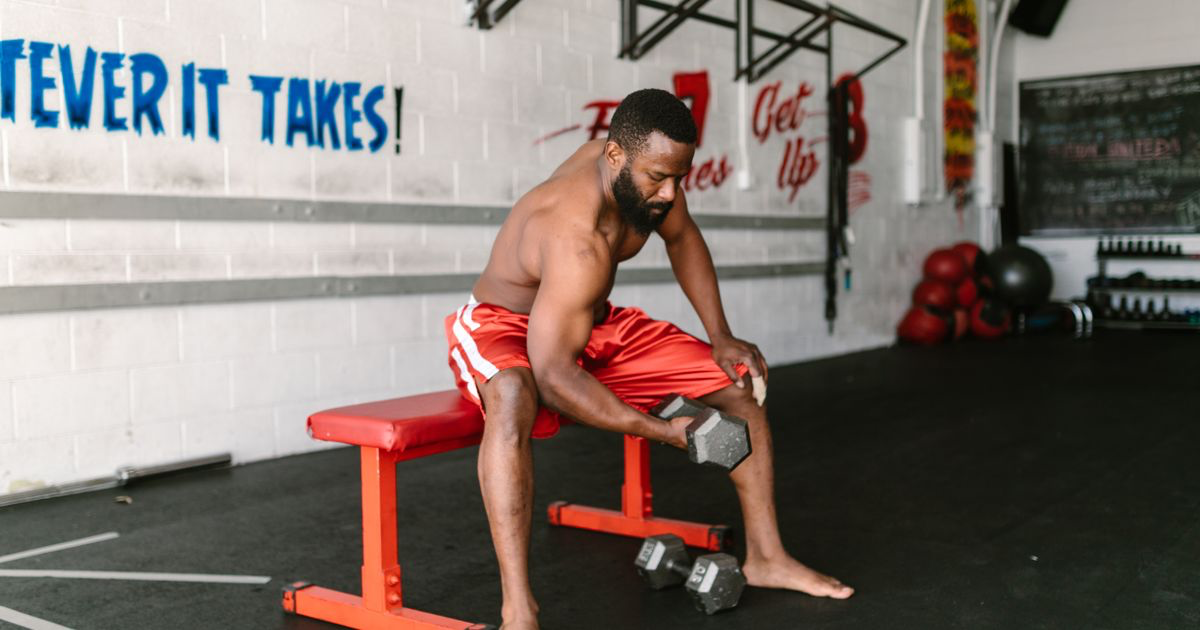
How to Hammer Curl: Form, Muscles Worked and How to Progress
Quick answer: Hold a dumbbell in each hand with your palms facing each other, elbows tucked at your sides. Curl one or both dumbbells up without letting your elbow drift forward, pause briefly at the top, then lower under control for two to three seconds. The hammer curl trains the brachioradialis and brachialis hardest, with the biceps assisting.
The hammer curl is what people do when the bicep curl gets boring, and then they log both under "curls" and lose the thread entirely.
It is a different exercise. Not dramatically, but enough that the loads will not match and enough that the arm it builds looks different.
What muscles does the hammer curl work?
Three elbow flexors, in a different balance from a normal curl.
- Brachioradialis. The muscle that runs from the outside of your elbow into your forearm and gives the arm its thickness from the side.
- Brachialis. Sitting underneath the biceps, pushing it up as it grows.
- Biceps brachii. Still involved, just not the star. The neutral grip parks the biceps at a mechanical disadvantage for supination, which is half of what it does.
Caufriez and colleagues studied all three in the Journal of Hand Surgery, recording surface EMG in 15 healthy men doing resisted elbow flexion with the forearm neutral, fully pronated and fully supinated. All three muscles were highly active in every forearm position, and the brachioradialis peaked at the end of flexion in nearly three quarters of subjects. Their conclusion was that the brachioradialis is a primary elbow flexor, not the forearm supinator it is usually filed under.
Practically: the hammer curl is not a brachioradialis isolation exercise. It is an elbow flexion exercise where the brachioradialis and brachialis carry more of the load than they do in a supinated curl.
How do you hammer curl with good form?
- Stand tall with a dumbbell in each hand. Palms facing your thighs, arms straight, shoulders back and down.
- Pin your elbows to your ribs. They stay there. If your elbow travels forward, your front delt has joined in.
- Curl without rotating. Palms stay facing each other the entire rep. That is the whole point of the variation.
- Stop before your forearm is vertical. Past that, the load falls on the joint rather than the muscle.
- Lower for two to three seconds. Most of the growth stimulus is in this half and most people throw it away.
- Finish with your arm properly straight. Not locked and shaking, just fully extended. Short reps at the bottom are the most common way to make a curl useless.
Breathe out on the way up. Nobody needs to hold their breath for a curl.
Should you do hammer curls one arm at a time or both?
Alternating is usually better. Curling both at once tempts you to lean back and use momentum, because the load is symmetrical and your body can rock as one unit.
Alternating gives each arm a rest, lets you watch the elbow that is working, and makes cheating obvious. The cost is a longer set.
Do both together when you are short on time, and only if you can do it without swinging.
Does range of motion matter on a hammer curl?
Yes, and the stretched end matters most.
Sato and colleagues, publishing in Frontiers in Physiology, had 32 untrained adults train elbow flexors for five weeks through the same size range of motion but at different joint angles. One group trained from 0 to 50 degrees (arm near straight), the other from 80 to 130 degrees (arm already bent). Only the extended-angle group gained strength, and its muscle thickness rose 8.9% against 3.4% for the flexed group.
Havers and colleagues found something similar in trained lifters in the European Journal of Sport Science, where partial reps kept in the stretched portion of a preacher curl matched full-range training for growth and slightly beat it at one measurement site. Full range still won on strength at the shortened position and on one rep max.
The takeaway is not "do partials". It is that the bottom of the rep is where the work is. Cutting the last twenty degrees of extension to keep the weight moving is the worst trade in arm training.
What are the most common hammer curl mistakes?
Elbows drifting forward. Once the elbow moves in front of the ribs, the front delt takes the load and the rep gets easier. Film a set from the side and watch the elbow, not the dumbbell.
Half reps at the bottom. Stopping short of straight cuts out exactly the range the research says matters most.
Swinging from the hips. If your torso moves, the dumbbell is too heavy. Hammer curls do not need to be heavy to work.
Rotating into a normal curl at the top. Easy to do without noticing when the set gets hard. At that point you are doing a different exercise and your log says otherwise.
Logging them as "curls". Hammer and supinated curls do not share a load. Merge them and neither number means anything.
Hammer curl vs bicep curl: which should you do?
| Hammer curl | Supinated bicep curl | |
|---|---|---|
| Grip | Neutral, palms facing | Palms up |
| Main movers | Brachioradialis, brachialis | Biceps brachii |
| Visual effect | Arm thickness from the side | Peak height |
| Usable load | Slightly heavier for most | Slightly lighter |
| Wrist comfort | High | Lower for some lifters |
| Grip carryover | Better | Limited |
Do both. They are not alternatives, they are two thirds of a complete arm. Our how to bicep curl guide covers the supinated version, and compound vs isolation exercises explains where curls fit in a week that already has rows and pulldowns in it.
What about cross-body hammer curls?
Curling across your body toward the opposite shoulder is a common variation. It changes the line of pull slightly and many lifters find it more comfortable. There is no evidence it builds more muscle than a straight hammer curl. Use whichever one lets you keep the elbow still.
Why do hammer curls get logged badly?
Because dumbbell arm work produces the messiest data in the gym.
The jumps are too big. Going from 12kg to 14kg is a 17% increase on a lift where you might add one rep a month. Our post on dumbbell weight jumps that are too big covers what to do about that.
Then there is the naming problem. "Curls 14kg 10,10,8" six weeks apart could be two different exercises with two different loads and no way to tell.
Write which curl it was, every time. hammer curl 14kg 10,10,8 takes one extra word.
| Physical notebook | Notes app | Traditional gym app | Gym Note Plus | |
|---|---|---|---|---|
| Logging speed | Fast | Fast | Slow, many taps | Fast, plain text |
| Room for variation notes | Total | Total | Rarely | Total, free text |
| Keeps hammer and supinated apart | If you remember | If you remember | Yes, if you pick the right entry | Yes, from your own wording |
| Turns loads into a trend | No | No | Yes | Yes, automatic |
| Handles per-arm reps | Manual | Manual | Sometimes | Yes, in free text |
A simple starting plan
- Pick a weight you can control for twelve strict reps. If your torso moves on rep one, go lighter.
- Run three sets of ten to fifteen, alternating arms. Arms recover fast, so take these close to failure.
- Lower for three seconds on every rep. Set a rule and stick to it, because tempo drift is invisible in a log.
- Add reps before weight. Get all three sets to fifteen, then move up one dumbbell and start again at ten.
- Write the variation and the tempo. Not "curls 14". Something like "hammer curl 14kg 12,11,9, 3s down". Reassess every four weeks.
Keep logging the way you already do
If you log in Apple Notes or a notebook, you already write the detail that machines-first apps drop: which curl, which arm, how the last two reps looked.
The problem is that free text never becomes a line on a chart.
Gym Note Plus keeps the typing and adds the memory.
- Type
hammer curl 14kg 12,11,9and it becomes structured, charted sets. - Hammer and supinated curls stay as separate exercises, tracked separately.
- Notes on tempo, arm and rep quality stay attached to the session.
- Old notes import, so your existing arm history comes with you.
Want to see it on your own text first? Paste your last arm session into the free notes to workout translator.
A hammer curl and a bicep curl are two exercises. Log them as one and you have thrown away the only record of which one was working.
Frequently Asked Questions
What muscles does the hammer curl work?
The hammer curl trains the brachioradialis and brachialis hardest, with the biceps brachii assisting. The neutral grip keeps the forearm in a mid-position, which reduces the biceps' mechanical advantage. Research in the Journal of Hand Surgery found the brachioradialis is highly active throughout resisted elbow flexion and peaks near the end of the range.
Are hammer curls better than regular bicep curls?
Neither is better outright. Hammer curls emphasise the brachioradialis and brachialis, which add thickness to the arm viewed from the side. Supinated curls emphasise the biceps brachii, which adds peak. Most lifters get the best result from doing both, either in the same session or on alternating weeks.
Should you go heavy on hammer curls?
Not particularly. Elbow flexors respond well to eight to twenty reps taken close to failure, and heavier loads on a curl mostly recruit your hips and shoulders. Pick a weight you can control through a full range with your elbow pinned to your ribs, then add reps before adding kilos.
How far down should you lower a hammer curl?
All the way to a straight arm. Research in Frontiers in Physiology found that elbow flexor training near full extension produced 8.9% muscle thickness gains against 3.4% for training in the bent-arm range, using the same size range of motion. Cutting the bottom of the rep removes the most productive part.
How many hammer curls should you do per week?
Six to twelve hard sets of direct elbow flexion work per week suits most lifters, split across two or three sessions. That total includes supinated curls and any hammer variation. Rows and pulldowns already train the elbow flexors, so count those as partial credit rather than adding curls on top of a heavy pulling week.
Final Takeaways
- It is an elbow flexion lift, not a biceps lift. Brachioradialis and brachialis lead, biceps assist.
- The elbow stays at your ribs. Once it drifts forward the exercise has changed and the log stops being true.
- The bottom of the rep matters most. Training near full extension produced more than double the thickness gain of bent-arm training in one trial.
- Alternate arms if you swing. Symmetrical loading invites momentum.
- Log the variation. "Hammer curl 14kg" and "curl 14kg" are two different records, and merging them destroys both.

Josh Ibbotson
Josh is the creator of Gym Note Plus, building tools that make workout tracking as simple as taking notes.
Ready to try it out?
Download Gym Note Plus and start tracking your workouts the way you want.
Download on App Store