
What to Do When the Next Dumbbell Is Too Heavy
Quick answer: Do not jump. Stay on the lighter dumbbell and add reps until you can do the top of your rep range for every set, then move up and expect the reps to fall. On small lifts like lateral raises, a rack that steps in 2.5 kg means the next pair can be 25% heavier, and no muscle adapts that fast.
You have been doing 10 kg lateral raises for three weeks. Twelve reps, clean, every set. The next pair on the rack is 12.5 kg, you pick them up, and you get five ugly reps with your traps doing the work.
So you go back to the 10s. Next week, same thing. That is not a strength problem. That is an arithmetic problem.
Why are dumbbell jumps so brutal on small lifts?
Because racks step in fixed amounts, and the same step is a different percentage depending on where you are on the rack.
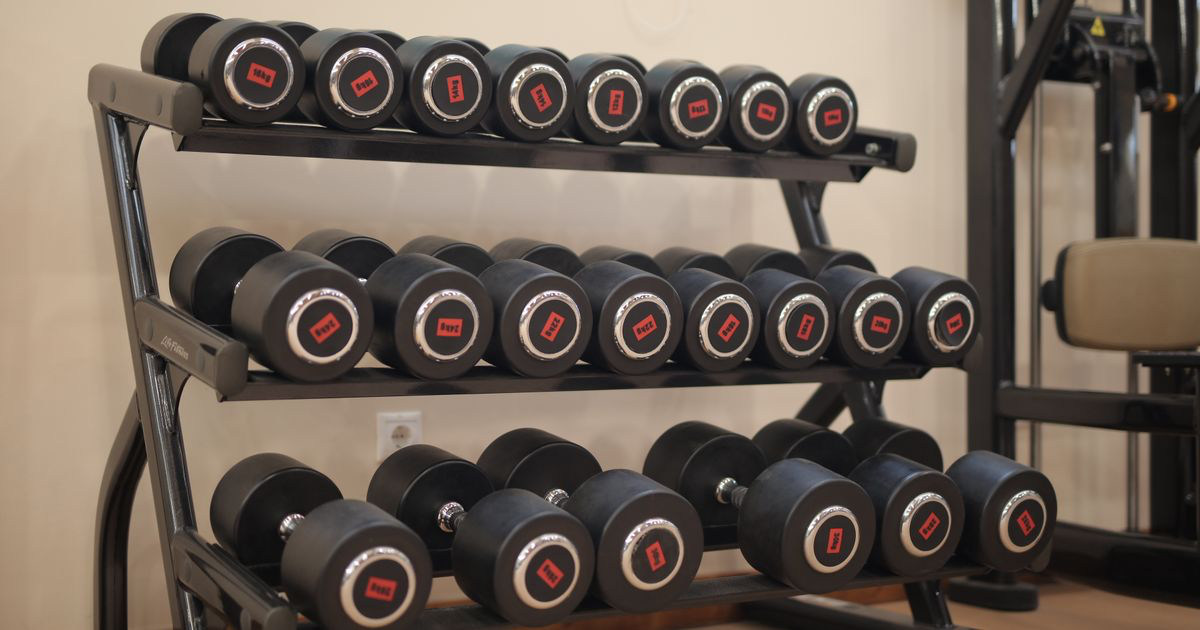
Most commercial racks go up in 2.5 kg pairs at the light end. That step means:
- 10 kg to 12.5 kg is a 25% increase
- 20 kg to 22.5 kg is a 12.5% increase
- 40 kg to 42.5 kg is a 6% increase
A barbell bench press with the smallest plates on each side goes up by roughly 2 to 3%. So on lateral raises you are being asked to absorb ten times the relative jump you would take on a big lift.
The lift does not matter, the percentage does. The heavier the dumbbell, the smaller the problem becomes. Which is why nobody complains about this on dumbbell rows and everybody complains about it on raises and curls.
Does staying on the lighter dumbbell actually work?
Yes, provided you push the sets hard.
The obvious fear is that a lighter weight is simply too light to build anything. The evidence says otherwise. A meta-analysis in the Journal of Human Kinetics pooled studies comparing low-load and high-load training taken to failure and found no significant difference in growth of either type I or type II muscle fibres.
The authors were careful about it. The confidence intervals were wide, meaning the true difference could still run in either direction, so read it as "light loads are not disqualified" rather than "load is irrelevant".
The condition attached to that finding is the important part. Every one of those comparisons had the low-load sets taken to failure. Fifteen easy reps with the 10s is not the same stimulus as fifteen reps where the last two barely move.
So the lighter dumbbell keeps working right up until you can no longer make the last rep hard. That point arrives much later than most people assume.
What are your options when the next dumbbell is too heavy?
You have more levers than "same weight" or "next weight". Ranked roughly by how little disruption they cause:
Add reps first. The cheapest progression there is. Go from three sets of 10 to three sets of 11, then 12, at the same weight. This is ordinary double progression and it should be your default.
Add a set. More total work at a weight you can already handle. A study of 34 trained men published in Medicine & Science in Sports & Exercise compared one, three and five sets per exercise over eight weeks and found muscle size followed a dose-response pattern, with the higher-volume groups gaining more in the elbow flexors and thigh.
Slow the lowering phase. Take three seconds down instead of one. Same dumbbell, more time under load, and on a raise it also kills the swing you were using to cheat the last two reps.
Do the harder version. A seated lateral raise removes the leg drive. An incline curl puts the arm behind the body. Same dumbbell, more demand.
Use microplates or a fractional pair. Magnetic add-on plates in 0.5 and 1 kg sizes clip onto dumbbell heads and turn a 25% jump into a 5% one. About twenty pounds, fits in a gym bag, and solves the problem permanently for the small lifts.
Run a mixed set. Do as many reps as you can with the heavier pair, then finish the set with the lighter one. Six with the 12.5s plus six with the 10s is real progress over twelve with the 10s.
What about just doing more reps forever?
There is a ceiling, but it is high and it is not where people think it is. Once a set runs past about 20 reps on an isolation exercise you are spending a long time for a set that is mostly the last few reps doing the work. That is the point to force the jump and accept the drop.
Until then, reps are free progress. Take them.
A simple starting plan
- Pick your rep range and write it down. Something like 10 to 15 for raises, 8 to 12 for curls. Without a stated top number you have no signal to move up on.
- Add one rep per set per week at the current weight. Not one rep total. One per set, until every set hits the top of the range.
- Then take the jump and expect to lose reps. Going from 10 kg × 15 to 12.5 kg × 9 is a win, not a setback. Write both lines down so you can see it as one.
- Rebuild to the top of the range at the new weight. This will take longer than it did at the lighter pair, because the jump was bigger.
- Buy microplates if the cycle takes more than about eight weeks. At that point the rack, not your training, is the limiting factor. Check your progress with the one rep max calculator rather than by feel.
Why this falls apart in a notes app
All of this depends on knowing your exact reps at your exact weight last week. Which means it depends entirely on your log being readable.
That is easy to write and hard to read back:
| Physical notebook | Notes app | Traditional gym app | Gym Note Plus | |
|---|---|---|---|---|
| Logging speed | Slow, needs a pen | Fast, plain typing | Slow, tap through menus | Fast, plain typing |
| Seeing reps creep up | Flick back through pages | Scroll and squint | Charts, once entered | Automatic per-exercise charts |
| Flexibility | Total | Total | Fixed fields | Total |
| Searchability | None | Basic text search | Good, within its structure | Full history, searchable |
Notes apps are the fastest place to write a set and the worst place to spot a trend. Three weeks of Lateral raise 10kg 12/11/11 looks identical to three weeks of 10kg 12/12/13 when it is buried in a wall of text.
Gym Note Plus reads the text you already write and turns it into the chart you needed. Nothing about how you log has to change.
- Type
Lateral raise 10kg 12/12/13and get three logged sets - Rep and weight trends per exercise, so a stall and a slow climb look different
- Your shorthand stays yours, including notes like "seated" or "3s down"
- Search back months to find what you lifted before the last jump
Paste a session into the free notes to workout translator to see it happen.
The rack only steps in 2.5 kg, and your muscles were never asked to agree to that. Reps are the smaller increment the rack forgot to stock.
Frequently Asked Questions
What should you do when the next dumbbell is too heavy?
Stay on the lighter dumbbell and add repetitions until you can complete the top of your rep range on every set, then take the jump and accept that reps will drop. Adding a set, slowing the lowering phase, or clipping on microplates are the other options when the rack's 2.5 kg step is too large.
Is it bad to use the same dumbbell weight for weeks?
No, as long as the reps are climbing and the last reps of each set are genuinely hard. A meta-analysis in the Journal of Human Kinetics found no significant difference in muscle fibre growth between low-load and high-load training when both were taken to failure. Effort, not the number on the dumbbell, is what stalls progress.
How many reps should you get before increasing dumbbell weight?
Set a rep range and move up when every set reaches the top of it. For isolation exercises like lateral raises, 10 to 15 works well. Once a set runs past roughly 20 repetitions you are spending a lot of time for little extra stimulus, so that is the point to force the jump regardless.
Do microplates work on dumbbells?
Yes. Magnetic fractional plates in 0.5 and 1 kg sizes attach to the ends of most fixed dumbbells and turn a 25% jump into roughly 5%. They are the direct fix for the problem on small lifts such as lateral raises, curls and rear delt work, where a whole 2.5 kg step is far too large.
Should you add reps or add sets when you cannot add weight?
Add reps first. It is the smallest change and the easiest to read back in a log. Once every set sits at the top of your rep range and the next dumbbell is still out of reach, add a set: research on trained men found muscle growth followed a dose-response pattern as weekly set volume rose.
Final Takeaways
- The jump is the problem, not you. A 2.5 kg step is 25% at the light end of the rack and 6% at the heavy end.
- Reps are progression. Climbing from 10 to 15 reps at the same weight is real progressive overload, not marking time.
- Effort is the condition. Light loads matched heavy loads for fibre growth in the research, but only when sets were taken to failure.
- Microplates end the argument. A cheap set of fractional plates converts every jump into something your body can absorb.
- Log reps per set, not a total.
12/12/13tells you something. "3 sets of 12ish" tells you nothing, which is the same reason knowing when to increase weight depends on a readable log.

Josh Ibbotson
Josh is the creator of Gym Note Plus, building tools that make workout tracking as simple as taking notes.
Ready to try it out?
Download Gym Note Plus and start tracking your workouts the way you want.
Download on App Store