
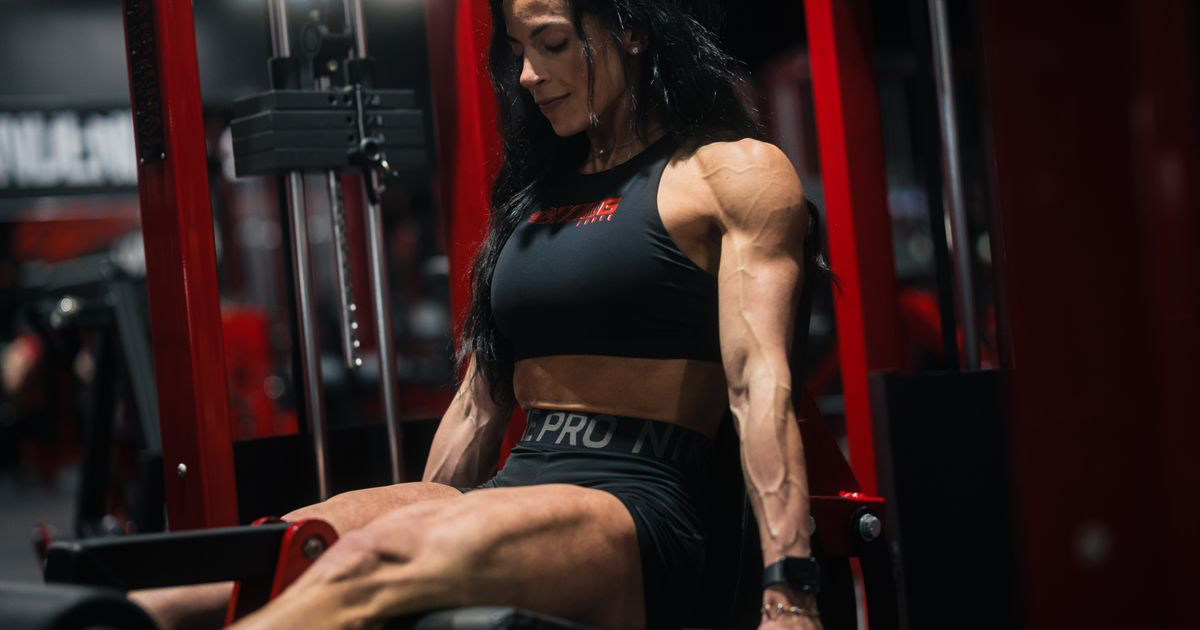
How to Do Leg Extensions
Quick answer: To do leg extensions, sit back into the pad, line the machine's pivot up with your knee joint, and set the shin pad just above your ankle bones. Straighten your knees under control until your legs are nearly locked, pause for a beat, then lower slowly. Leg extensions isolate the quadriceps.
The leg extension is the machine people either dismiss as pointless or use as a warm-up they never actually track.
Both are mistakes. It is the only common gym movement that loads the rectus femoris through a full knee extension, and it is one of the easiest lifts in the building to progress week to week, provided you write down what you did.
What muscles do leg extensions work?
The quadriceps, and almost nothing else. All four heads work: rectus femoris, vastus lateralis, vastus medialis, and vastus intermedius. There is no hip drive, no bracing, no balance component. Your knees extend and the quads do the job.
The rectus femoris is the interesting one. It crosses the hip as well as the knee, so it is the only quad head a squat or leg press cannot fully stretch and shorten. That is the argument for keeping leg extensions in a program that already has heavy compounds.
Hip angle changes how much of that head you recruit. A 2024 study in the Journal of Sports Sciences had 22 untrained men train one leg at 90 degrees of hip flexion and the other at 40 degrees (a reclined seat) for ten weeks. Rectus femoris thickness grew more in the reclined condition, while vastus lateralis growth was the same either way.
Practical version: if your machine reclines, recline it.
How do you set up the leg extension machine?
Setup is most of the exercise. Two adjustments do the work.
Line the pivot up with your knee
The machine's rotation point must sit level with the side of your knee joint. Slide the seat back or forward until it does. If the pivot is behind your knee, the pad drags your shin through an arc your joint is not making, and it shows up as pain under the kneecap.
Set the shin pad low
The pad belongs just above your ankle bones, not halfway up your shin. Higher placement shortens the lever, which flatters your numbers and cuts the tension. Then push your hips fully into the seat back and hold the handles so your body does not slide forward as the load gets heavy.
Take five seconds to note the seat number and pad hole. Those two numbers are the difference between comparing sets and guessing.
How do you perform a leg extension?
- Sit fully back. Hips against the seat back, thighs flat on the pad, hands on the handles.
- Extend to almost straight. Take one to two seconds up. Stop just short of a hard lock rather than snapping into it.
- Squeeze at the top. A one second pause at peak contraction is where this exercise earns its place, because the quads are shortest and least assisted there.
- Lower for three seconds. The eccentric is the half most people throw away. Control it back to a full stretch.
- Stop before your hips lift. When your backside starts peeling off the seat to help, the set is over.
Keep your toes neutral. Turning your feet in or out to bias a specific quad head is gym folklore with very little support behind it, and it adds torsion to your knee for no return.
What are the most common leg extension mistakes?
Swinging the weight up. If your torso rocks back to start the rep, the load is too heavy. This is the single most common fault on the machine and it removes the reason to use it.
Slamming into lockout. Full, forceful extension under a heavy load is where the knee joint takes the most direct hit. Stop a few degrees short and stay under tension.
Dropping the weight back down. Letting the stack fall wastes the eccentric and bangs the plates.
Skipping the setup. Wrong pivot alignment plus a high shin pad turns a quad exercise into a knee irritant.
Going too heavy, too often. The leg extension is a long-lever isolation movement. It works best at moderate loads and higher reps, roughly 10 to 20, where you can control both directions.
How do you progress leg extensions?
Add reps before you add plates. Machine stacks jump in 5kg or 10kg increments, which can be a 20 percent leap on an isolation lift. Work the top of your rep range on every set first, then move the pin.
Then add quality. A longer pause at the top or a slower eccentric raises the difficulty at the same weight, which is useful when the next plate is out of reach.
If you want a single number to watch across a training block, run your best set through the free one rep max calculator and track the estimate rather than the raw stack weight. The load has to climb somewhere, and it has to be visible.
A four-week starting plan
- Week one: find your setup. Light stack, three sets of 15. Write the seat position, the pad hole, and the pin number in the same place you log the reps.
- Week two: add the pause. Same weight, three sets of 12 with a one second squeeze and a three second lower.
- Week three: push the reps. Same weight, three sets taken to two reps in reserve. Note where each set landed.
- Week four: move the pin. One increment up, back to 12 reps, same tempo. If your form breaks, drop back and repeat week three.
- Reassess. Compare week four's numbers against week one's. If nothing moved, the problem is usually rest, not the exercise.
What are the best leg extension alternatives?
Sissy squats load the quads at a similar knee-dominant angle without a machine, and they hit the rectus femoris hard because the hips stay extended.
Reverse Nordics are the bodyweight version most people can start with: kneel, keep your hips locked out, and lean back under control.
Cable knee extensions with an ankle strap replicate the movement in gyms that have no leg extension machine.
Heavy compounds still do most of the work. The leg press and the squat build far more total quad mass, and leg extensions sit on top of them rather than replacing them. If you are not sure how to divide your session between the two types, compound vs isolation exercises breaks down the order and the ratio.
How should you log leg extensions?
"Leg extension 7" means nothing to you next month. Pin seven on your gym's machine is not pin seven on another one, and it is not pin seven if you moved the seat.
A useful leg extension log needs the stack number, the reps, the seat position, and the tempo. That is four pieces of information, which is exactly why most people give up and write nothing.
| Logging method | Logging speed | Data visualization | Flexibility | Searchability |
|---|---|---|---|---|
| Physical notebook | Fast | None | Total | Manual page flipping |
| Notes app | Fastest | None | Total | Basic text search |
| Traditional gym app | Slow (tapping menus) | Good charts | Locked to the app's fields | Good, within its structure |
| Gym Note Plus | Fastest (plain text) | Automatic charts | Total | Full search across sessions |
The notebook and the notes app win on speed and lose on memory. Traditional apps win on charts and lose on the friction of five taps per set. Our guide to logging machine weights covers the shorthand that keeps machine entries comparable between gyms.
Where Gym Note Plus fits
If you already type sets into Apple Notes between rounds, you have the right habit and the wrong storage.
Gym Note Plus reads plain text the way you already write it and turns it into tracked data.
- Type
leg extension 45kg 12,12,10and it becomes structured, charted sets. - Setup details such as seat position and pad hole stay attached to the exercise.
- Estimated one rep max and weekly volume are calculated per exercise.
- Existing notes import, so old sessions arrive with you.
You can test the idea before installing anything by pasting a recent session into the free notes to workout translator.
The leg extension is not a hard exercise to do. It is a hard exercise to remember, which is why so few people ever see it improve.
Frequently Asked Questions
Are leg extensions bad for your knees?
Leg extensions are not inherently bad for healthy knees. The exercise does produce forward shear force across the knee, and a review in the International Journal of Sports Physical Therapy notes the highest ACL strain occurs between 40 and 0 degrees of flexion. Anyone recovering from an ACL reconstruction should follow their clinician's guidance.
Do leg extensions build muscle on their own?
Leg extensions build quadriceps mass, particularly in the rectus femoris, but they train one joint action and cannot substitute for squats, leg presses, or lunges. Most lifters get the best result from two to four weekly sets of leg extensions added after their main compound leg work, not from leg extensions used alone.
How many sets and reps of leg extensions should you do?
Two to four sets of 10 to 20 reps suits the leg extension for most lifters. The long lever and single-joint action make heavy low-rep sets uncomfortable and hard to control, while moderate loads let you pause at the top and lower slowly. Add these sets after squats or leg presses in the same session.
Should you lean back on the leg extension machine?
Leaning back is worth doing if the machine allows it. Reclining the seat reduces hip flexion, which lengthens the rectus femoris; that reclined position produced more rectus femoris growth in a ten-week training study. Keep your hips pressed into the pad and your lower back supported so the reduced hip angle does not turn into a torso swing.
What can you do instead of leg extensions at home?
Reverse Nordic curls are the closest home substitute for the leg extension. Kneel on a padded surface, keep your hips locked straight, and lean your torso back under control until you feel a strong stretch in the front of your thighs. Sissy squats and banded knee extensions cover the same movement pattern.
Final Takeaways
- Leg extensions isolate the quadriceps and are the only common gym movement that loads the rectus femoris through full knee extension.
- Setup decides everything. Pivot level with your knee, shin pad just above your ankles, hips pressed back.
- Recline the seat if you can. Less hip flexion favoured rectus femoris growth in a ten-week study.
- Control both directions. One second up with a pause, three seconds down, and no swinging.
- Log the stack number and the seat position. Without both, next week's set is not comparable to this one.

Josh Ibbotson
Josh is the creator of Gym Note Plus, building tools that make workout tracking as simple as taking notes.
Ready to try it out?
Download Gym Note Plus and start tracking your workouts the way you want.
Download on App Store