
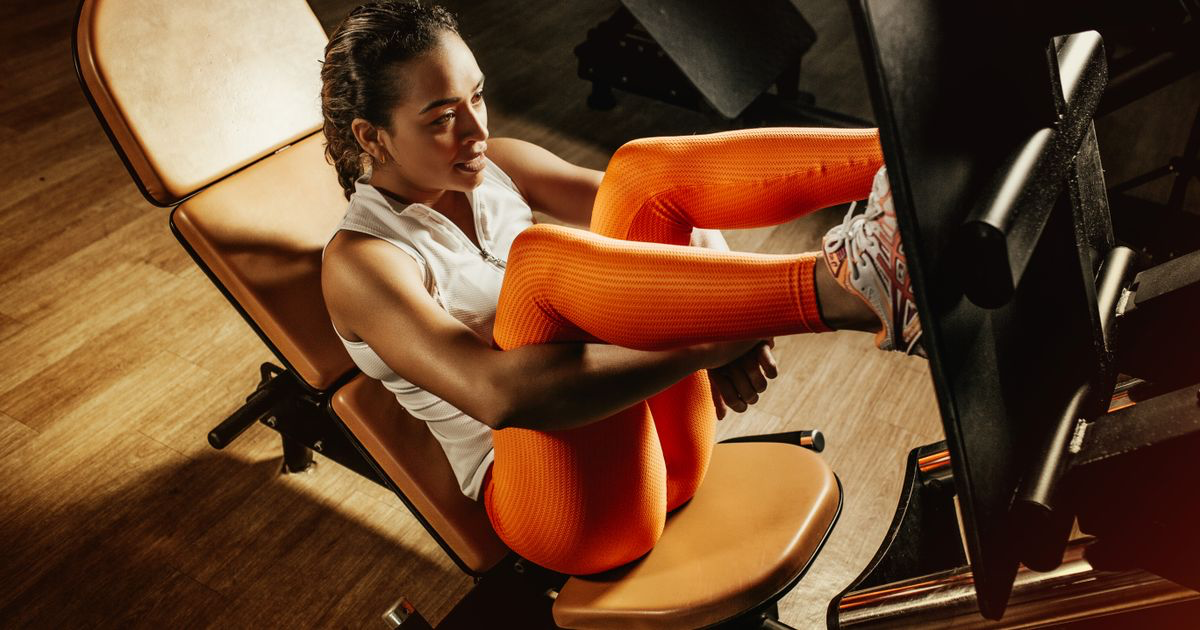
How to Leg Press: Proper Form, Depth and Muscles Worked
Quick answer: To leg press, sit with your back and hips flat against the pad, place your feet shoulder-width on the platform, unrack, then lower under control until your knees reach about 90 degrees or slightly deeper. Press through your whole foot without locking out hard. The leg press trains quads first, then glutes and hamstrings.
The leg press is the machine everyone loads with too many plates and moves about four inches.
It is also one of the most useful lifts in the building, because it lets you train your quads hard without your lower back, your balance, or your bracing being the thing that fails first.
Done properly, it is not the easy option. It is the honest one.
What muscles does the leg press work?
Quads first, by a clear margin. A systematic review of surface EMG studies published in the International Journal of Environmental Research and Public Health found that the leg press elicits the greatest muscular activity from the quadriceps complex, and that this activity increases as the knee flexion angle increases.
Translated: the deeper you go, the more quad you get.
Glutes and hamstrings assist, with the split depending heavily on where your feet sit. The same review found that a high foot placement on the platform produced higher gluteus maximus activity, while a low foot placement produced greater rectus femoris (front of the thigh) activity.
Your calves and adductors contribute at the margins. Your lower back does almost nothing, which is the entire appeal for people who already deadlift and squat.
How do you do a leg press with good form?
Set up before you touch the weight.
- Sit fully back. Hips and lower back flat against the pad, no gap. If your back is not in contact, the sled will pull your pelvis off the seat at the bottom.
- Feet shoulder-width, mid-platform. Toes turned out five to fifteen degrees. Whole foot in contact, weight spread across heel and forefoot.
- Unrack and set the safeties. Press up, rotate the handles, and know where the stops are before your first rep.
- Lower under control. Two to three seconds down. Knees track over your toes, not collapsing inwards.
- Stop when your lower back starts to lift. That is your depth. For most people it is somewhere near 90 degrees of knee flexion or a little past.
- Press through the full foot. Drive back up without slamming into a locked knee at the top.
Do not hold your breath for the entire set. Breathe in on the way down, out on the way up. Long breath-holds against a heavy sled are how people see stars on the leg press.
What foot placement should you use on the leg press?
Foot position is the main dial on this machine. Here is what each setting changes.
| Foot position | Emphasis | Notes |
|---|---|---|
| High on the platform | More glutes and hamstrings | Reduces knee flexion range, easier on knees |
| Low on the platform | More quads (rectus femoris) | Demands more ankle range, harder on knees |
| Narrow stance | More outer quad | Watch for knees drifting in |
| Wide stance, toes out | More adductors and glutes | Often allows more depth |
| Shoulder-width, mid | Balanced quad-dominant default | Where most people should start |
Start at shoulder-width and mid-platform for a few weeks. Learn the movement before you start chasing emphasis, because a foot position that feels great for one set can wreck your knees over a month.
If your knees complain on low placement, move your feet up. That is not a compromise, it is the correct adjustment.
The EMG evidence behind this table is thinner than the infographics suggest, and stance width in particular shows almost no effect. Our full breakdown of leg press foot placement goes through what each study actually measured.
What are the most common leg press mistakes?
Going too deep and losing your lower back. This is the one that actually injures people. When the sled comes down far enough that your pelvis tucks under and your lumbar spine rounds off the pad, the load moves from your legs to your lower back in the worst possible position.
Your depth is defined by the point just before that happens. Have someone watch a set, or film it from the side once.
Locking out hard at the top. Slamming into full extension under a loaded sled puts the whole thing on your knee joint rather than your muscles. Stop just short and keep tension.
Loading the machine and moving four inches. The leg press is uniquely easy to ego-lift, because the numbers are large and the range is optional. A partial rep at 300kg is worth less than a full one at 180kg.
Pushing with your hands on your knees. It feels helpful. It is offloading the exact muscles you came to train.
Letting knees cave inward. If your knees collapse toward each other on the way up, the weight is too heavy or your stance is too narrow. Fix it now rather than in six months.
Is the leg press better than the squat?
They are not competing, they are complementary. The squat trains your legs plus your bracing, balance, and upper back. The leg press removes all of those and lets your legs work in isolation from your capacity to hold a bar.
That removal is the point. It means you can train quads hard on a day when your lower back is beaten up, or push closer to failure without a spotter, or add volume that a squat could not carry.
Use both when you can. Squat first in the session, leg press second for volume. If you want to sharpen your squat, the how to squat guide covers the setup, and compound vs isolation exercises explains where each type of movement earns its place.
If you only have machines available, the leg press plus a Bulgarian split squat covers most of what a squat would have given you.
A simple starting plan
- Spend session one finding your depth. Light weight, film one set from the side, note the exact point where your lower back lifts. That is your bottom position from now on.
- Run three sets of eight to twelve. The leg press responds well to moderate reps and full range, and it is a safer place to push hard than a barbell squat. Rep ranges explained covers why.
- Add weight only when you hit the top of the range on every set with full depth. Depth first, load second, always.
- Log the plate count, not just "leg press". Machines differ, so also note the gym if you train in more than one.
- Reassess every four weeks. If the weight is climbing but the depth is shrinking, you are not progressing, you are just adding plates. This is exactly the trap progressive overload is meant to avoid.
If you want a strength reference point without testing a true max on a machine, plug your best set into the one rep max calculator and track the estimate over time.
Logging the detail that actually matters
Leg press is the lift where a bare number lies to you most. Leg press 200kg 10 says nothing about whether that was a full rep or a twitch.
If you log in Apple Notes or a notebook, you probably already write the extra bits: the foot position, the depth, the fact that the sled felt heavy. That is good instinct, and it is more useful than most app data.
The problem is that free text never becomes a trend.
Gym Note Plus keeps the typing and adds the memory.
- Type
leg press 200kg 10,10,8and it becomes structured, charted sets. - Notes about foot placement and depth stay attached to the session.
- Estimated one rep max and volume are tracked automatically per exercise.
- Old notes import, so months of leg press history arrive with you.
You keep writing what you would have written anyway. It stops being a wall of text.
On the leg press, the plate count is the number people brag about and the range of motion is the number that actually grows legs.
Frequently Asked Questions
How deep should you go on the leg press?
Go as deep as you can while keeping your lower back and hips flat against the pad, which for most people means roughly 90 degrees of knee flexion or slightly deeper. The moment your pelvis tucks under and your lower back lifts off the pad, the load shifts to your lumbar spine. Depth beyond that point adds injury risk rather than muscle stimulus.
Does the leg press build glutes?
The leg press does build glutes, particularly with a high foot placement on the platform. A systematic review of leg press EMG studies found that high feet placement produced higher gluteus maximus activity than low placement, while low placement favoured the rectus femoris. The leg press remains quad-dominant overall, so hip thrusts and Romanian deadlifts are better primary glute exercises.
Why does the leg press feel easier than squats at the same weight?
The leg press feels easier at a given weight because the machine supports your torso and fixes the movement path, removing the balance, bracing, and upper-back demands of a barbell squat. The sled also travels on rails at an angle, so the effective load on your legs is less than the total plate weight. Leg press numbers are not comparable to squat numbers.
Should you lock your knees on the leg press?
Do not lock your knees hard at the top of a leg press. Stopping just short of full extension keeps tension on the quadriceps and prevents the loaded sled from transferring force directly through the knee joint. Locking out under heavy load is a common cause of knee discomfort on this machine and provides no additional training benefit.
How many sets of leg press should you do?
Three to four sets of eight to twelve reps is a productive leg press prescription for most lifters, performed after squats or as the primary quad exercise on a machine-based session. Because the leg press removes lower-back and stability limits, it tolerates higher volume than a barbell squat, which makes it a useful place to add quad sets without adding systemic fatigue.
Final Takeaways
- Quads first, glutes and hamstrings second. Deeper knee flexion means more quad involvement.
- Foot placement is the dial. High for glutes and hamstrings, low for quads, shoulder-width mid as your default.
- Your depth ends where your lower back lifts. Not before, and definitely not after.
- Do not lock out hard, and do not push on your knees. Both cost you the training effect you came for.
- Log the plate count and the depth. A leg press number without range of motion attached is not progress data.

Josh Ibbotson
Josh is the creator of Gym Note Plus, building tools that make workout tracking as simple as taking notes.
Ready to try it out?
Download Gym Note Plus and start tracking your workouts the way you want.
Download on App Store