
How to Log Machine Weights When Every Gym Is Different
Quick answer: Log the pin position and the machine, not just the number printed on the stack. Write something like Chest press (Hammer, seat 3) plate 8, 3x10. Machine numbers are only comparable to themselves, so what makes them useful is recording enough detail to reproduce the exact setup next week.
You did 60 on the chest press at your old gym. At the new one, 60 nearly kills you. Neither number was wrong. They were just never measuring the same thing.
This is the quiet reason a lot of people abandon machines in their log, or stop logging them at all. The numbers look precise and turn out to be meaningless.
Why do machine weights differ between gyms?
Four things, and any one of them is enough to break the comparison.
Pulley ratios. Most cable-driven machines run the stack through a pulley system. Depending on the design, 50 on the stack might put 25, 50 or 75 kg at the handle. Two chest presses with identical stacks can feel 30% apart.
Cam and lever design. Machines change the resistance through the range of motion on purpose. A cam that peaks early feels completely different from one that peaks at the end, at the same stack number.
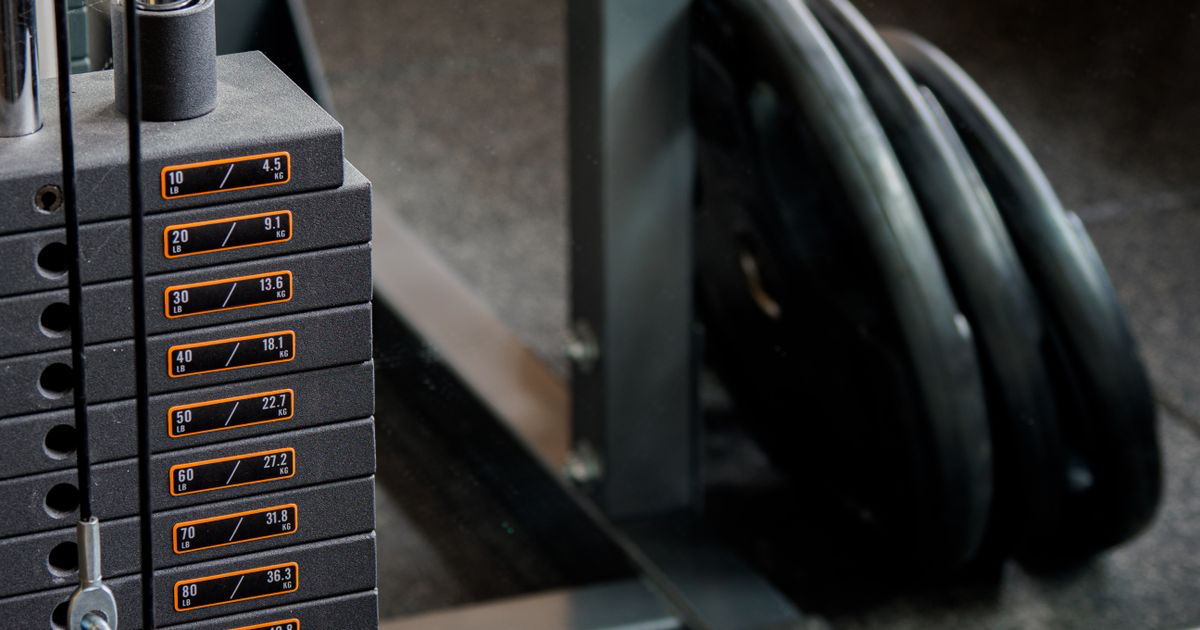
Where the stack numbers come from. Some manufacturers print actual kilograms on the plates. Others print a sequence: 1, 2, 3, 4. Others print a number that includes the carriage weight, and others that excludes it.
Plate-loaded machines have their own weight. A plate-loaded leg press carries a sled that weighs something before you put a single plate on, and that number varies enormously between models. Four plates a side means four different things on four different machines.
The upshot: a machine number describes one machine. Take it anywhere else and it is a guess.
Should you use machines at all, then?
Yes. The logging problem is worth solving rather than avoiding.
A meta-analysis in BMC Sports Science, Medicine and Rehabilitation pooled 13 studies covering 1,016 participants and compared free-weight training against machine-based training directly. It found no meaningful difference for muscle growth (standardised mean difference -0.055, p = 0.751) or for dynamic strength (0.084, p = 0.387).
The one place they differed was in what got tested. Free-weight training produced bigger gains on free-weight strength tests (-0.210, p = 0.023), and machine training tended to do better on machine tests. Strength is partly a skill, and you get good at the thing you practise.
So machines build muscle. They just do not automatically make you better at a barbell lift, and their numbers do not travel.
What should you actually write down?
Enough to set the machine up identically next time. In practice, four things:
The machine as well as the exercise. Chest press (Hammer) and Chest press (Life Fitness) are different exercises for logging purposes. If your gym has one of each, name them.
The pin or plate position. Prefer the position over the printed number. "Plate 8" or "pin 8" is unambiguous. "60" might be kilograms, might be pounds, might be a sequence number.
Seat and pad settings. Almost every machine has a numbered seat height, back pad, or lever arm position. That number changes your leverage and therefore your weight. Write it.
The gym, if you use more than one. Two lines a year apart from two different gyms will otherwise sit next to each other looking comparable.
A complete line looks like this:
Chest press (Hammer, seat 3) plate 8, 10/10/9
That takes about four seconds to type and it is the difference between a number you can progress and a number you cannot.
What about plate-loaded machines?
Log plates per side and the machine, and leave the sled weight out of it entirely.
Leg press (angled) 4 plates/side x 10 works fine. Trying to convert it into a real kilogram figure means guessing at the sled weight and the angle, and the guess adds nothing. You are tracking whether the number goes up, not publishing it.
The same logic applies to foot placement on the leg press, which changes what the exercise trains without changing a single plate.
Do machine numbers belong in a one-rep max estimate?
Only for comparison against themselves.
A rep-max estimate turns a weight and a rep count into an estimated maximum. Feed it a machine number and it will give you an answer, and that answer is fine for tracking your own trend on that machine. It is not your bench press, and it is not portable between gyms.
Use the one rep max calculator on your barbell lifts for a number that means something outside your gym, and treat machine estimates as a private trend line.
What happens when you switch gyms?
Expect the numbers to move, and do not panic when they do.
- Reset the machine lifts, keep the barbell lifts. A barbell 80 kg is 80 kg anywhere. A machine 60 is not.
- Spend one session finding your starting pin on each machine. Aim for a weight that leaves you 2 or 3 reps short of failure at your usual rep count.
- Write the new line with the new gym name in it. From that point on you have a fresh, internally consistent series.
- Do not compare across the gap. Comparing your new gym's leg press to your old one's tells you about the machines, not about you.
- Give it three weeks before you draw conclusions. New machines feel wrong for a while. If your numbers still have not recovered after that, read why you might be getting weaker before you rewrite your programme.
Why traditional gym apps struggle with this
Most workout apps model an exercise as a name and a number. That model has nowhere to put "seat 3, Hammer, plate 8", so the detail either goes in a free-text notes field nobody reads or gets dropped.
| Physical notebook | Notes app | Traditional gym app | Gym Note Plus | |
|---|---|---|---|---|
| Logging speed | Slow, needs a pen | Fast, plain typing | Slow, tap through menus | Fast, plain typing |
| Room for machine setup | Anywhere on the line | Anywhere on the line | Separate notes field, if any | Kept with the set as written |
| Data visualization | None, you flick back pages | None | Charts, once entered | Automatic per-exercise charts |
| Flexibility | Total | Total | Fixed fields | Total |
| Searchability | None | Basic text search | Good, within its structure | Full history, searchable |
The notes app is the obvious escape hatch, and it is why so many people log machines in Apple Notes and everything else in an app. You can write whatever you want. The cost is that nothing ever reads it back to you.
Gym Note Plus is built for exactly that line. You type it the way you would in your notes app, machine and seat number included, and it becomes structured sets with charts behind them.
- Write
Chest press (Hammer, seat 3) plate 8, 10/10/9and get three logged sets - Per-exercise trends, so a machine's own progression is visible even though the number is arbitrary
- Setup details stay attached to the sets rather than living in a separate notes box
- Search months back for what pin and seat you used, including at your old gym
Paste your last machine session into the free notes to workout translator and see what it makes of it.
A machine number is worth nothing at another gym and a great deal at your own, provided you wrote down which machine and which seat setting produced it.
Frequently Asked Questions
How do you log machine weights properly?
Record the machine name, the pin or plate position, and the seat or pad setting alongside your reps, for example Chest press (Hammer, seat 3) plate 8, 10/10/9. Machine numbers are only comparable against the same machine, so the setup details are what make the number usable a week later.
Why is the same weight harder on a different machine?
Because pulley ratios, cam design, lever length and carriage weight all differ between manufacturers. A stack marked 50 might deliver 25 kg at the handle on one machine and 75 kg on another. The printed number describes the plate, not the resistance reaching your muscles.
Are machines as good as free weights for building muscle?
For muscle growth, yes. A 2023 meta-analysis in BMC Sports Science, Medicine and Rehabilitation pooled 13 studies and 1,016 participants and found no significant difference between free-weight and machine-based training for hypertrophy or dynamic strength. Strength gains were specific to the modality tested, so free weights still transfer better to free-weight tests.
Should you convert machine weights into kilograms?
No. Converting a plate-loaded sled or a pulley-driven stack into a true kilogram figure requires guessing at sled weight, angle and pulley ratio, and the guess adds no information. Log plates per side or the pin position instead, and treat the series as a private trend on that specific machine.
Can you estimate your one-rep max from a machine?
Only as a trend for that machine. A one-rep max estimate from a leg press or chest press is useful for watching your own progress climb, but it is not comparable to a barbell one-rep max or to the same machine at another gym. Keep barbell estimates for numbers you want to compare externally.
Final Takeaways
- Log the position, not the printed number. "Plate 8" survives; "60" might be kilograms, pounds or a sequence.
- Name the machine and the seat setting. Leverage changes with both, and neither shows up in the weight.
- Machines build muscle just fine. The 2023 meta-analysis found no hypertrophy difference against free weights.
- Do not carry machine numbers between gyms. Start a fresh series and expect a week or two of recalibration.
- Keep barbell lifts as your portable measure. They are the numbers that mean the same thing everywhere, which is why they anchor tracking gym progress.

Josh Ibbotson
Josh is the creator of Gym Note Plus, building tools that make workout tracking as simple as taking notes.
Ready to try it out?
Download Gym Note Plus and start tracking your workouts the way you want.
Download on App Store