
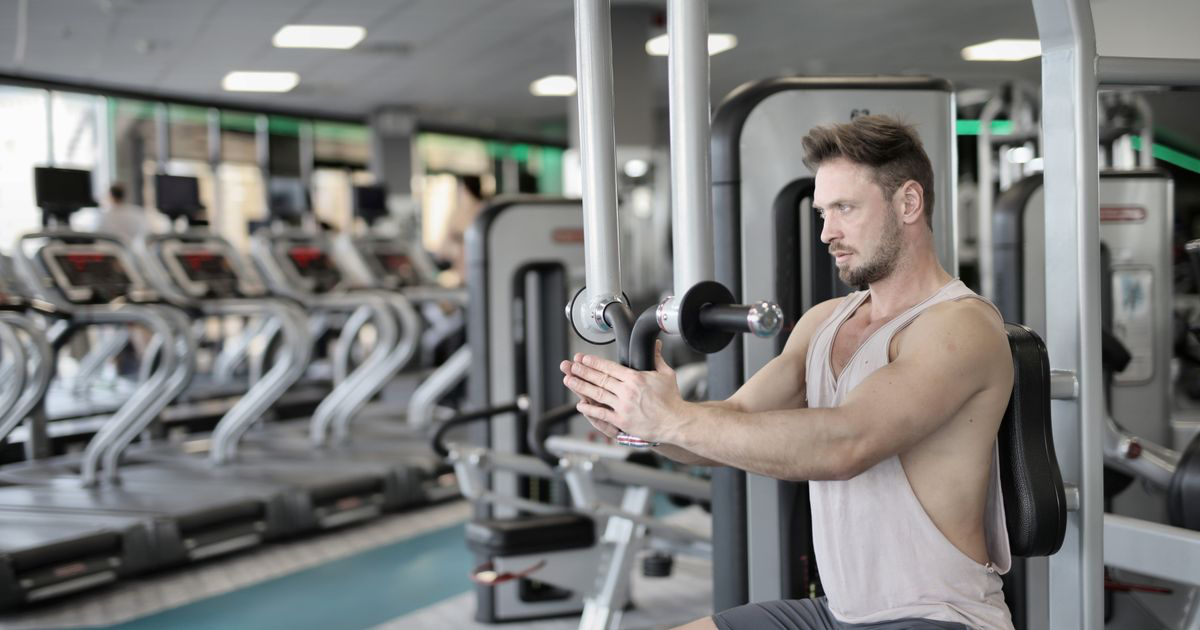
How to Use the Chest Press Machine: Setup, Form and Progression
Quick answer: Set the seat so the handles sit level with the middle of your chest, plant your feet, keep your shoulder blades pinned back against the pad, then press until your elbows are almost straight. The chest press machine builds chest and triceps as effectively as a barbell bench, provided you add weight over time.
The chest press machine is the piece of equipment people use when they do not want to ask anyone for a spot, and then quietly feel guilty about.
They should not. The evidence on machines versus free weights is far less flattering to the barbell than gym folklore suggests. What the machine does demand is that you set it up properly, and that you write the seat height down.
Does the chest press machine build as much muscle as a bench press?
For muscle size, the evidence says yes.
Haugen and colleagues pooled 13 studies and 1,016 participants in BMC Sports Science, Medicine and Rehabilitation, comparing free-weight training with machine-based training.
For muscle growth, the standardised mean difference was -0.055 with a confidence interval running from -0.397 to 0.287. In plain terms: the two produced the same amount of growth, and the range of uncertainty sits comfortably around zero. Jump performance and isometric strength came out the same way.
Where they differed was specificity. Free-weight training was better at improving free-weight strength (a difference of -0.210, which reached significance), and machine training trended toward being better at machine strength (0.291, which did not quite reach significance).
That is not "machines are worse". It is "you get good at what you practise". If your goal is a bigger chest, the machine is a legitimate choice. If your goal is a bigger bench press number, bench press.
How do you set up the chest press machine?
The seat height is the whole exercise. Get it wrong and you are doing an incline press, a decline press, or an impingement.
- Sit down and look at where the handles land. They should line up with the middle of your chest, roughly nipple height, not your collarbones and not your ribs.
- Adjust the seat until they do. Then remember the number. Write it in your log.
- Plant both feet flat. If your feet dangle, use the footplate or a platform. You cannot press hard from an unstable base.
- Pin your shoulder blades back and down against the pad. They stay there for the whole set. This is the single biggest form point on any pressing movement.
- Set the handle depth if the machine has one. Start where your hands are level with your torso, not behind it.
If the handles are above your chest at the start, the front delts take over and your shoulders will let you know within a few sessions.
How do you press with good form?
- Grip at roughly the width you would bench, or use the neutral handles if the machine offers them and your shoulders prefer it.
- Press forward and slightly together. The chest brings the arms toward the midline, so a path that converges a little matches what the muscle does.
- Stop just short of locking out. Keep tension on the chest rather than dumping it into your elbows.
- Lower for two to three seconds. The machine makes it very easy to let the stack drop, and the lowering half is where a large part of the growth stimulus is.
- Go back until you feel a stretch across the chest, then reverse. Do not let the plates touch down between reps.
- Keep your shoulder blades pinned. If they roll forward at the bottom, shorten the range slightly.
What are the advantages of the machine over a bench press?
It removes the parts of a bench press that have nothing to do with growing a chest.
- No spotter needed. You can take a set to failure without a stranger hovering.
- The stabilising cost is gone. More of the effort lands on the chest and triceps rather than on holding the bar steady.
- The setup is repeatable. Seat 4, handle 2, 60kg. Same every time.
- Small load increments. Many stacks move in 5kg steps, and some have half-plates, which beats the dumbbell weight jumps that are too big problem.
- Easier to run drop sets and rest-pause on. Move a pin, keep going.
The trade is that you learn less about controlling a load in space, and you inherit the machine's fixed path whether or not it suits your body. If it hurts your shoulder in every position, that is the machine, not you. Our post on machines vs free weights covers the full comparison.
How do you progress on a chest press machine?
The machine makes progression easy and also makes it easy to avoid.
Because you never have to unrack anything or find a spotter, the friction that normally forces you to confront a stalled lift disappears. People sit at the same pin for a year.
- Pick a rep range and stick to it. Six to twelve works for most people.
- Add reps to the top of the range before adding weight. Three sets of eight becomes three sets of twelve, then move the pin and start again at eight.
- Take the last set to two reps from failure. You do not need a spotter to justify this on a machine.
- Log the seat and handle settings, every time. A "personal best" at a different seat height is not a personal best.
- Reassess every four to six weeks. If the pin has not moved, change the rep range or the frequency.
Plug your best set into the one rep max calculator if you want a comparable number across rep ranges.
What are the most common chest press machine mistakes?
Seat too low. Handles end up above chest height, front delts take over, shoulders complain.
Shoulder blades unpinned. The shoulders round forward at the bottom and the joint takes the load instead of the chest.
Locking out hard every rep. Tension leaves the chest, elbows take a beating.
Letting the stack slam. No control on the way back means no eccentric, which is a large share of the stimulus thrown away.
Never changing the pin. The most common one, and the reason machine work gets a bad reputation it does not deserve.
Not recording the settings. Two months later you cannot tell whether 60kg on seat 3 beat 55kg on seat 5.
How do the ways to track machine work compare?
| Physical notebook | Notes app | Traditional gym app | Gym Note Plus | |
|---|---|---|---|---|
| Logging speed between sets | Fast | Fast | Slow, many taps | Fast, plain text |
| Room for seat and handle settings | Total | Total | Rarely a field | Total, free text |
| Handles gym-specific machines | Yes | Yes | Only if it is in the database | Yes, your own names |
| Turns pin weights into a trend | No | No | Yes | Yes, automatic |
| Keeps two gyms' machines apart | If you remember | If you remember | Awkward | Yes, name them differently |
A simple starting plan
- Find your seat height once and write it down. Handles level with mid-chest. That number goes in every log entry from now on.
- Run three sets of eight to twelve, twice a week. Chest press first in the session or straight after a compound press.
- Lower for three seconds on every rep. Set the rule so tempo drift does not quietly change the exercise.
- Take the last set to two reps from failure. No spotter required, so there is no excuse.
- Log it as
chest press machine 60kg 12,11,9, seat 4. Reassess in six weeks.
If you already log your workouts as text
Machine work is where notes-app logging beats gym apps outright, because gym apps rarely have a field for "seat 4, handle position 2, the machine by the window".
You already write that kind of detail. The problem is that free text never becomes a chart.
Gym Note Plus keeps the typing and adds the memory.
- Type
chest press machine 60kg 12,11,9 seat 4and it becomes structured sets on a trend line. - Your machine names are your own, so two gyms' equipment stays separate.
- Setup notes stay attached to the session where they belong.
- Old notes import, so your existing machine history comes with you.
Our guide to logging machine weights covers the notation in detail, or paste a session into the free notes to workout translator and see what it becomes.
A chest press machine builds the same muscle a bench press does. It just never forces you to notice when you have stopped adding weight.
Frequently Asked Questions
Is the chest press machine as good as the bench press?
For muscle growth, yes. A meta-analysis in BMC Sports Science, Medicine and Rehabilitation pooling 13 studies and 1,016 participants found no difference between machine and free-weight training for hypertrophy. Free weights were better at improving free-weight strength specifically, which matters if your goal is a bigger bench press number.
What height should the chest press machine seat be?
Set the seat so the handles line up with the middle of your chest, roughly nipple height, when you sit back against the pad. If the handles sit higher than that, the front deltoids take over the press and the shoulder joint carries load it does not need. Record the seat number in your log.
Should you lock out on the chest press machine?
Stop just short of a full lockout. Finishing with the elbows slightly bent keeps tension on the chest instead of transferring it to the elbow joints and the weight stack. Locking out fully also gives the chest a rest mid-set, which shortens the effective working time of each repetition.
How many sets of chest press should you do per week?
Six to twelve hard sets of chest pressing per week suits most lifters, split across two sessions. That total includes any other chest press variation you run. Take the last set of each exercise to within two repetitions of failure, which is straightforward on a machine because no spotter is involved.
Why does the chest press machine hurt my shoulders?
The usual cause is a seat set too low, which places the handles above chest height and forces the shoulders into an overhead-pressing position. Check the handles are level with mid-chest, keep the shoulder blades pinned back against the pad, and shorten the range slightly if the shoulders roll forward at the bottom.
Final Takeaways
- The machine grows chest as well as a barbell does. The meta-analysis found no difference for hypertrophy.
- Free weights win on free-weight strength. Specificity, not superiority.
- The seat height is the exercise. Handles at mid-chest, every time, recorded.
- Shoulder blades stay pinned. Everything that goes wrong on this machine starts with them rolling forward.
- Move the pin. The machine's biggest weakness is how easy it is not to.

Josh Ibbotson
Josh is the creator of Gym Note Plus, building tools that make workout tracking as simple as taking notes.
Ready to try it out?
Download Gym Note Plus and start tracking your workouts the way you want.
Download on App Store