
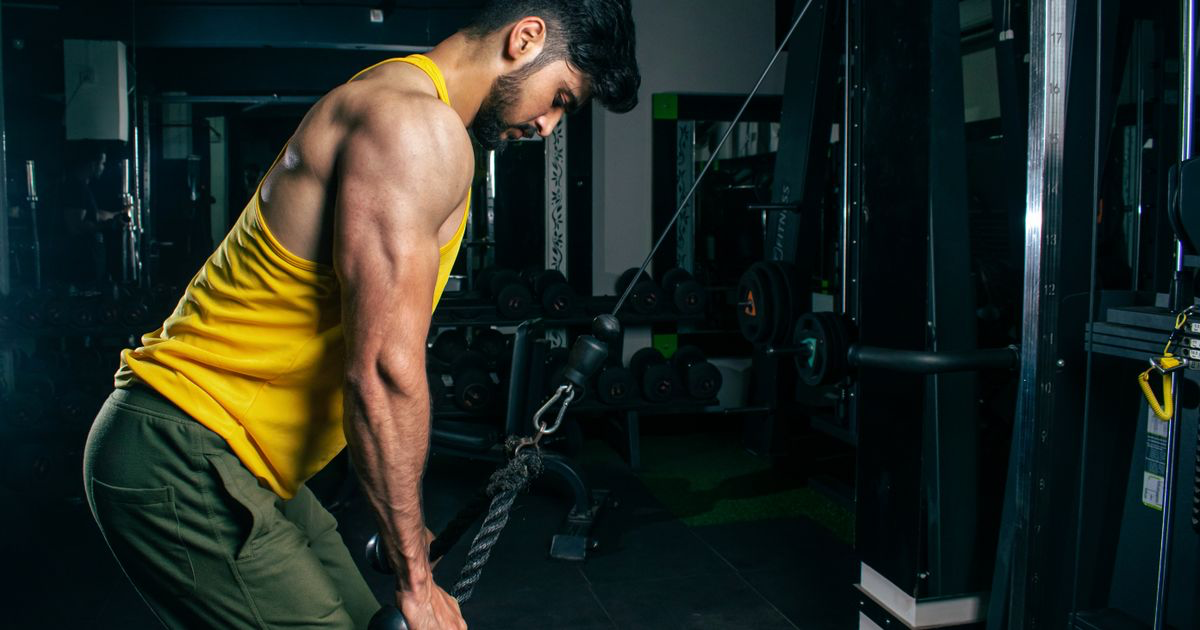
How to Do a Tricep Pushdown (Form, Mistakes, and Progression)
Quick answer: To do a tricep pushdown, set a cable at roughly head height, grab a rope or bar, and pin your elbows to your sides. Push down by straightening your elbows only, squeeze at the bottom, then let the handle rise until your forearms pass parallel. Your torso and shoulders should not move.
The pushdown is the busiest station in most gyms and the one people get away with doing badly for years. Watch it for five minutes and you will see a stack that is far too heavy, a lifter leaning their bodyweight over the bar, and elbows swinging forward on every rep.
What muscles does the tricep pushdown work?
All three heads of the triceps, but not equally.
- Lateral head. The outer part of the upper arm, and the one doing the most visible work here. Pushdowns hit it hard.
- Medial head. Sits underneath, works throughout the movement, and is especially involved near lockout.
- Long head. The largest of the three, and the one this exercise short-changes. It crosses the shoulder joint, so it only reaches a full stretch when your arm is overhead. With your elbows pinned to your sides, it never gets there.
That last point matters. If pushdowns are your only triceps exercise, you are training two heads well and one in a permanently shortened position. Pair them with an overhead movement and that gap closes.
The pushdown is an isolation lift. One joint moves, and it sits alongside your pressing work rather than replacing it. If that distinction is fuzzy, compound vs isolation exercises covers where each belongs.
How do you perform a tricep pushdown correctly?
Setup and execution, step by step:
- Set the pulley high, roughly at head height or just above. Too low and you lose the top of the range.
- Attach your handle and take a grip with both hands. Rope, straight bar, or V-bar all work.
- Stand a short step back, feet under your hips, with a very slight forward lean from the hips. Not a hunch.
- Pin your elbows to your ribs. Get this wrong and nothing else you do matters.
- Push down by straightening the elbows only until your arms lock out, keeping your upper arms still.
- Squeeze for a beat at the bottom with the elbows fully extended.
- Let the handle travel back up under control until your forearms are past parallel with the floor.
The cue that fixes most people: your upper arm is a hinge bolted to your torso. Only the forearm is allowed to move.
How much should you lean forward?
A small lean of maybe 10 to 15 degrees keeps the cable path clear of your body. Anything more and you have started using your bodyweight to shove the handle down, which is how most people fake a heavier pushdown.
Rope vs straight bar vs V-bar: which is better?
They are all good, and they differ mainly at the bottom of the rep.
- Rope. Your hands can pull apart at lockout, so the elbows fully extend and the contraction is harder. Wrists sit neutral. It is less stable, so you will handle slightly less weight.
- Straight bar. The most stable option, so it is where you can load heaviest. The pronated grip fixes the wrists in one position, which irritates some lifters over time.
- V-bar. A middle ground that takes pressure off the wrists while keeping most of the stability.
A rule instead of a debate: use the rope by default and the straight bar when you want to push heavier.
The attachment does not change how you progress. It changes what your logbook needs to say, because a rope pushdown at 25 kg and a straight bar pushdown at 25 kg are not the same set.
What are the most common cable tricep pushdown mistakes?
Elbows drifting forward is the parent mistake. Most of the rest are symptoms of it.
- Elbows travelling away from the ribs. Once the upper arm moves, the lats and chest start assisting and the triceps get a discount.
- Leaning your bodyweight onto the handle. If your chest drops as the bar goes down, you are doing a strange standing dip.
- Too much load. The stack is easy to add to and there is no barbell to keep you honest.
- Cutting the range. Stopping halfway up skips the stretched position, and stopping short of lockout skips where the medial and lateral heads work hardest.
- Flaring the wrists. Bending at the wrist to squeeze the last few centimetres moves the work into your forearms.
Test it. Drop the weight by a third and film one set from the side. If your upper arms hold still for all ten reps, put the weight back on. If they do not, you have found your real working weight.
How many sets and reps should you do?
Three to four sets of 10 to 15 reps suits most people. The triceps tolerate volume and respond to controlled tension, and heavy low-rep pushdowns tend to turn into leaning contests.
Rest is short here. Sixty to ninety seconds is plenty, against the two or three minutes a heavy compound needs.
Put pushdowns after your pressing work. Fatiguing the triceps first costs you reps on the bench press and gives you nothing back. For where rep targets come from, rep ranges explained covers the reasoning.
How do you progress the tricep pushdown over time?
The cable stack is a blunt instrument.
Most stacks move in 5 kg or 10 lb plates. Going from 25 kg to 30 kg is a 20% jump on an exercise where you might have 5% of extra strength available, so the weight sits still for weeks even while you are getting stronger.
Progress with reps first:
- Pick a plate you can control for 10 clean reps with the elbows locked in place.
- Add reps each session until you hit 15 on every set.
- Then move up one plate and expect to drop back toward 10. That drop is correct.
- If the jump is too big, add a set at the old weight or slow the lowering phase to three seconds, then try the jump again in a fortnight.
Some machines have a small add-on weight, a 2.5 kg pin or magnet, that halves the jump. Use it if your gym has one. If you are unsure when a jump is earned, when to increase weight lifting gives you a better trigger than "it felt easy today".
Good alternatives and additions
- Overhead cable or dumbbell extension. The fix for the long head, because the arm is raised and the muscle reaches a real stretch.
- Skull crusher. Lying elbow extension with a bar or dumbbells, between the two in shoulder position.
- Dips. The heaviest triceps movement most people can do, and a compound as well. Our guide on how to do dips covers the torso angle that shifts emphasis toward the triceps.
- Close-grip bench press. For loading the triceps with real weight.
One overhead movement plus pushdowns beats doing pushdowns three times over.
Why cable exercises are the hardest thing to log
Pushdowns break most logging systems, because "45" means nothing on its own.
The number on a cable stack depends on the pulley ratio and the plate weights, so two machines in the same gym can feel very different at the same setting. Move gyms and the numbers become fiction.
So the log needs the load, the machine, and the attachment. Pushdown 45x12 tells you nothing next month. Pushdown rope, cable 2, plate 7, 12 reps tells you exactly what to repeat.
| Physical Notebook | Notes App | Traditional Gym App | Gym Note Plus | |
|---|---|---|---|---|
| Logging speed | Slow, needs a pen | Fast, free typing | Slow, tap through menus | Fast, free typing |
| Recording machine and attachment | Yes, if you remember | Yes, free text | Often no field for it | Yes, free text |
| Data visualization | None | None | Charts | Charts from your text |
| Flexibility | Total | Total | Rigid exercise list | Total |
| Searchability | None | Text search only | Structured search | Structured search |
Rigid gym apps are the worst fit here. They give you a weight field and an exercise name, with nowhere obvious to write "cable 2, rope, plate 7", which is the detail that makes the entry usable later.
A simple starting plan
- Set the cable at head height and take a rope. Default to the rope until you have a reason not to.
- Choose a plate you can control for 12 reps with your upper arms completely still. Expect it to be lighter than what you used before.
- Do three sets of 10 to 15, full lockout at the bottom, forearms past parallel at the top, 60 to 90 seconds rest.
- Write down the machine and the attachment, not just the number.
Rope pushdown, cable 2, plate 7: 13, 12, 11. - Add reps until every set hits 15, then move up one plate and start again from 10.
If you already log your sets in a notes app
Plenty of people type their sessions into their phone between sets, one line per exercise. It is the fastest option in a busy gym, and it swallows messy details like "plate 7, second cable station" without a fight.
The habit is right. The limitation is that six months of those lines never become a picture, so you cannot see whether your pushdown has moved since spring.
Gym Note Plus keeps the typing and adds the missing half:
- Write sets as plain text, machine notes and all, with no dropdowns.
- Weights and reps become per-exercise charts automatically.
- Stalled lifts are easy to spot, which is where accessories usually hide.
- Existing notes import, so the history you already typed comes with you.
Paste an old session into the free notes to workout translator and watch a wall of text turn into tracked sets. For a reference point on your pressing strength alongside it, the one rep max calculator estimates it from a single hard set.
The pushdown is decided at the elbow, not the stack. Pin your upper arms, earn the reps, and write down which machine you used.
Frequently Asked Questions
How do you do a tricep pushdown with correct form?
Set a cable pulley at head height, grip a rope or bar, and pin your elbows against your ribs with a slight forward lean. Straighten your elbows to push the handle down until your arms lock out, pause briefly, then let it rise until your forearms pass parallel. Only your forearms should move.
Is a rope or straight bar better for tricep pushdowns?
Both work well for tricep pushdowns. The rope allows the hands to separate at lockout for a stronger contraction and keeps the wrists neutral. The straight bar is more stable, so most lifters can load it heavier. A V-bar sits between them. Rotating between attachments every few weeks suits most training plans.
Why can I not feel my triceps during pushdowns?
The usual cause is elbow drift. If the upper arms swing forward during the rep, the chest and lats take over and the triceps get less work. Reduce the weight by roughly a third, press the elbows into your ribs, and lock out fully at the bottom of each repetition.
Do tricep pushdowns work the long head?
Tricep pushdowns work the long head, but not in its stretched position. The long head crosses the shoulder joint, so it only reaches a full stretch when the upper arm is raised overhead. Pushdowns train it with the arm at the side, which is why overhead extensions make a useful pairing.
Do tricep pushdowns work your forearms?
Tricep pushdowns work the forearms only as grip, not as a training stimulus. The forearm flexors hold the rope or bar while the triceps do the pushing, so they fatigue without receiving enough load to grow. If your forearms give out before your triceps, the handle is the limit, and straps or a wider bar fix it.
What height should the cable be for a tricep pushdown?
Set the cable at roughly head height, or slightly above, for a standard tricep pushdown. That position lets your elbows stay pinned at your sides through the full range without the weight stack bottoming out. Setting it too low shortens the range; setting it far overhead turns the movement into a lean-forward press.
How much weight should you use on tricep pushdowns?
Use a load you can control for at least 10 reps with your torso still and your elbows locked against your sides. Cable stack numbers vary between machines, so the plate number matters more than the printed weight. If your chest drops toward the handle on the last reps, the load is too heavy.
Final Takeaways
- Pin your elbows to your ribs. That one thing separates a real pushdown from an expensive lean.
- Use the full range. Forearms past parallel at the top, complete lockout at the bottom.
- Rope, straight bar, and V-bar are all fine. Pick one, note which you used, and stay consistent within a block.
- Add reps before plates. Stack jumps are large, so 10 to 15 reps is your real progression lever.
- Pair pushdowns with an overhead extension so the long head gets trained in a stretched position.
- Log the machine and the attachment, not just the number. A cable weight without context is not data.

Josh Ibbotson
Josh is the creator of Gym Note Plus, building tools that make workout tracking as simple as taking notes.
Ready to try it out?
Download Gym Note Plus and start tracking your workouts the way you want.
Download on App Store