
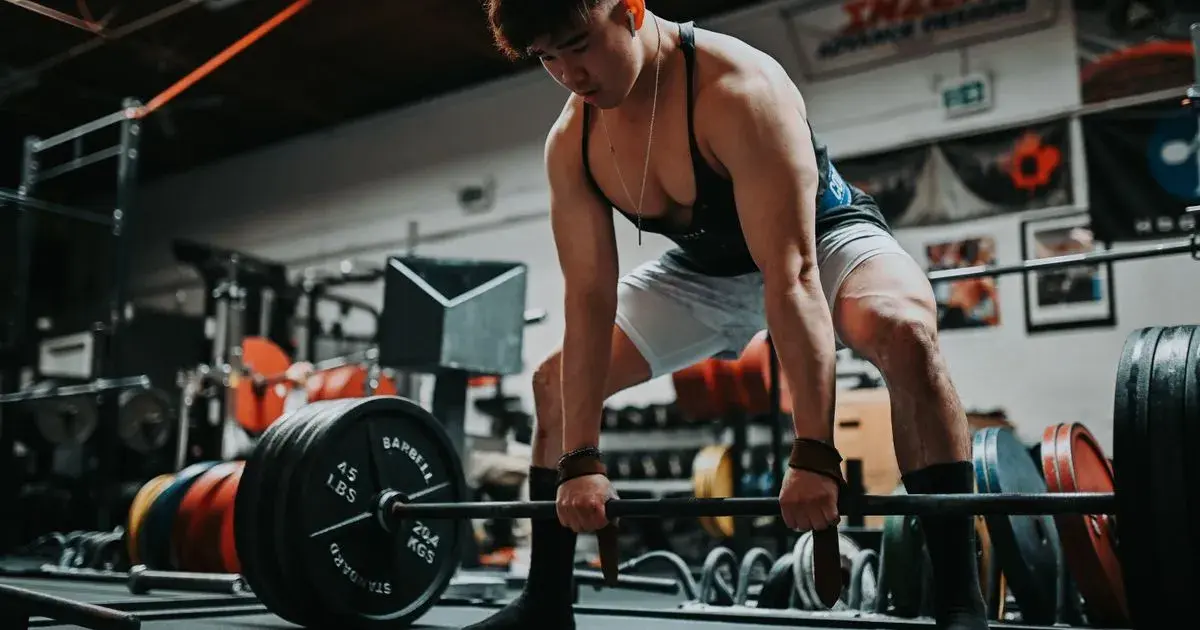
How to Rack Pull: Pin Height, Form and Muscles Worked
Quick answer: A rack pull is a deadlift that starts from the safety pins of a power rack, usually set just below or just above the knee. Grip the bar, brace, push your hips forward and stand up tall. It trains the glutes, lower back, hamstrings and upper back with heavier loads than a full deadlift allows.
Rack pulls are easy to start and easy to get wrong. You set the pins somewhere around knee height, load more plates than you have ever deadlifted, and the bar goes up.
The next week the pins go up a hole, the number goes up with them, and it gets hard to tell whether you got stronger or just moved the bar.
What is a rack pull?
A rack pull is a partial deadlift. The bar sits on the safety pins (or on blocks) instead of the floor, so you skip the bottom part of the lift and train only the top part.
Because the bar starts higher, your knees are already close to straight. The work shifts away from the quads and onto the muscles that finish a deadlift: the glutes, the spinal erectors and the upper back.
The shorter range is also why rack pulls feel so strong: you are lifting from the part of the deadlift where your leverage is best.
What muscles do rack pulls work?
Rack pulls mainly train the glutes and lower back, with the hamstrings, traps, adductors and forearms working hard too.
- Glutes. They drive the hips forward to lockout, which is most of a rack pull.
- Spinal erectors. They hold your back flat against a load that is often heavier than your deadlift.
- Hamstrings. They work more when the pins are below the knee and less as the pins go higher.
- Traps and upper back. They hold the shoulders in place, and from high pins they become a big part of the lift. For direct trap work, shrugs take the muscle through its full range.
- Forearms. Your grip has to hold the heaviest bar you will touch all week.
The quads do much less than in a floor deadlift, since the knees barely bend.
How much more can you rack pull than deadlift?
Usually around 20% more from just above the knee, and more again from higher pins.
Two studies give real numbers. In a 2012 study in the Journal of Trainology, 14 competitive powerlifters who deadlifted at least 2.5 times their body mass pulled against a fixed bar at several heights. They averaged 3,380 N of force at the floor, 4,093 N with the bar just above the kneecap, and 4,910 N close to lockout. That is about 21% more at knee height and 45% more near the top.
A 2023 study in the Journal of Strength and Conditioning Research tested 18 college wrestlers. Their one rep max from a rack, with the bar about 2.5 cm above the kneecap, averaged 226.0 kg, against 191.7 kg from the floor. That is roughly 18% higher, and the two numbers were strongly correlated (r = 0.85).
So a rack pull number only means something next to its pin height. A 220 kg pull from above the knee and a 220 kg pull from mid-shin are not the same lift.
What pin height should you use for rack pulls?
Below the knee (mid-shin)
The longest range and the closest to a real deadlift. You feel a stretch in the hamstrings at the start, and the glutes and hamstrings do most of the work. Good if you want deadlift carryover with a little less fatigue.
At the knee
The standard rack pull. Hamstrings do less, and the glutes and lower back have to break the bar off the pins. Good if your deadlift slows down around the knees.
Above the knee
The shortest range and the heaviest loads. This becomes mostly a lockout and upper back exercise, with the traps doing a lot of the holding. Good for overloading the top of the lift and building the upper back.
Pick one height and keep it. Most racks number their holes, so write down the hole number every session. If your rack does not, measure from the floor to the top of the bar once and use that.
How do you do a rack pull with good form?
- Set the pins. Choose your height, then load the bar so it rests on both pins evenly.
- Stand close. Feet about hip width, the bar touching or nearly touching your legs.
- Grip just outside your thighs. Double overhand for as long as you can hold it. Use lifting straps once grip, not your back, is what stops the set.
- Set your back. Push your hips back until your torso leans forward, chest up, lats pulled tight as if bending the bar around your legs.
- Brace, then push. Take a big breath into your belly, then drive your hips forward and stand up. Keep the bar against your legs the whole way.
- Finish tall. Hips and knees straight, shoulders over the bar. Do not lean back.
- Lower under control. Hinge back down and set the bar on the pins. Reset your brace before the next rep.
Our guide on how to deadlift covers bracing and the hinge in more detail.
What are the most common rack pull mistakes?
Changing the pin height every week. Moving up a hole makes the lift easier, so the weight goes up and looks like progress even when your strength has not changed.
Bouncing off the pins. Rebounding off the pins skips the hardest part of each rep. Settle the bar, then pull.
Leaning back at the top. Over-extending your lower back at lockout adds nothing and loads the spine where you do not want it loaded.
Treating it as an ego lift. Rack pulls let you handle very heavy weights, which is useful, but a big rack pull does not mean your deadlift is that strong.
Logging it as "deadlift". A rack pull and a deadlift need to be separate entries, or your deadlift history ends up full of numbers you could never pull from the floor.
How do the ways to track rack pulls compare?
| Method | Physical notebook | Notes app | Traditional gym app | Gym Note Plus |
|---|---|---|---|---|
| Logging speed | Fast | Fast | Slower, several taps | Fast, plain text |
| Records pin height | Free text, if you remember | Free text, if you remember | Rarely a field | Yes, kept with the set |
| Keeps rack pulls apart from deadlifts | Up to you | Up to you | Yes, if you pick the right exercise | Yes, from your wording |
| Data visualization | None | None | Charts | Automatic charts |
| Searchability | Flip through pages | Text search | Filters by exercise | Search and history by exercise |
| Flexibility | Total | Total | Fixed forms | Total, it reads your text |
A simple rack pull starting plan
- Pick one pin height and stick with it for six to eight weeks. Knee height is a sensible default. Write down the hole number.
- Start at or just above your deadlift working weight, rather than your deadlift max, so there is room to add load each week.
- Do three to four sets of three to six reps, once a week. Put it after your main lift or on a separate back or pull day.
- Add 2.5 to 5 kg when every set hits the top of the rep range. If you use straps, note it so later sessions compare fairly.
- Write each session down the same way, for example
rack pull pin 5 (knee) 180kg 5,5,4, straps.
Keep logging the way you already do
If you log in a notebook or your phone's notes app, you already have the habit, which is the hard part. A line like rack pull pin 5 180 5,5,4 is a perfectly good record.
The trouble comes months later, when checking whether that 180 kg was from pin 5 or pin 6 means scrolling back through every note.
Gym Note Plus keeps that plain-text habit and does the sorting for you.
- Type your sets the way you already write them, and they become structured, charted data.
- Rack pulls and deadlifts stay separate, so neither history gets polluted.
- Notes such as pin height and straps stay attached to the set.
- Your old notes can be imported, so the history you already have still counts.
Curious what your own shorthand turns into? Paste a recent session into the free notes to workout translator.
A rack pull number means little without its pin height. Write the height down every time and you can compare one session to the next.
Frequently Asked Questions
What muscles do rack pulls work?
Rack pulls work the glutes and the lower back (spinal erectors) most, with the hamstrings, trapezius, adductors and forearms also working hard. The quads do less than in a floor deadlift because the knees start nearly straight. Lower pin heights add hamstring work, while higher pin heights shift more of the load onto the traps and upper back.
Are rack pulls better than deadlifts?
Rack pulls and deadlifts train different parts of the same movement. The floor deadlift covers the full range and builds strength off the floor. Rack pulls overload the top half with heavier weights and less fatigue. Most lifters get the most from keeping the deadlift as the main lift and adding rack pulls as an accessory.
How high should the bar be for rack pulls?
Most lifters set rack pull pins around knee height, either just below or just above the kneecap. Below the knee is closer to a full deadlift and works the hamstrings more. Above the knee allows heavier loads and trains lockout and the upper back. Pick one height, write it down, and keep it the same between sessions.
How much more can you rack pull than deadlift?
Most lifters can rack pull roughly 20% more than they deadlift from around knee height. A 2023 study of 18 wrestlers found a 226.0 kg rack pull one rep max against 191.7 kg from the floor. A 2012 study of powerlifters measured about 21% more force just above the knee than at the floor.
Do rack pulls help your deadlift?
Rack pulls can help a deadlift that slows down near the knees or at lockout, because they let you train that range with heavier loads. A 2023 study found partial and full deadlift maxes were strongly correlated (r = 0.85). Rack pulls do not train the start off the floor, so they work best alongside regular deadlifts.
Final Takeaways
- Rack pulls are partial deadlifts. They train the top of the lift, mostly glutes, lower back and upper back.
- Pin height decides the lift. Below the knee is close to a deadlift, above the knee is a lockout and upper back exercise.
- Expect around 20% more weight from knee height. That is normal, not a sign your deadlift is that strong.
- Keep the height fixed. Moving the pins up is the easiest way to fake progress.
- Log height, load and straps every time. Track it in its own entry, apart from your deadlift, and use the one rep max calculator on your floor deadlift sets to see whether the rack work is carrying over.

Josh Ibbotson
Josh is the creator of Gym Note Plus, building tools that make workout tracking as simple as taking notes.
Ready to try it out?
Download Gym Note Plus and start tracking your workouts the way you want.
Download on App Store