
How to Shrug: Form, Muscles Worked and How to Progress Traps
Quick answer: Hold a heavy dumbbell or barbell at arm's length, then lift your shoulders straight up toward your ears without bending your elbows or rolling them backward. Pause at the top for a full second, then lower under control. The shrug trains the upper trapezius, and it needs a genuine pause to be worth doing.
The shrug is the most commonly butchered exercise in the gym, and the reason is that it looks impossible to get wrong. Weight in hands, shoulders up. What is there to mess up?
The pause, mostly. And the rolling. And the fact that almost nobody writes down what they used.
What muscles does the shrug work?
The upper trapezius, primarily, with help from the levator scapulae and the rhomboids.
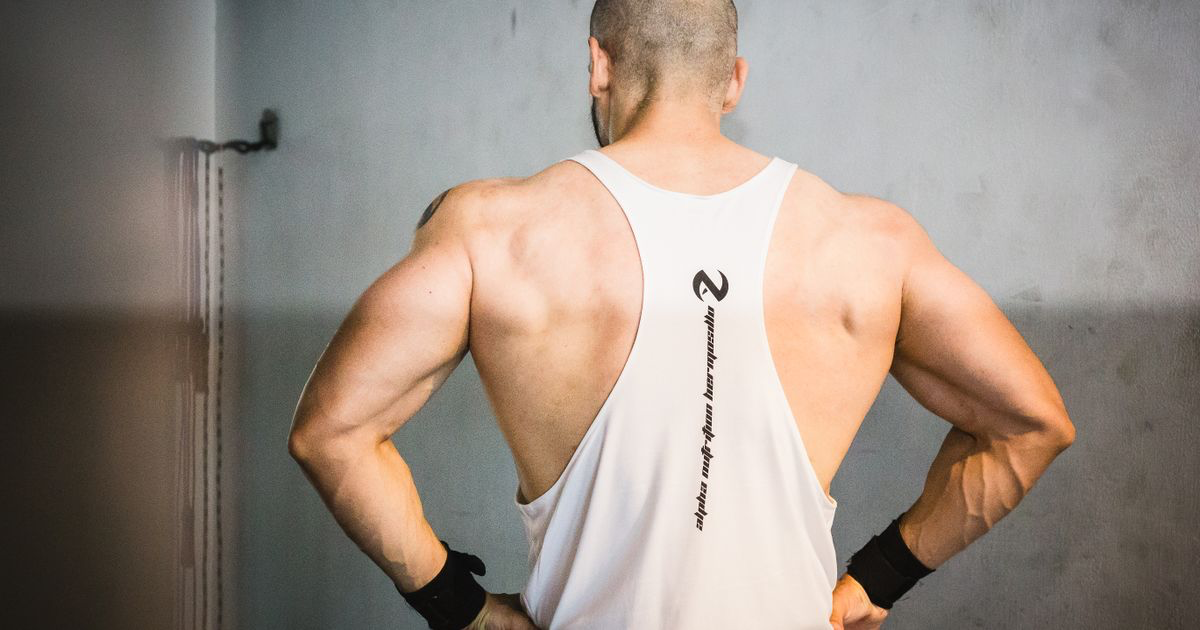
The upper trapezius runs from the base of your skull and your neck vertebrae out to the outer third of your collarbone and the top of your shoulder blade. When it contracts, it lifts and rotates the shoulder blade. That is the shrug, exactly.
Ekstrom, Donatelli and Soderberg tested ten exercises for the trapezius and serratus anterior in 30 healthy people, publishing in the Journal of Orthopaedic and Sports Physical Therapy. The unilateral shoulder shrug produced the greatest upper trapezius activity of everything they measured.
That is the whole case for the exercise. If you want the upper traps to grow, nothing else asks them for as much.
The middle and lower trapezius are a different story. They retract and depress the shoulder blade, which a shrug does not do. Rows and face pulls handle those.
How do you shrug with good form?
- Set up with the weight hanging at arm's length. Dumbbells at your sides, or a barbell in front of your thighs. Elbows straight and staying straight.
- Stand tall before you move. Chest up, chin neutral, weight through the middle of your foot.
- Lift your shoulders straight toward your ears. Vertical only. Nothing else in your body moves.
- Pause for a full second at the top. Count it. This is the difference between a shrug and a bounce.
- Lower all the way down. Let the shoulder blades travel to the bottom of their range, then start the next rep from there.
- Breathe out on the way up.
Do not roll your shoulders. Rolling adds a horizontal path that the upper traps do not produce and your shoulder joint does not need. It feels like more work because more joints are moving. It is not.
Should you shrug with a barbell or dumbbells?
| Barbell shrug | Dumbbell shrug | Trap bar shrug | |
|---|---|---|---|
| Usable load | Highest | Limited by grip and rack space | Highest |
| Range of motion | Slightly restricted by the thighs | Full | Full |
| Grip demand | High, straps often needed | Highest | High |
| Set-up cost | Rack or deadlift the bar first | Pick up and go | Needs a trap bar |
| Best for | Top-end loading | Range and per-side control | Both, if available |
Dumbbells win on range, barbells win on load, and the trap bar wins on both if your gym has one. Pick whichever one you can add weight to reliably, then stop switching.
Does grip strength limit your shrugs?
Usually, yes, and that is worth solving rather than working around.
The traps can handle more than the fingers can hold for the time a set of twelve takes. If your sets end because the bar is slipping, the traps never reached the point that would make them adapt.
Straps fix this directly. Our post on when to use lifting straps covers where they earn their place and where they cost you.
The alternative is to keep the reps lower and heavier, which trades grip time for load. Both work. What does not work is quietly doing lighter shrugs forever because the grip gave out first, and never noticing because none of it was written down.
Does arm position change the shrug?
There is some evidence that it does. Research published in Manual Therapy found that modifying the arm position during a shrug alters which scapular muscles are recruited, with abducted-arm variations shifting more work onto the upward rotators of the shoulder blade.
For a lifter, the practical version is simpler: the standard arms-at-sides shrug is the one that loads the upper traps heaviest. Variations are worth trying if the standard one bothers your shoulder, not because they are secretly better.
What are the most common shrug mistakes?
No pause at the top. The most common by a distance. A bounced shrug spends almost no time under tension in the shortened position, which is the only position the exercise trains.
Rolling the shoulders. Adds nothing, loads the joint at an angle.
Bending the elbows. Turns it into a half-hearted upright row and takes the traps out of it.
Cutting the bottom of the rep. Holding the shoulders permanently half-shrugged means a tiny range and no stretch.
Loading it like a deadlift. A shrug you cannot pause is not heavy, it is untrained.
Logging it as "shrugs". Barbell shrugs at 100kg and dumbbell shrugs at 40kg per hand are two different exercises with two different numbers. Merged, neither means anything.
How do the ways to track shrugs compare?
| Physical notebook | Notes app | Traditional gym app | Gym Note Plus | |
|---|---|---|---|---|
| Logging speed | Fast | Fast | Slow, many taps | Fast, plain text |
| Keeps barbell and dumbbell shrugs apart | If you remember | If you remember | Yes, if you pick the right entry | Yes, from your wording |
| Records the pause length | Free text | Free text | Rarely a field | Yes, free text |
| Turns loads into a trend | No | No | Yes | Yes, automatic |
| Notes whether straps were used | Free text | Free text | Rarely | Yes |
A simple starting plan
- Pick one variation and stay on it for eight weeks. Barbell or dumbbell, not both.
- Choose a weight you can pause for one full second on every rep. If rep eight has no pause, it was too heavy.
- Run three sets of eight to fifteen, twice a week, on the days you already train back or shoulders.
- Use straps once grip becomes the limit, and write down that you did.
- Add reps to the top of the range, then add weight. Log every set as something like
barbell shrug 90kg 12,12,10, 1s pause, straps.
Keep logging the way you already do
Shrugs are an accessory exercise, and accessory exercises are where logging discipline goes to die. They come last, they feel minor, and they never get written down.
Which is why nobody knows whether their traps have grown or whether they have been shrugging the same 60kg for two years.
Gym Note Plus takes the line you would have typed anyway and turns it into a tracked exercise.
- Type
barbell shrug 90kg 12,12,10and it becomes structured, charted sets. - Barbell and dumbbell shrugs stay separate, tracked separately.
- Notes on the pause, the straps and the grip stay attached to the session.
- Old notes import, so the accessory work you did record still counts.
Want to see what your own shorthand becomes? Paste a session into the free notes to workout translator.
A shrug without a pause is a rep you did, not a rep that trained anything. Write the pause down or you will lose it inside a month.
Frequently Asked Questions
What muscles does the shrug work?
The shrug primarily trains the upper trapezius, with assistance from the levator scapulae and rhomboids. Research in the Journal of Orthopaedic and Sports Physical Therapy tested ten trapezius exercises in 30 people and found the unilateral shoulder shrug produced the greatest upper trapezius activity of any exercise measured.
Should you roll your shoulders when shrugging?
No. Rolling adds horizontal shoulder movement that the upper trapezius does not produce and places the shoulder joint under load at an awkward angle. The upper trapezius elevates the shoulder blade vertically, so a straight-up shrug with a one-second pause at the top trains it more directly and more safely.
How many reps should you do on shrugs?
Eight to fifteen reps suits most lifters, taken close to failure with a full one-second pause on every rep. Heavier, lower-rep shrugs are usable if your grip holds, but the pause is what makes the exercise work, and it is the first thing to disappear when the load is too high.
Are barbell or dumbbell shrugs better?
Neither is better outright. Barbell shrugs allow the heaviest load but the bar sits against your thighs, slightly restricting range. Dumbbell shrugs allow a full range and per-side control but are limited by grip and available dumbbell weights. Pick the one you can add weight to consistently and stay with it.
Do you need to train traps directly if you deadlift?
Deadlifts load the upper trapezius isometrically to hold the shoulder blades in place, which builds strength but does not take the muscle through its range. If you want the upper traps to grow visibly, add direct shrugs. Six to twelve hard sets a week across two sessions is a reasonable starting point.
Final Takeaways
- The pause is the exercise. One full second at the top, or the set does not count.
- Straight up, never rolled. Rolling adds joint stress and no extra trapezius work.
- Pick one variation and progress it. Barbell, dumbbell or trap bar, then stop switching.
- Fix the grip, not the weight. Straps let the traps reach the load they can actually handle.
- Log the variation and the pause. "Shrugs 90kg" is a record of nothing.

Josh Ibbotson
Josh is the creator of Gym Note Plus, building tools that make workout tracking as simple as taking notes.
Ready to try it out?
Download Gym Note Plus and start tracking your workouts the way you want.
Download on App Store