
How to Do Face Pulls
Quick answer: Set a rope at roughly eye height on a cable machine, take an overhand grip, and pull the rope towards your forehead while spreading your hands apart and rotating your knuckles up. Your elbows should finish high and wide. Use a light weight and 12 to 20 reps.
The face pull is the exercise everyone tells you to do and almost nobody does properly. Watch a gym for ten minutes and you will see it performed as a very bad cable row, elbows dropping, the whole body rocking backwards.
Done right it is one of the few movements that trains the rear delts and the muscles that hold your shoulder blades in place, which are exactly the ones a lot of pressing leaves behind.
What muscles do face pulls work?
Rear deltoids. The back head of the shoulder, which pulls the upper arm backwards and out to the side. It gets almost nothing from rows done with a tucked elbow.
Middle and lower trapezius. The parts of the traps that pull your shoulder blades together and down. Most people train the upper traps constantly and these two barely at all.
Rhomboids. Underneath the traps, between the shoulder blade and the spine, doing the same job of pulling the blades together.
External rotators of the shoulder. The infraspinatus and teres minor, the small muscles that rotate your upper arm outwards. The knuckles-up finish is what recruits them, and it is the part most people skip.
It is an isolation exercise in the sense that matters: light, high rep, and not something you should be grinding. If the difference between that and a compound lift is not obvious, compound vs isolation exercises explains it.
How do you set up a face pull?
- Set the pulley at eye height or slightly above. Too low and it becomes a row. Too high and your lats take over.
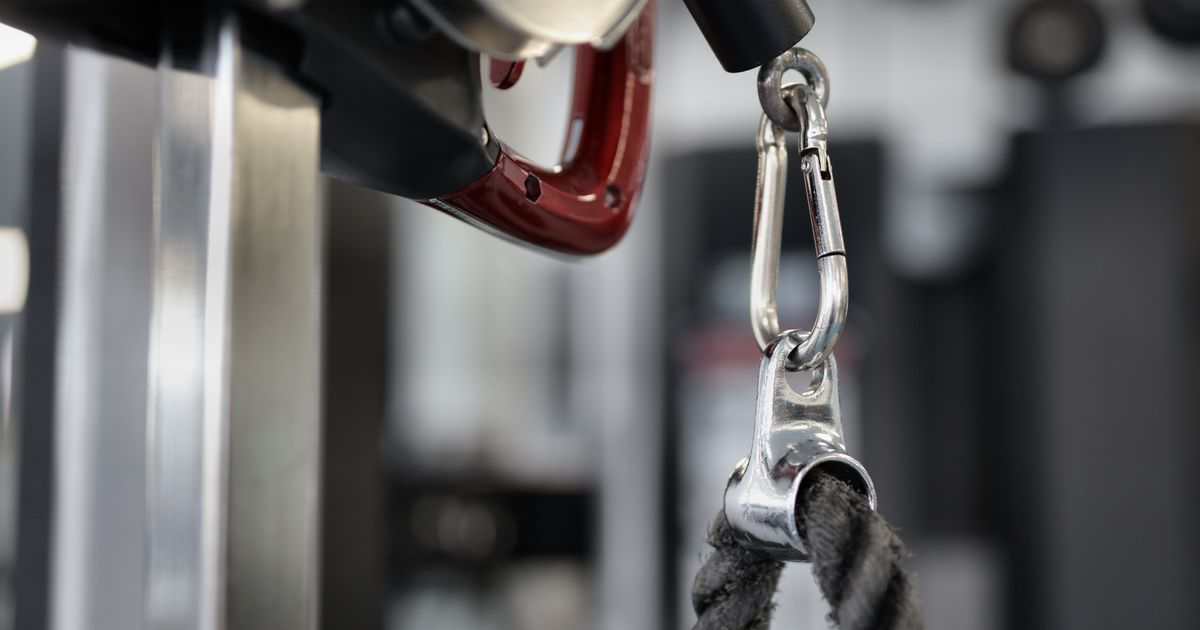
- Attach a rope. A single rope works. A double rope or two D-handles gives you more room to spread at the end, which some people prefer.
- Take an overhand grip. Thumbs pointing down at the start, palms facing the floor. Grab the rope above the stoppers, not on them.
- Step back until the cable is taut with your arms straight. You want tension before the first rep, not slack you have to take out.
- Stand in a split stance. One foot forward. This stops the backwards rocking that turns the lift into a whole-body movement.
How do you perform the rep?
Pull the rope towards your face, leading with your elbows rather than your hands.
Your elbows go up and out. They should finish level with or slightly above your shoulders, pointing out to the sides. This is the single detail that decides whether the exercise trains your rear delts or your lats.
Spread your hands apart at the end. The rope ends should pass either side of your head, not stack in front of your nose.
Rotate your knuckles towards the ceiling. As your hands pass your face, turn them so your palms end up facing forward and your knuckles point up. That external rotation is where the rotator cuff work comes from.
Hold for a beat. One second at the end position, then lower under control over two seconds. Do not let the stack drag your arms forward.
Your torso stays still throughout. If your ribs are flaring or your lower back is arching to help, the weight is too heavy.
What are the most common face pull mistakes?
Too much weight. Far and away the biggest one. The rear delts and external rotators are small; loading a face pull like a cable row means your traps and biceps do it instead.
Elbows dropping. If your elbows finish below shoulder height, you have done a high row. It trains the mid back, which is fine, but it is not what you came for.
Pulling to the chest. The clue is in the name. To the face, or to the forehead.
No external rotation. Stopping when the rope reaches your face, hands still palms-down, cuts out the rotator cuff entirely.
Rocking backwards. Using bodyweight to move the stack. The split stance fixes it. So does dropping the weight.
Shrugging. Upper traps rising towards your ears means the load has moved to the muscle you were trying to avoid.
How much weight and how many reps?
Start absurdly light. Lighter than you think. Most people should begin somewhere around 10 to 15 kg on a cable stack and many gyms' lightest plate is already enough.
Rep range: 12 to 20. This is a movement that responds to control and range of motion, not load. A set of 8 heavy face pulls is a set of 8 badly performed rows.
Sets: 2 to 4 per week. It is accessory work. Two sets at the end of a push day and two at the end of a pull day covers most people.
Progression is slow and that is normal. You will spend a long time on the same plate, adding reps rather than weight, for the same reason dumbbell jumps feel impossible on small lifts. Add reps to the top of your range, then move up one plate and expect to lose reps.
What if your gym has no cable machine?
Band face pulls. Loop a resistance band around a rack at eye height and do the identical movement. Bands are arguably better here, because tension rises as you spread your hands, which is exactly where you are weakest.
Prone rear delt raise. Lie face down on an incline bench and raise light dumbbells out to the sides with your thumbs up. It trains the rear delts well, though it drops the external rotation component.
Reverse pec deck. Fine substitute if the machine allows a high enough arm position, though most set the arms at chest height.
None of these are quite the same exercise. The band version is the closest.
A simple starting plan
- Add two sets to the end of your next push day. Do not build a session around face pulls. They are the thing you do while you catch your breath.
- Pick the lightest plate that still feels like something. If you can do 20 clean reps with knuckles rotating fully, that is the right weight.
- Film one set from the side. You are checking one thing: are your elbows above shoulder height at the end?
- Run 3 sets of 15 twice a week for a month. Same weight throughout. The goal is the movement, not the load.
- Write down the setup alongside the numbers.
Face pull (rope, eye height) 15kg 3x15will still mean something in six months.Face pull 15kgwill not, because you will not remember what height the pulley was at.
Where do you write all that down?
Face pulls are exactly the exercise whose log needs more than a weight and a rep count. Pulley height, attachment, whether you were on the good cable stack or the sticky one. All of it changes the numbers.
| Physical notebook | Notes app | Traditional gym app | Gym Note Plus | |
|---|---|---|---|---|
| Logging speed | Slow, needs a pen | Fast, plain typing | Slow, tap through menus | Fast, plain typing |
| Room for setup details | Anywhere on the line | Anywhere on the line | A notes field, if there is one | Kept with the set as written |
| Data visualization | None | None | Charts, once entered | Automatic per-exercise charts |
| Searchability | None | Basic text search | Good, within its structure | Full history, searchable |
Notes apps let you write anything and give you nothing back. Traditional gym apps give you charts but make you fight their form fields to record "eye height, double rope".
Gym Note Plus reads the line as you wrote it. Your setup notes stay attached to the sets, and the sets still become a chart.
- Type
Face pull rope eye height 15kg 15/15/14and get three logged sets - Per-exercise rep and weight trends, so slow accessory progress is still visible
- Your shorthand and your setup notes survive
- Search back months for what height and attachment you used last time
Paste your last session into the free notes to workout translator to see it work on your own shorthand.
A face pull done with your elbows below your shoulders is just a bad row. Nothing about the weight on the stack changes that.
Frequently Asked Questions
How do you do a face pull correctly?
Set a cable pulley to eye height with a rope attachment, take an overhand grip, and step back until the cable is taut. Pull the rope towards your forehead, leading with your elbows so they finish level with your shoulders, spread your hands apart past your head, and rotate your knuckles towards the ceiling.
What muscles do face pulls work?
Face pulls train the rear deltoids, the middle and lower trapezius, the rhomboids, and the external rotators of the shoulder, mainly the infraspinatus and teres minor. The high elbow position recruits the rear delts and mid traps, while the knuckles-up rotation at the end is what brings in the rotator cuff.
How much weight should you use for face pulls?
Much less than for a cable row. Most lifters should start around 10 to 15 kg on a cable stack, and in many gyms the lightest plate is enough. If you cannot finish the rep with your elbows above shoulder height and your knuckles rotating upward, the weight is too heavy regardless of the number.
How many reps should you do for face pulls?
Twelve to 20 reps, for 2 to 4 sets across the week. Face pulls target small muscles that respond to control and full range of motion rather than heavy load. Sets of 8 heavy reps almost always turn into a high row performed with the traps and biceps.
Can you do face pulls with a resistance band?
Yes, and a band is the closest substitute when no cable machine is available. Loop the band around a rack at eye height and perform the identical movement. Band tension increases as you spread your hands apart, which loads the end range where the rear deltoids and external rotators are weakest.
Final Takeaways
- Pulley at eye height, rope attachment, overhand grip. Setup decides most of the outcome.
- Elbows high and wide. If they drop below your shoulders, you are doing a row.
- Rotate the knuckles up. Skipping this removes the rotator cuff work entirely.
- Go light and go for 12 to 20 reps. Loading a face pull heavily just hands the work to your traps.
- Log the setup with the set. Pulley height and attachment change the numbers, in the same way a lateral raise changes when you sit down for it.

Josh Ibbotson
Josh is the creator of Gym Note Plus, building tools that make workout tracking as simple as taking notes.
Ready to try it out?
Download Gym Note Plus and start tracking your workouts the way you want.
Download on App Store