

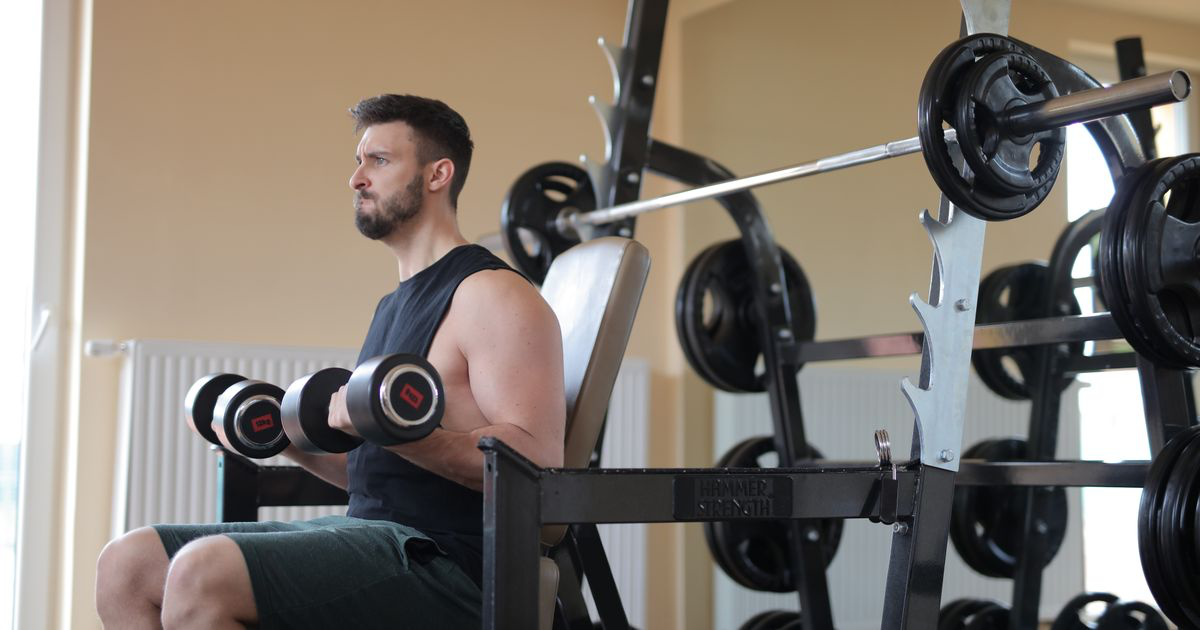
Time Under Tension: What It Does and Does Not Do
Quick answer: Time under tension is how long a muscle stays loaded during a set. It matters, but it is oversold. Research finds hypertrophy is similar across rep durations from about 0.5 to 8 seconds. Deliberately slowing reps past roughly 10 seconds appears worse. Control the eccentric, do not count seconds.
You have heard it on the gym floor. Slow it down, feel the burn, your muscles do not count reps, they count seconds under tension.
Half of that is true. The half that gets left out is that slowing a rep forces you to use less weight, and the weight is doing most of the work.
What is time under tension?
Time under tension (TUT) is the total number of seconds a muscle spends loaded during a set. Eight reps at three seconds each is roughly 24 seconds of TUT. The same eight reps banged out in one second each is closer to 8 seconds.
Tempo training assumes the longer number produces more growth, because mechanical tension is the main driver of hypertrophy.
The problem is that TUT and load move in opposite directions. Add four seconds per rep and the weight on the bar has to come down. You bought seconds and paid in tension.
Does time under tension actually build muscle?
Some, but far less than the slogan implies. The most direct evidence is a meta-analysis, and its answer sits closer to "tempo barely matters within a normal range" than to "slower is better."
What the meta-analysis found
In a 2015 systematic review and meta-analysis in Sports Medicine, Schoenfeld, Ogborn and Krieger pooled eight studies comparing different repetition durations. Hypertrophy outcomes were similar across durations ranging from 0.5 to 8 seconds per rep.
The one clear exception was the slow end. The authors noted that volitionally very slow durations, over about 10 seconds per repetition, look inferior for hypertrophy, while cautioning that few controlled studies exist on that specific question.
So a 1-second rep and a 6-second rep landed in roughly the same place. A 15-second rep did not.
The protein synthesis study everyone quotes
The Burd study is real, and it is narrower than the internet version of it. In a 2012 study in The Journal of Physiology, eight men did unilateral knee extensions at 30% of their one-rep max. One leg used 6-second concentric and eccentric actions and went to failure. The other did a work-matched bout at 1 second per action.
Myofibrillar protein synthesis, the fraction tied to muscle growth, was higher in the slow condition during the 24 to 30 hour recovery window.
That is a genuine finding. It is also one acute measurement in eight men at very light loads, and acute protein synthesis predicts long-term growth poorly. The 2015 meta-analysis measured actual muscle size over training programs and found no matching advantage.
What a review of tempo research concluded
A 2021 review in Sports Medicine by Wilk, Zajac and Tufano put it plainly: neither isolated slow nor isolated fast movement tempos are more effective for hypertrophy, though a slower eccentric paired with a faster concentric may be the most useful combination.
The things that outrank tempo are boring and well established. Total weekly volume shows a graded dose-response relationship with muscle growth in a 2017 meta-analysis by the same group, and how close you take a set to failure changes the stimulus more than how you count the seconds. Get your weekly set count and proximity to failure right first.
What do tempo numbers like 3-1-1-0 mean?
Tempo is written as four digits, each one a phase of the rep in seconds. Programs write it as 3-1-1-0 or @3110, and the order almost always starts with the eccentric.
| Digit | Phase | In a bench press |
|---|---|---|
| 1st | Eccentric (lowering) | Bar travels down to the chest |
| 2nd | Pause at the bottom | Bar held at the chest |
| 3rd | Concentric (lifting) | Bar pressed back up |
| 4th | Pause at the top | Lockout before the next rep |
So 3-1-1-0 means lower for three seconds, pause one second, press for one second, no pause at the top, repeat.
Two conventions worth knowing. An X in the third slot means explosive, so 3-0-X-0 is a controlled lowering and a maximal-intent press. A 0 never means "drop it," it means no deliberate pause.
Total that line up and you get your TUT. A 3-1-1-0 set of 8 is 40 seconds. The same 8 reps at 2-0-1-0 is 24 seconds. That gap is the entire argument, and the research says it is a small one.
When is controlling tempo worth it?
Tempo earns its place as a technique tool, not a growth hack. These are the cases where prescribing seconds does something a rep count cannot.
- Learning a new movement. A slow eccentric gives you time to notice where your knees, elbows, or ribcage are going. Speed hides errors.
- Taking momentum out. If your rows are half bicep curl and half hip thrust, a 3-second lowering plus a one-second pause makes cheating impossible.
- Machines and isolation work. Cable flyes, leg extensions and lateral raises are cheap to control and easy to bounce through. Tempo work costs you least here.
- Managing joint stress. When a load irritates an elbow or a shoulder, dropping the weight and slowing the eccentric keeps stimulus while cutting peak forces.
- Loading the stretched position. A pause at the bottom holds the muscle at length under load, which connects to stretch-mediated hypertrophy.
When to ignore it
Heavy compound barbell work. On a top-set squat or deadlift, the bar moves at the speed it moves. Counting seconds under a near-maximal load adds risk and subtracts reps.
When it makes sets harder without making them better. Grinding out six reps with a weight you used to press for twelve is not progress, it is junk volume with a stopwatch attached.
How do you log tempo?
Write it as a suffix on the line and nothing else changes. Tempo is four characters, so it fits the same way RIR does: Squat 80 3x8 @3010.
That token is what makes a tempo experiment readable later. Leg ext 40 3x12 looks identical whether you controlled every rep or bounced through them. Leg ext 40 3x12 @3010 tells you which one happened, so when you hit 45kg next month you know it came under the same rules.
Some common formats, all fine if you stay consistent:
Squat 80 3x8 @3010Squat 80 3x8 (3-1-1-0)Squat 80 3x8 slow ecc
The last one is honestly enough for most people. Our workout shorthand guide covers the rest of the symbols you will meet in a program.
Where you write it changes what you can do with it:
| Physical Notebook | Notes App | Traditional Gym App | Gym Note Plus | |
|---|---|---|---|---|
| Logging speed | Fast | Fast | Slow (menus and dropdowns) | Fast (plain text) |
| Recording tempo | Write it anywhere | Write it anywhere | Often no field for it | Parsed from the line |
| Data visualization | None | None | Charts | Charts from your own notes |
| Flexibility | Total | Total | Rigid templates | Total |
| Searchability | Poor | Text search only | Structured search | Structured search |
If you already type lines like this into your phone, paste a session into the free notes to workout translator and watch it come back as sets, reps and charts without reformatting anything.
A simple starting plan
- Pick two isolation exercises this week and control the lowering on both. Three seconds down, no pause, normal speed up. Nothing else changes.
- Drop the weight by about 10% on those two. A controlled eccentric costs you load. Expect it and stop fighting it.
- Leave your compounds alone. Squats, deadlifts and presses stay at whatever speed lets you move the most weight with good technique.
- Log the tempo as a suffix, like
Lat raise 12 3x12 @3010, so next month's line is comparable to this one. - Judge it in four weeks on the numbers, not the burn. If the controlled version is adding reps and weight, keep it. If it stalled, go back.
Where does Gym Note Plus fit in?
Your notes app already handles this fine. Tempo is four characters on the end of a line, and no app menu will ever beat typing @3010. If you log in Apple Notes or a paper notebook, nothing here says you should stop.
The gap opens later. Four weeks after you start controlling your eccentrics, nobody scrolls back through a wall of notes to check whether the lateral raise line actually moved. Gym Note Plus reads the text you already write and does that part:
- Type
Squat 80 3x8 @3010and it logs three sets of eight at 80kg with the tempo attached. - Charts build themselves per exercise, so a tempo change in March is measurable in June.
- Your notation stays yours. Weight, reps, RIR, tempo and free-text comments live on one line.
- You never reformat anything. Paste a whole session in and it parses.
Tempo is worth controlling and rarely worth counting. Write down what you did, then let the numbers over eight weeks tell you whether it helped.
Frequently Asked Questions
Does time under tension build muscle?
Time under tension contributes to muscle growth, but it is not the primary driver. A 2015 Sports Medicine meta-analysis found similar hypertrophy across repetition durations of roughly 0.5 to 8 seconds. Total training volume and how close each set gets to failure matter considerably more than how many seconds a rep takes.
What is a good time under tension per set?
Most productive hypertrophy sets land somewhere between 20 and 60 seconds of tension, which happens naturally with 6 to 15 controlled reps. No specific target has been shown superior. Rather than timing sets, pick a rep range you can progress in and avoid rushing or artificially dragging out the reps.
What does 3-1-1-0 tempo mean?
Tempo notation 3-1-1-0 prescribes four phases in seconds: three seconds lowering the weight, a one-second pause at the bottom, one second lifting it, and no pause at the top. An X in the third position means lift explosively. Programs use tempo notation to control technique rather than to increase total workout time.
Is slower always better for muscle growth?
Slower is not always better. Research on repetition duration found comparable hypertrophy across a broad range of tempos, and very slow reps beyond roughly 10 seconds each appear worse, partly because they force much lighter loads. A controlled eccentric with a normal-speed concentric captures most of the benefit.
Should beginners use tempo training?
Beginners benefit from controlling the eccentric because it teaches positions and removes momentum, but they should skip formal tempo prescriptions. Counting four separate phases while learning a squat splits attention that technique needs. Lowering under control for two or three seconds, then lifting normally, covers everything a new lifter requires.
Final Takeaways
- Time under tension is real but oversold. Hypertrophy looks similar across rep durations from about 0.5 to 8 seconds.
- Very slow reps are the one clear loser. Past roughly 10 seconds per rep, the load drops far enough that growth suffers.
- Volume and proximity to failure outrank tempo. Fix those before you touch a stopwatch.
- Control the eccentric, skip the counting. Two or three seconds down on isolation work does the job without a metronome.
- Log tempo as a suffix.
Squat 80 3x8 @3010costs four characters and makes next month's comparison honest, whether you write it on paper, in notes, or in Gym Note Plus.

Josh Ibbotson
Josh is the creator of Gym Note Plus, building tools that make workout tracking as simple as taking notes.
Ready to try it out?
Download Gym Note Plus and start tracking your workouts the way you want.
Download on App Store