
How to Do an Overhead Tricep Extension (Form, Muscles, and Progression)
Quick answer: To do an overhead tricep extension, hold a dumbbell or cable rope above your head with your elbows pointing forward. Bend only at the elbows to lower the weight behind your head until your triceps are fully stretched, then straighten your arms. Keep your upper arms still and your ribs down.
Most people train their triceps with pushdowns and call it done. The overhead extension is the one they skip, usually because it feels awkward, the weight is embarrassingly light, and their elbows flare all over the place.
The light weight is expected. Your arm position makes the triceps work from a longer, weaker length, and a well-run 12-week study suggests that is exactly why the exercise builds more muscle.
What muscles does the overhead tricep extension work?
All three triceps heads, with the long head doing far more than usual.
- Long head. The biggest of the three. It starts on the shoulder blade, so raising your arm overhead stretches it before you even bend the elbow. This is the head the exercise exists for.
- Lateral head. The outer part of the upper arm. It works through the whole rep, especially near lockout.
- Medial head. Sits underneath the other two and assists on every rep.
Your shoulders, upper back, and core hold the arm in place. They stabilise; they are not the muscles being trained.
Why does the arm position matter so much?
Because a stretched muscle under load seems to grow more. Maeo and colleagues had 21 adults train cable elbow extensions with one arm overhead and the other at their side, at 70% of one-rep max, five sets of 10, twice a week for 12 weeks.
The overhead arm grew the long head 28.5% against 19.6% for the arm at the side. Whole triceps volume rose 19.9% against 13.9%. Strength gains were similar, even though the overhead arm always lifted 34 to 39% less weight.
So a lighter number on the overhead extension tells you about the position, not about your strength. For the bigger picture behind this finding, see which muscles benefit from stretch-mediated hypertrophy.
How do you do an overhead tricep extension with correct form?
The dumbbell version, step by step:
- Sit on a bench with back support, or stand with a slight brace. Seated is easier to keep strict.
- Cup one end of a dumbbell with both hands, thumbs wrapped around the handle, and press it overhead.
- Point your elbows forward, roughly shoulder-width apart. Not straight out to the sides.
- Lower the weight behind your head by bending only at the elbows. Go until your forearms touch your biceps or your triceps are fully stretched.
- Pause for a beat in the bottom position.
- Straighten your arms back to the top without letting your upper arms swing forward.
Lower for two to three seconds. Bouncing out of the bottom is where elbows get sore.
What is the cable overhead tricep extension setup?
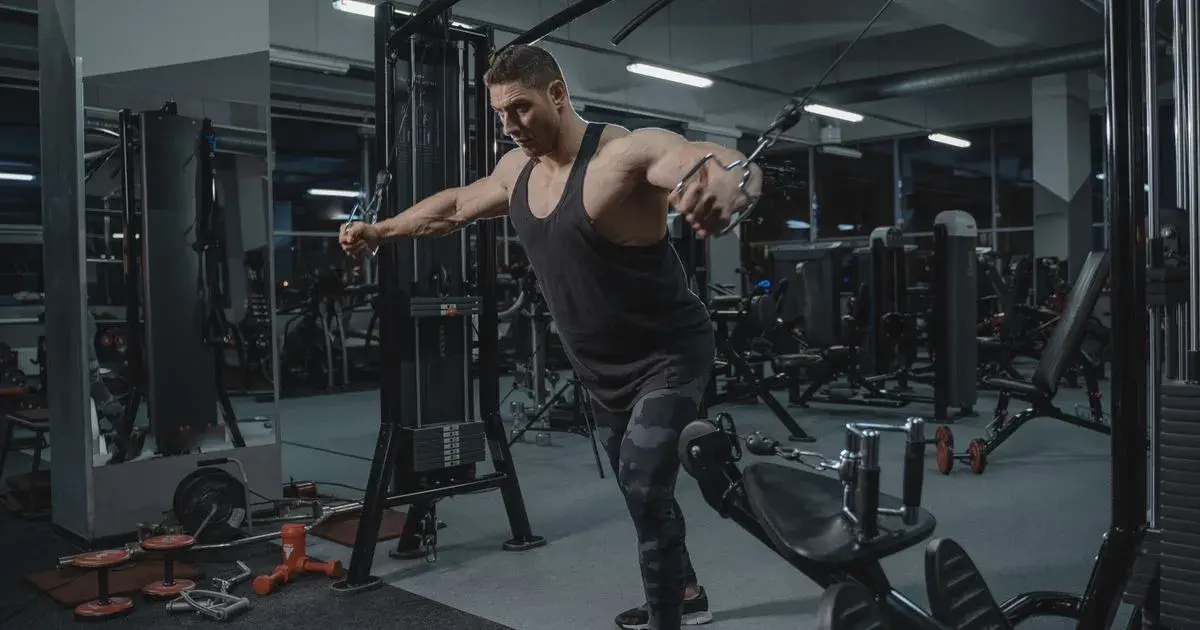
Set the pulley low or at roughly chest height, attach a rope, and turn away from the stack. Take a staggered stance, lean your torso forward a little, and start with your hands behind your head and your elbows by your ears. Extend forward and up until your arms are straight, then let the rope pull your hands back behind your head.
The cable keeps tension at the bottom of the rep, where a dumbbell gets lighter as your forearms hang straight down.
Cable vs dumbbell overhead tricep extension: which is better?
The cable and dumbbell overhead tricep extensions both put the long head in a stretched position, which is the part that counts. They differ in feel and setup.
- Dumbbell. Needs only a dumbbell and a bench. Easy to learn. The load drops off near the bottom and a heavy dumbbell over your head gets awkward to handle.
- Cable. Constant tension through the whole range, which matches how the Maeo study was run. You need a cable station, and changing the pulley height changes the exercise.
- EZ bar. Lets you load heavier with a comfortable grip, but it is harder on the elbows for many lifters.
- Single arm. Good for evening out a weaker side and for anyone whose shoulders do not like both arms overhead at once.
The simple rule: use the cable if your gym has a free one, and the dumbbell when it does not. Pick one and stay with it for a training block so your numbers mean something.
What are the most common overhead tricep extension mistakes?
- Elbows flaring out. Wide elbows let the chest and shoulders join in. Keep them pointed forward, shoulder-width.
- Arching the lower back. If your ribs flare as the weight goes up, brace harder or sit with back support.
- Cutting the range short. Stopping halfway skips the stretch, which is the reason to do this exercise instead of another pushdown.
- Going too heavy too soon. Big loads behind the head are rough on the elbows. Lighter and slower works better here.
- Moving the upper arms. If your elbows drift forward and down on the way up, it has become a pullover.
Test it. Film one set from the side. If your upper arms stay fixed and the weight reaches a full stretch on every rep, the load is right.
How many sets and reps should you do?
Two to four sets of 8 to 15 reps works for most lifters. The triceps handle volume well, and the overhead position is uncomfortable under very heavy loads, so moderate reps suit it.
Rest 60 to 90 seconds. Put the extension after your pressing work, since tired triceps cost you reps on presses. If you also do pushdowns, one overhead movement and one pushdown cover all three heads well. Our guide on how to do a tricep pushdown covers the other half.
How do you progress the overhead tricep extension?
Dumbbells usually jump in 2 kg or 5 lb steps, and cable stacks in bigger plates. On a small muscle, that jump is a large percentage, so progress with reps first.
- Pick a weight you can control for 10 reps with a full stretch.
- Add a rep or two each session until every set hits 15.
- Move up to the next dumbbell or plate and drop back toward 10 reps.
- If the jump is too big, slow the lowering to three seconds or add a set at the old weight first.
If you are unsure when a jump is earned, when to increase weight lifting gives you a clear rule.
How should you log overhead tricep extensions?
"Tricep extension 20x12" is a weak log entry. Was it a dumbbell or a cable? Seated or standing? Rope or bar? Each of those changes what you can lift, and the Maeo data shows arm position alone changed the load by more than a third.
A useful entry names the version: OH ext, cable rope, plate 6: 12, 11, 10.
| Feature | Physical Notebook | Notes App | Traditional Gym App | Gym Note Plus |
|---|---|---|---|---|
| Logging speed | Slow, needs a pen | Fast, free typing | Slow, tap through menus | Fast, free typing |
| Recording the variation | Yes, if you remember | Yes, free text | Often one fixed exercise name | Yes, free text |
| Data visualization | None | None | Charts | Charts from your text |
| Flexibility | Total | Total | Rigid exercise list | Total |
| Searchability | None | Text search only | Structured search | Structured search |
A simple starting plan
- Choose one version (cable rope or seated dumbbell) and use it for the next six weeks.
- Start lighter than you think. Pick a weight you can lower to a full stretch for 12 slow reps.
- Do three sets of 10 to 15 after your presses, resting 60 to 90 seconds.
- Write down the version and the load every session, not just the number.
- Add reps until all sets reach 15, then move up one step and start again near 10.
Already logging your sets in a notes app?
Typing your sets into your phone between exercises is a good habit. It is fast, and it handles details like "cable 3, rope, seated" without forcing them into a dropdown.
The gap is that months of those lines never turn into a chart, so you cannot see whether your overhead extension has actually moved.
Gym Note Plus keeps the typing and fills that gap:
- Log sets as plain text, with whatever variation notes you like.
- Per-exercise charts build themselves from what you type.
- Stalled accessories show up quickly, so you know when to change something.
- Old notes import, so your existing history comes with you.
Paste your last arm day into the free notes to workout translator to see how your current notes turn into tracked sets.
The overhead extension looks light because the position makes it hard. Use that weight, take the full stretch, and log which version you did.
Frequently Asked Questions
What muscles does the overhead tricep extension work?
The overhead tricep extension works all three heads of the triceps: the long, lateral, and medial heads. It emphasises the long head, because raising the arm overhead stretches that head across the shoulder joint. The shoulders, upper back, and core work only as stabilisers that hold the arm in position.
Is the overhead tricep extension better than the tricep pushdown?
For triceps growth, the overhead tricep extension has the stronger evidence. In a 12-week trial by Maeo and colleagues, overhead cable extensions grew the whole triceps 19.9% compared with 13.9% for extensions with the arm at the side. Pushdowns still allow heavier loads, so many programs use both.
Should you use a cable or dumbbell for overhead tricep extensions?
Both cable and dumbbell overhead tricep extensions stretch the long head, which is the main benefit. The cable keeps tension at the bottom of the rep and matches the setup used in the research. The dumbbell needs less equipment and is easier to learn. Pick one and keep it consistent within a block.
Why do overhead tricep extensions hurt my elbows?
Overhead tricep extensions usually hurt the elbows because the load is too heavy or the bottom of the rep is bounced. Drop the weight, lower for two to three seconds, and pause briefly at the stretch. Switching to a cable, a rope, or a single-arm version also reduces strain for many lifters.
How heavy should an overhead tricep extension be?
An overhead tricep extension should be light enough to lower to a full stretch for at least 10 controlled reps with the upper arms still. Expect to use roughly a third less weight than on an extension with the arms at your sides, as the Maeo trial found loads 34 to 39% lower overhead.
Final Takeaways
- Put your arm overhead to train the long head. The stretched position is what makes this exercise worth doing.
- Keep your elbows forward and still. Only the forearms move.
- Take the full stretch at the bottom, under control, with a short pause.
- Accept the lighter weight. The research shows similar strength gains and more growth with less load.
- Add reps before weight, working from 10 up to 15 before each jump.
- Log the exact version you did, so next month's numbers compare like with like.

Josh Ibbotson
Josh is the creator of Gym Note Plus, building tools that make workout tracking as simple as taking notes.
Ready to try it out?
Download Gym Note Plus and start tracking your workouts the way you want.
Download on App Store