
Incline Bench Press Muscles Worked: Chest vs Front Delts
Quick answer: The incline bench press works the clavicular head of the pectoralis major (your upper chest), the anterior deltoid, and the triceps. At about 30 degrees the upper chest leads. Set the bench steeper than that and the front delt takes over, so an incline press gradually becomes a shoulder press.
Your notes app says Incline BB 3x8 @ 60. It does not say what the bench was set to.
Two months later you press the same weight at what turns out to be a steeper angle, it feels harder, and you conclude you got weaker. You did not. You changed the exercise and did not write it down.
How does bench angle change which muscles work?
Around 30 degrees, and this one is actually settled reasonably well.
Researchers put 30 trained adults through the bench press at five inclinations, 0, 15, 30, 45, and 60 degrees, each at 60 percent of their one-rep max for that angle, and measured muscle activity throughout. The results were published in the International Journal of Environmental Research and Public Health.
Two findings matter for how you set the bench.
The upper chest peaked at 30 degrees. Activation of the upper portion of the pectoralis major was highest there, and it did not keep climbing as the bench got steeper. At 45 and 60 degrees it dropped back toward flat-bench levels.
The front delt kept climbing. Anterior deltoid activation rose steadily with the angle and was significantly higher at 45 and 60 degrees than at flat. Past about 30 degrees you are progressively converting a chest press into a shoulder press.
Triceps activity stayed roughly flat across every angle, at around 15 percent of maximum voluntary contraction, so the angle is not a triceps decision.
If your gym's benches only have fixed notches, take the one closest to 30 and note which hole you used.
Our incline bench press angle guide works through every setting from flat to 60 degrees.
How do you incline bench press with good form?
Set the shoulder blades before you unrack. Pull them down and back into the bench and keep them there for the whole set. This is the difference between pressing off a stable base and pressing off your shoulder joint.
Plant your feet and keep your hips down. A small arch in the lower back is fine. Lifting your hips off the bench to grind out a rep turns the movement into a worse flat bench.
Grip slightly wider than shoulder width. Roughly the same grip you use on flat bench, sometimes a touch narrower because of the angle.
Lower to the top of the chest, just below the collarbone. Not to the sternum, which is where a flat bench bar path wants to go. Take two seconds on the way down and keep the elbows at roughly 45 to 60 degrees from your torso rather than flared straight out.
Press up and slightly back. The bar should finish over your upper chest or chin, not out in front of you. Pressing straight up from an incline puts the bar too far forward and loads the front delt.
One cue covers most of it: think about driving your shoulder blades into the bench rather than pushing the bar away from you.
What muscles does the incline bench press work?
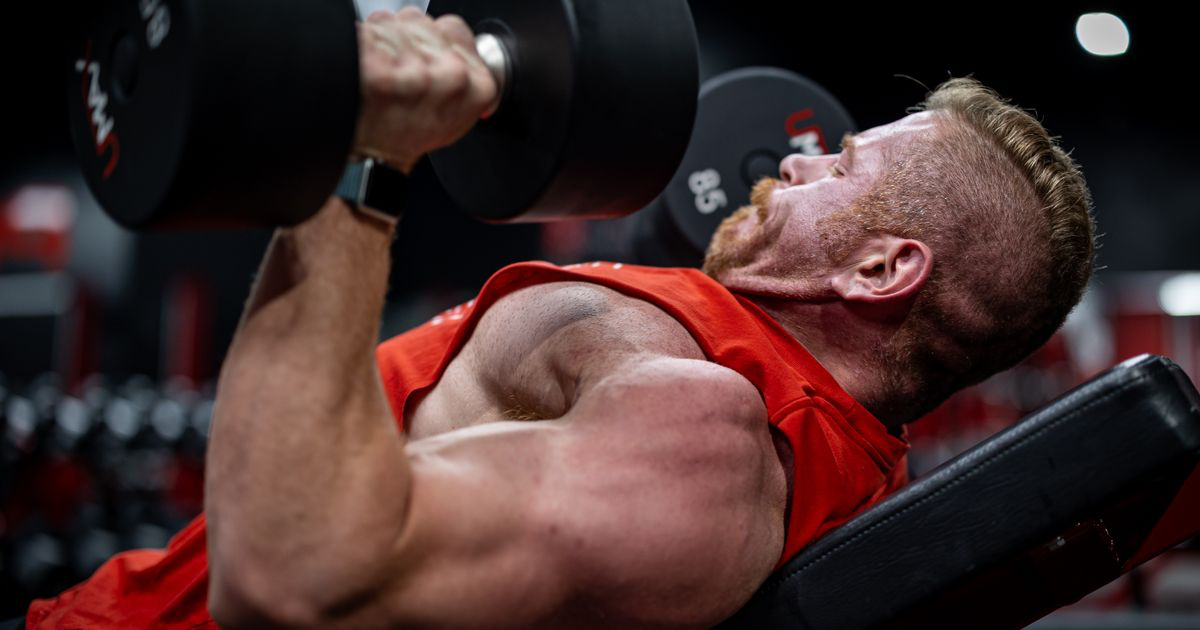
The incline bench press works the chest, front delts, and triceps, with the emphasis shifted upward compared with flat bench.
- Pectoralis major, clavicular head. The upper chest fibres, and the reason people program this lift at all.
- Anterior deltoid. A genuine contributor at 30 degrees and an increasingly dominant one above it.
- Triceps brachii. Extends the elbow and finishes the rep at lockout, working about as hard as it does on flat bench.
- Serratus anterior and upper back. Stabilise the shoulder blades so the press has something solid to work against.
Worth noting that the same study found the middle and lower portions of the pectoralis major decreased in activation at every inclination compared with a flat bench. Incline bench does not replace flat bench, it complements it. If you want the full picture on the flat version, our bench press guide covers it.
Barbell or dumbbell incline press?
Barbell if you want to load it heavy and track it cleanly. The bar path is fixed, the loading is precise, and small jumps are easy with fractional plates.
Dumbbells if your shoulders complain or your bench is crowded. Your wrists and elbows can rotate freely, the range of motion at the bottom is longer, and each side has to work independently, which exposes imbalances the barbell hides.
Neither is clearly better for growth. The practical difference is that dumbbell incline is harder to get into position for as the weight climbs, and harder to compare across sessions if you are not writing the angle down.
What are the most common incline bench press mistakes?
Setting the bench too steep. The most common one by a distance. People assume steeper means more upper chest. Above roughly 30 degrees it mostly means more front delt.
Letting the shoulder blades come loose. If your shoulders roll forward at the bottom, the load transfers to the joint. Reset before every rep, not just every set.
Bouncing off the chest. The bar should touch and change direction under control. A bounce inflates the weight you can move and takes tension off the muscle you are trying to train.
Pressing the bar forward. Ending each rep with the bar over your stomach means the front delt is doing the work. The bar goes up and slightly back.
Changing the angle without recording it. This one is invisible and costs you months. A 30 degree set and a 45 degree set at the same weight are two different exercises, and comparing them tells you nothing.
How should you progress the incline bench press?
Double progression is the simplest method that works. Pick a rep range, say 6 to 10. Add a rep each session until you hit 10 on every set, then add the smallest available weight and drop back to 6.
Progress on incline is slower than on flat bench because the working weight is lighter and the increments are proportionally bigger. Microplates of 1.25kg or less are genuinely useful here.
Two things worth logging every single time:
- The bench angle or notch number. Without it, none of your numbers are comparable.
- Reps achieved, not reps planned. A 3x8 that turned into 8, 8, 6 is more useful than a tidy entry that never happened.
If you want to see where a set puts your estimated max, plug your heaviest one into the one rep max calculator. For the underlying method, our progressive overload guide walks through the options.
Where should incline bench sit in your week?
Early in a push or upper day, if upper chest is a priority. Fresh, before flat bench, when you can put real effort into it.
After flat bench, if pressing strength is the priority. Most people run it this way, treating incline as the second pressing movement of the session for 3 to 4 sets of 6 to 12.
Two upper-body pressing days a week is plenty. You do not need incline on both.
| Physical Notebook | Notes App | Traditional Gym App | Gym Note Plus | |
|---|---|---|---|---|
| Logging speed | Fast | Fastest | Slow, lots of tapping | Fastest |
| Recording bench angle | Yes, if you remember | Yes, it is just text | Often no field for it | Yes, write what you want |
| Data visualization | None | None | Charts | Charts |
| Flexibility | Total | Total | Locked to their exercise list | Total |
| Searchability | None | Text search only | Good | Good |
A simple starting plan
- Set the bench to the notch nearest 30 degrees and write down which notch that was.
- Start lighter than your flat bench by 20 to 30 percent and build from there. Almost everyone overestimates this on the first session.
- Run 3 sets of 6 to 10 reps, twice a week at most, leaving one or two reps in reserve on the early sets.
- Add a rep before you add weight. When all sets hit the top of the range, add the smallest plate you have and start again at the bottom.
- Log the angle, the weight, and the reps you actually got, every session, in the same format.
Keeping the log you already have
If you write Incline BB 60x8x3 @ notch 2 in Apple Notes, you are already doing the hard part correctly. You have the angle, the load, and the reps in one line, and it took four seconds.
What plain text cannot do is tell you that the set beat the one from five weeks ago.
Gym Note Plus reads that same line and does the comparison:
- Type it the way you already type it, with no exercise dropdowns to fight between sets
- Sets, reps, and weights are parsed into charts per exercise automatically
- Personal records are detected as you hit them, including rep PRs on working sets
- Notes you add, like the bench angle, stay attached to the entry rather than getting lost
Paste your last pressing session into the free notes to workout translator if you want to see what that looks like first.
The incline bench angle is part of the exercise, not a setting. Change it without recording it and you have quietly replaced the lift you were tracking.
Frequently Asked Questions
Which muscle does the incline bench press work most?
The clavicular head of the pectoralis major, the upper chest, provided the bench sits near 30 degrees. The anterior deltoid and triceps both contribute, and the front delt overtakes the chest as the bench gets steeper. Our incline bench press angle guide has the activation numbers for each angle.
What notch should the incline bench be on?
Use the notch closest to 30 degrees. Bench makers rarely print the angles, so count the holes up from flat and write that number in your log next to the weight. Two notches higher is a different exercise, not a harder version of the same one.
Does the incline bench press work the front delts?
Yes. Anterior deltoid activation climbs steadily as the bench gets steeper and is significantly higher at 45 and 60 degrees than on a flat bench. At 30 degrees the front delt contributes real work while the upper chest still leads. Above that, an incline press gradually turns into a shoulder press.
What muscles does the incline bench press work?
The incline bench press works the clavicular (upper) head of the pectoralis major, the anterior deltoid, and the triceps brachii, with the serratus anterior and upper back stabilising the shoulder blades. Compared with a flat bench press, incline reduces activation of the middle and lower portions of the chest.
How much less should you incline bench compared to flat bench?
Most lifters incline bench roughly 20 to 30 percent less than their flat bench press. The shorter effective range for the stronger sternal chest fibres and the greater shoulder contribution both reduce the load you can handle. The exact gap varies by individual and by the bench angle used.
Is incline bench press better than flat bench press?
Neither is better overall. Incline bench press produces more upper chest activation, while flat bench produces more activation across the middle and lower chest. Most balanced training programmes include both, typically using flat bench as the primary heavy press and incline as a secondary pressing movement for 3 to 4 sets.
Should you touch your chest on incline bench press?
Yes, provided your shoulders stay set and you can control the bar. The bar should touch the upper chest just below the collarbone, pause briefly, and reverse without bouncing. If touching causes shoulder pain or forces the shoulder blades to roll forward, reduce the range slightly rather than continuing through it.
Final Takeaways
- Set the bench near 30 degrees. Upper chest activation peaks there, and steeper angles hand the work to your front delts.
- Lower to just below the collarbone, press up and slightly back, and keep the shoulder blades pinned throughout.
- Expect to press 20 to 30 percent less than flat bench. That is normal, not a weakness.
- Log the angle every session. Without it, the same weight at two different notches looks like progress or regression that never happened.
- Progress by adding a rep first, then the smallest plate available. Microplates are worth owning for this lift.

Josh Ibbotson
Josh is the creator of Gym Note Plus, building tools that make workout tracking as simple as taking notes.
Ready to try it out?
Download Gym Note Plus and start tracking your workouts the way you want.
Download on App Store