
How to Do the Good Morning Exercise: Form, Muscles, and Progression
Quick answer: To do a good morning, put a barbell on your upper back as you would for a squat, take a hip-width stance, and push your hips backwards while your torso folds forward with a flat back. Keep a soft bend in the knees, stop when your hamstrings run out of stretch, then drive the hips forward to stand up.
The good morning has a reputation problem. It is the lift everyone can picture going wrong, with a bar on someone's back and their spine folding under it.
Done properly it is a Romanian deadlift with the load in a different place, and it is one of the best ways to teach a hip hinge to someone whose grip gives out before their hamstrings do.
What muscles does the good morning work?
The hamstrings and the spinal erectors, with the glutes finishing the movement. Folding forward under load stretches the hamstrings at the hip and forces the erectors to hold your spine rigid against a lever that gets longer the further you bend.
The glutes take over near the top, driving the hips through to standing. The lats and upper back work quietly the whole time, keeping the bar pinned to your shoulders instead of rolling up your neck.
The hamstrings work slightly differently here than in a Romanian deadlift. A systematic review of deadlift-variant EMG studies by Martin-Fuentes, Oliva-Lozano and Muyor in PLOS ONE found the good morning produced a similar overall muscle pattern to the Romanian deadlift, with more activation in the semitendinosus and less in the biceps femoris.
Their practical conclusion is the one worth keeping: the good morning is a reasonable substitute for the Romanian deadlift when you want the load on your back rather than in your hands.
Good morning vs Romanian deadlift: which should you do?
The movement is nearly the same. What changes is what limits you.
In a Romanian deadlift, your grip and your upper back give out before your hamstrings do, especially on higher-rep sets. The bar is in your hands, so the weight is capped by what you can hold.
In a good morning, the bar is on your back. Grip is irrelevant, so the hamstrings get to be the thing that fails. That is the whole argument for the lift.
The trade is the loading ceiling and the risk. A bar on your back at the bottom of a hinge is a long lever on your spine, and the margin for error is smaller. You will use much less weight, and you should.
| Good Morning | Romanian Deadlift | |
|---|---|---|
| Bar position | Upper back | Hands |
| Limiting factor | Hamstrings and erectors | Grip and upper back |
| Typical load | Light | Moderate to heavy |
| Hamstring emphasis | More semitendinosus | More biceps femoris |
| Margin for error | Small | Larger |
How do you perform a good morning?
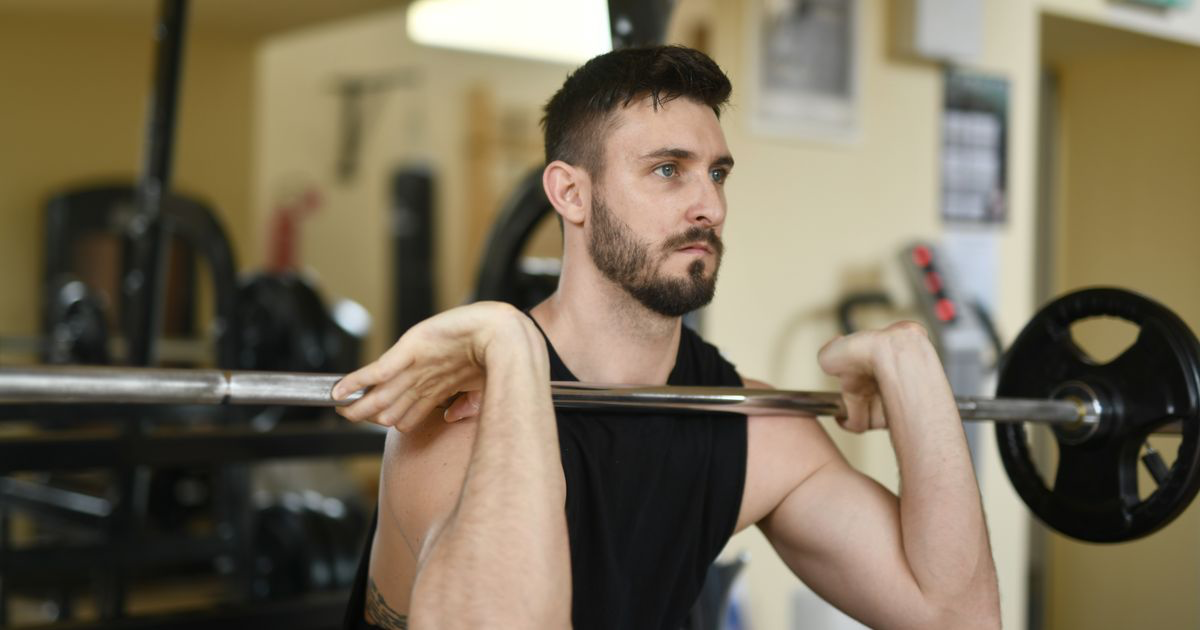
- Set the bar in a rack at upper-chest height and take it on your back exactly as you would for a squat, high bar or low bar.
- Step back and set your feet hip to shoulder width, toes forward or slightly out.
- Unlock the knees slightly. A soft bend, not a squat. The knee angle should barely change during the rep.
- Brace, then push your hips straight back, letting your chest travel down as a consequence rather than bending forward on purpose.
- Stop when your hamstrings stop the movement, usually somewhere between 45 degrees and parallel to the floor. Never past the point where your lower back rounds.
- Drive your hips forward to stand, squeezing the glutes at the top without leaning back.
The cue that fixes most people is "push the wall behind you with your hips". Thinking about the chest going down produces a spinal bend. Thinking about the hips going back produces a hinge.
How far should you go down?
As far as you can go with a flat back, and not one degree further. For most people that is nowhere near parallel on day one, and that is fine.
Depth in a good morning is a hamstring flexibility measurement, not a target. Chasing it by rounding your back removes the hamstrings from the exercise and hands the work to your lumbar spine, which is exactly the failure mode the lift is famous for.
What are the most common good morning mistakes?
Treating it as a squat. If your knees bend a lot and your hips drop, you are doing a bad squat with the bar too far forward. Keep the shins vertical.
Going too heavy. Expect to use somewhere around a quarter to a third of your squat, and treat that as normal rather than a failing. Anyone repping a good morning near their squat weight is bending, not hinging.
Rounding at the bottom to reach depth. The set ends the rep before your back does. Stop at the last flat-backed inch.
Resting the bar on your neck. The bar sits on the shelf your rear delts make when you pull your shoulder blades together, the same as a squat. On your neck it will slide forward as soon as you fold.
Holding your breath the whole set. Brace and breathe at the top between reps rather than doing six reps on one lungful. Our guide to breathing when lifting covers the pattern.
How much weight should you use on the good morning?
Start with an empty barbell, and expect your working weight to look small. A common landing spot for a trained lifter is 25% to 35% of their back squat for sets of 8 to 12.
This is not a low-rep lift. Sets of 5 or fewer push you toward a load where technique fails before the muscles do, and there is no prize for a heavy good morning.
Progress with reps first. Add a rep per set each week until you hit the top of your range across every set, then add the smallest plate you have and start again at the bottom. If you want a single number to compare across months, estimate one from your best set with the one rep max calculator, and read when to increase weight lifting for how to judge the jump.
Where does it fit in a session?
After your main lift, on a lower-body or posterior-chain day. It is an accessory. Two or three sets is plenty, and putting it before squats or deadlifts is a way to make both worse.
Some lifters use light good mornings as a warm-up before squatting, which works well precisely because the weight should be light anyway.
Why is the good morning easy to log badly?
Because the number that matters is not the weight, it is the depth you reached with a flat back. Two sets logged as "Good morning 40kg 3x10" can be entirely different exercises: one folded to parallel, one barely past vertical.
Depth is also the thing that changes as your hamstrings loosen up over months, so it is the actual progress marker for many people. It has a field in almost no gym app.
| Physical Notebook | Notes App | Traditional Gym App | Gym Note Plus | |
|---|---|---|---|---|
| Recording depth reached | Free text | Free text | Rarely a field | Free text, kept |
| Noting where form broke | Margin scribble | Free text | Fixed notes field | Free text, kept |
| Charting the trend | None | None | Charts | Charts from your text |
| Comparing to RDL | Manual | Manual | Per-exercise view | Per-exercise view |
| Finding last session | Flip pages | Text search | Structured search | Structured search |
Three extra words solve it: Good morning 40kg x10,10,8 to parallel, back held. Next month, the same weight to a lower position is progress, and you will have the evidence.
A simple good morning starting plan
- Practise the hinge with a broomstick. Hold it against your head, upper back and tailbone, and keep all three in contact as you fold.
- Do three sets of ten with an empty bar in your first session, filming one set from the side.
- Add 2.5 kg a week for four weeks, stopping early any week the flat-backed depth shrinks.
- Keep it to sets of 8 to 12, placed after your main lift.
- Write down the depth you reached, not just the weight.
Keep logging the way you already do
If you type your sessions into your notes app, you already have the right tool for a lift like this. Plain text takes "to parallel, felt tight on the left" without asking you to choose it from a dropdown that will never have it.
Gym Note Plus is built for that habit. You write the line the way you always have, and it turns every set into per-exercise history you can actually read.
- Type the set in plain text, depth notes and all.
- See the trend per exercise, so a light lift still shows progress.
- Pull up last session in a tap, before you load the bar.
Paste an old leg session into the free notes to workout translator and see what comes back.
The good morning is a hamstring exercise that fails as a back exercise. Keep the spine flat and the weight embarrassing, and it does a job nothing else quite does.
Frequently Asked Questions
What muscles does the good morning exercise work?
The good morning works the hamstrings and spinal erectors primarily, with the glutes driving the final part of the movement and the upper back holding the bar in place. A PLOS ONE review of deadlift-variant EMG studies found it produces more semitendinosus activation and less biceps femoris activation than the Romanian deadlift.
Is the good morning exercise safe?
The good morning is safe when the back stays flat and the load stays light, and dangerous when either fails. The bar sits on your back at the end of a long lever, so rounding under load puts high shear force through the lumbar spine. Stop each rep at the last flat-backed inch.
How much weight should you use for good mornings?
Most trained lifters work at roughly 25% to 35% of their back squat for sets of 8 to 12. Beginners should start with an empty barbell. Loads heavy enough to make the good morning a low-rep lift usually break technique before they challenge the hamstrings.
Are good mornings better than Romanian deadlifts?
Neither is better overall. The good morning removes grip as a limiter because the bar is on your back, so the hamstrings fail first, but it caps how much you can safely load. The Romanian deadlift allows heavier loads and carries less spinal risk at a given effort.
How low should you go on a good morning?
Go as low as you can while keeping a flat back, which for many lifters is well short of parallel at first. Depth in the good morning reflects hamstring flexibility, so it improves over weeks. Reaching further by rounding the spine transfers the work from the hamstrings to the lower back.
Can you do good mornings without a barbell?
Yes. A resistance band looped under your feet and over your shoulders, a dumbbell held against your chest, or a single kettlebell in the front rack all train the same hinge. These versions cap the load, which suits the good morning well since it is a light exercise anyway.
Final Takeaways
- Hips back, not chest down. The hinge cue decides whether this is a hamstring exercise or a back one.
- Keep the knees soft and the shins vertical. Bending them turns it into a poor squat.
- Expect 25% to 35% of your squat for sets of 8 to 12. Heavy good mornings are not a goal.
- Depth is capped by your flat back, not by parallel. Stop at the last honest inch.
- Log the depth alongside the weight, or a month of real progress will look like a plateau.

Josh Ibbotson
Josh is the creator of Gym Note Plus, building tools that make workout tracking as simple as taking notes.
Ready to try it out?
Download Gym Note Plus and start tracking your workouts the way you want.
Download on App Store