
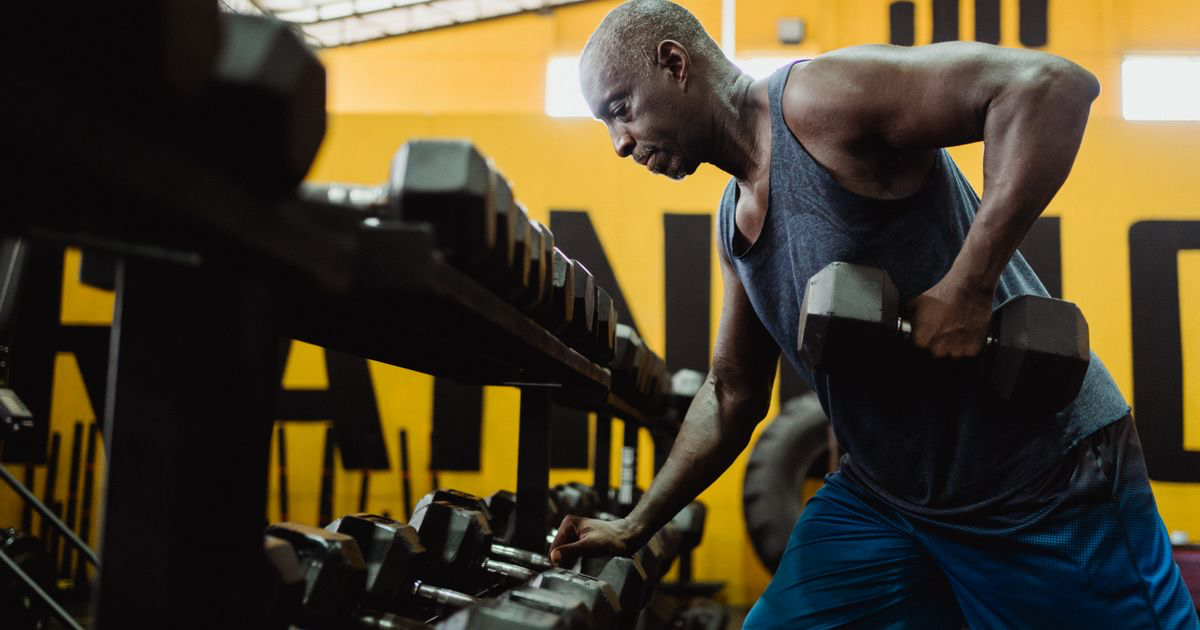
How to Do a Dumbbell Row: Muscles Worked, Form, and Progression
Quick answer: To do a one-arm dumbbell row, put one knee and the same-side hand on a flat bench, keep your back flat, and let the dumbbell hang under your shoulder. Pull your elbow back towards your hip, pause, then lower for two to three seconds. The dumbbell row trains the lats, mid back, rear delts and biceps.
Almost every gym has a bench and a dumbbell, so the dumbbell row is the back exercise you can always do.
It is also easy to do badly. Most sets turn into a twisting, jerking shrug, and the weight goes up on paper while the back does less of the work. Set it up properly and the bench carries much of your body weight, which leaves your back free to pull.
What muscles does the dumbbell row work?
The lats do most of the pulling. Driving the elbow back towards the hip is shoulder extension, which is the latissimus dorsi's main job. Keep the elbow close to your side and the lats carry more of the load.
The mid back finishes the rep. The rhomboids and middle trapezius pull the shoulder blade back towards the spine at the top. The rear delts help as the elbow travels past your torso.
The biceps and forearms assist. They flex the elbow and hold the handle, which is why grip gives out first for some lifters on heavy sets.
Your trunk works to stop you twisting. A single dumbbell loads one side of your body, so the obliques have to resist rotation. In a study of 15 resistance-trained men by Saeterbakken and colleagues in the International Journal of Sports Medicine, external oblique activity during two-arm rows was only 37 to 41 percent of the one-arm versions, across free-weight, cable and machine rows.
The same study found the reverse for the lower back. The two-arm free-weight row produced 12 percent more erector spinae activity than the one-arm free-weight row. So rowing one arm at a time asks less of the lower back and more of the muscles that stop you rotating.
How do you do a one-arm dumbbell row with good form?
Setup takes about fifteen seconds and decides how the whole set goes.
- Brace on a flat bench. Put your left knee and left hand on the bench, hand under your shoulder. Plant your right foot on the floor, slightly out to the side, for a stable base.
- Get your back flat. Your torso should be close to parallel with the floor, with your head in line with your spine. Stick your chest out a little so your upper back does not round.
- Let the dumbbell hang. Hold it in your right hand, arm straight, directly under your shoulder. Let the shoulder blade drift forward so the lat starts in a stretch.
- Pull your elbow to your hip. Drive the elbow back and up, keeping it close to your side, until the dumbbell reaches your lower ribs. Think of the hand as a hook and the elbow as the thing that moves.
- Pause, then lower for two to three seconds. Hold the top for a beat, then lower until your arm is straight and the shoulder blade has moved forward. Finish one side, then switch.
Keep your hips and shoulders square to the floor. If your chest opens up towards the ceiling on each rep, the weight is too heavy.
Can you do it without a bench?
Yes. Stand in a split stance and rest your free hand on a dumbbell rack, a box or your front thigh. It asks more of your legs and lower back, so start lighter than your bench-supported weight.
The research on bench support is thin. In a preliminary study by García-Jaén and colleagues, three trained lifters did dumbbell bent-over rows either standing or with their chest on an incline bench. The standing versions produced more lower back and upper back EMG. Three people is a very small sample, so treat it as a hint that support takes load off your lower back, not as proof.
What are the most common dumbbell row mistakes?
Twisting the torso to finish the rep. The most common fault. Rotating your chest towards the ceiling makes the rep look longer while your back does less. If you can only finish the rep by twisting, use a lighter dumbbell.
Shrugging instead of rowing. If the dumbbell travels straight up towards your ear, your upper traps are doing it. Pull towards your hip, not your shoulder.
Cutting the bottom short. Stopping with your arm still bent skips the stretched position. Let the arm straighten and the shoulder blade reach forward on every rep.
Rounding the back. A rounded upper back makes the shoulder blades harder to move. Keep your chest proud and your back flat.
Yanking the weight off the floor. A jerked first rep usually means the rest of the set is jerked too. Start each set from a dead hang and pull smoothly.
Dumbbell row vs barbell row vs cable row: which should you do?
The dumbbell row is the easiest on your lower back of the three. The bench takes a large part of your body weight, so you can row hard without holding a hinged position for the whole set. That makes it a sensible choice the day after heavy deadlifts.
The barbell row lets you load the most weight. Both arms work together and the plates go up in small steps. Our barbell row guide covers the hinge, the torso angle and the spinal loading research.
The cable row gives constant tension. The load does not fall away at the bottom the way it does with a dumbbell. See our seated cable row guide for grip and attachment choices.
One arm at a time shows imbalances. You can see straight away whether your left side matches your right, which a barbell hides. Our breakdown of unilateral vs bilateral training covers what the research says about training one side at a time.
No single row wins on every measure. A 2026 narrative review of latissimus dorsi EMG studies concluded that differences in methods between studies mean a statistically valid ranking across exercise families is not supported yet. The best row for you is one you can keep adding weight or reps to.
How many sets and reps of dumbbell rows should you do?
Three to four sets of 8 to 12 reps per arm, one or two times a week, suits most lifters. Heavy sets of 5 or 6 are fine, but grip and the urge to twist usually fail before your back does.
Add reps before you add weight. Dumbbells often jump in 2kg or 2.5kg steps. Going from 20kg to 22.5kg is a 12.5 percent increase, which is a big leap for a single-arm pull. Reach the top of your rep range on every set first, then move up.
Start with your weaker side. Do the harder arm first and match its reps on the stronger side. Otherwise the gap tends to grow.
To check that your rowing strength is climbing across a block, run your best set through the free one rep max calculator and compare the estimates week to week. Our guide to progressive overload covers other ways to progress when the next dumbbell is too big a jump.
What are the best dumbbell row alternatives?
Chest-supported dumbbell row. Lie face down on an incline bench and row both dumbbells. Your trunk is fully supported, so this is the pick when your lower back needs a break.
Kroc row. A high-rep, heavier version with a little more body English, usually done for sets of 15 to 20 or more. Keep it for experienced lifters who already row cleanly.
Single-arm cable row. Same one-sided pull with constant cable tension. Good when every bench is taken.
How should you log dumbbell rows?
"DB row 25" tells you nothing in three months. A useful dumbbell row entry needs the variation, the weight, the reps for each arm, and a note if one side fell short. Left and right numbers are the whole point of a one-arm lift, yet most logs record just one.
| Logging method | Speed per set | Tracks left and right | Shows progress over months | Searchable later |
|---|---|---|---|---|
| Physical notebook | Fast | Only if you write both | Flick back through pages | No |
| Notes app | Fastest | Only if you write both | Plain text, no trend | Text search only |
| Traditional gym app | Slow, menus per set | Sometimes, via extra fields | Charts | Inside the app |
| Gym Note Plus | Fastest, plain text | Yes, from what you typed | Automatic per-exercise trends | Whole history |
A four-week starting plan
- Week one: find your weight. Three sets of 10 per arm with a weight you could row for about 13. Write down the weight and both sides' reps.
- Week two: fix the form. Same weight, three sets of 10, with a one second pause at the top and a three second lowering phase. It should feel harder than last week.
- Week three: push the reps. Same weight, three sets taken to roughly two reps in reserve. Start with your weaker arm and match it on the other side.
- Week four: move up one dumbbell. Drop back to 8 reps per arm with the same tempo. If your torso starts twisting, go back to the lighter weight and repeat week three.
Where Gym Note Plus fits
If you already type your sets into Apple Notes between rounds, keep the habit. What you need is a way to read that text back as progress.
Gym Note Plus reads plain text the way you already write it and turns it into tracked data.
- Type
1 arm db row 25kg 10,10,9 L / 10,10,10 Rand it becomes structured sets. - Bench-supported and standing rows stay separate because you gave them different names.
- A note like "left arm weaker" stays attached to the session.
- Estimated one rep max and weekly back volume are worked out for you.
Paste your last back day into the free notes to workout translator to see what your own shorthand turns into.
If your chest turns towards the ceiling to finish the rep, the dumbbell is too heavy for your back.
Frequently Asked Questions
What muscles does the dumbbell row work?
The dumbbell row mainly works the latissimus dorsi, with the rhomboids, middle trapezius and rear deltoids pulling the shoulder blade back at the top. The biceps and forearms assist, and because one arm works at a time, the obliques work to stop your torso rotating through each rep.
Should your elbow stay tucked or flare out on a dumbbell row?
For a lat-focused dumbbell row, keep the elbow close to your side and pull towards your hip. Flaring the elbow out wide and pulling towards the chest moves more of the work to the upper back and rear delts. Both are valid, so pick one and log it consistently.
Is the dumbbell row better than the barbell row?
Neither is better overall. The barbell row allows heavier loads and trains both sides together, while the one-arm dumbbell row supports your trunk on a bench, puts less demand on your lower back and shows strength differences between sides. Many programs use one of each.
How heavy should my dumbbell row be?
Choose a dumbbell you can row for 8 to 12 clean reps per arm without twisting your torso or jerking the weight off the floor. If your chest opens towards the ceiling to finish a rep, the dumbbell is too heavy. Add reps across every set before moving to the next dumbbell.
Can you do dumbbell rows without a bench?
Yes. The one-arm dumbbell row works in a split stance with your free hand braced on a rack, box or your front thigh. The standing version asks more of your legs and lower back, so most lifters start slightly lighter than their bench-supported weight and build up.
Final Takeaways
- The dumbbell row trains the lats first, with the mid back, rear delts and biceps finishing each rep.
- Brace on a bench and keep your torso square. Twisting to finish the rep is the most common mistake.
- Pull your elbow towards your hip and let the arm straighten fully at the bottom.
- Three to four sets of 8 to 12 per arm covers most goals. Add reps before you add weight.
- Log both arms separately. A one-arm lift that only records one number hides the imbalance it is meant to reveal.

Josh Ibbotson
Josh is the creator of Gym Note Plus, building tools that make workout tracking as simple as taking notes.
Ready to try it out?
Download Gym Note Plus and start tracking your workouts the way you want.
Download on App Store