
How to Do Skull Crushers: Form, Bar Path, and Elbow Pain
Quick answer: To do a skull crusher, lie on a bench holding an EZ bar or dumbbells with arms vertical. Keep your upper arms fixed and bend only at the elbow, lowering the weight behind your head rather than straight to your forehead. Extend back to the start without letting the elbows drift forward.
Nobody names an exercise "skull crusher" by accident.
The name comes from the version most people copy: lower the bar to your forehead, stop an inch short, press it back. That version is the one that hurts your elbows and undertrains the biggest part of your triceps.
What muscles do skull crushers work?
All three heads of the triceps brachii, with the long head doing the most interesting work. The lateral and medial heads cross only the elbow. The long head crosses the shoulder too, which means its length depends on where your upper arm is pointing.
That single anatomical fact drives everything else in this article. Lower the bar behind your head and the shoulder flexes, the long head lengthens, and it takes more of the load. Lower it to your forehead and the upper arm stays vertical, so the long head never stretches.
The long head is roughly half the triceps by volume, so training it in a lengthened position is not a detail.
Should you lower the bar to your forehead or behind your head?
Behind your head, in almost every case. This is the highest-value change you can make to the exercise.
A 12-week trial had 21 adults train elbow extensions with one arm overhead and the other in a neutral position, at 70% of one-rep max, 5 sets of 10, twice a week. The overhead arm grew the triceps long head 28.5% versus 19.6%, and the whole triceps 19.9% versus 13.9%, according to Maeo and colleagues in the European Journal of Sport Science. The overhead arm achieved that on lower absolute loads.
That study compared fully overhead against fully neutral, which is the extreme version of the same choice you make on a bench. Lowering behind the head shifts the exercise toward the position that grew more muscle.
Practically, aim the bar for the bench above your head, not your face. The upper arms end up angled back roughly 20 to 30 degrees, and the stretch at the bottom is obvious.
Does this make it a different exercise?
Somewhat, and that is fine. Purists call the behind-the-head version a "JM press adjacent" skull crusher or just an incline extension. Call it what you like. The elbows still do the work, the long head gets stretched, and your elbows stop taking the brunt.
How do you perform a skull crusher?
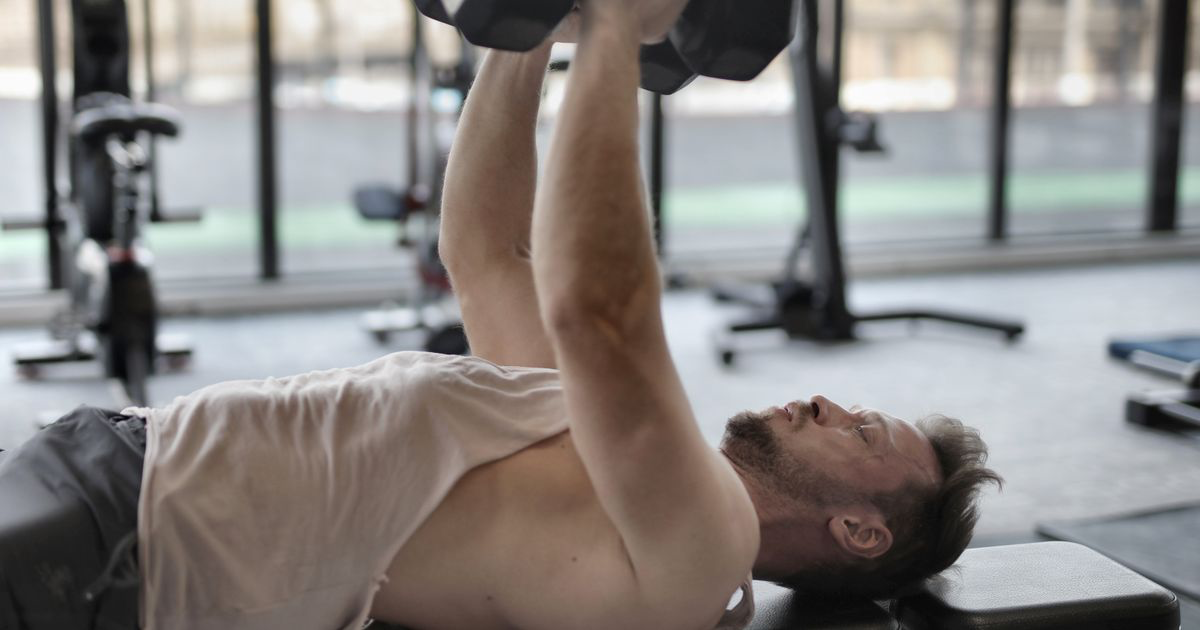
- Lie on a flat bench with an EZ bar or a pair of dumbbells, feet planted, shoulder blades set.
- Press the weight up until your arms are vertical, then tip the upper arms back slightly so the load sits over your forehead.
- Bend only at the elbow, lowering the weight past your forehead toward the bench behind your head.
- Stop where you feel a strong stretch down the back of the upper arm, usually just past ear level.
- Extend the elbows back to the start, keeping the upper arms in the same place the whole time.
- Stop short of full lockout if you want continuous tension, or lock out if you are chasing strength.
The upper arm is the reference point. If it swings forward on the way up, you have turned the movement into a press and the triceps just got help from the chest and shoulders.
Why do skull crushers hurt my elbows?
Usually load, speed, and a bar that does not suit your wrists, in that order.
Too much weight is the common one. Skull crushers put a long lever on a small muscle, so the elbow joint takes a lot of torque for a modest-looking dumbbell.
Dropping into the bottom turns the stretch into a snap. Take two seconds down, always.
A straight bar locks your forearms into full pronation. An EZ bar's angled grip, or dumbbells with a neutral grip, removes a lot of elbow strain for most lifters.
Try the fix in this order: switch to an EZ bar or dumbbells, halve the weight, slow the eccentric, and lower behind the head instead of to the forehead. If pain persists after that, swap to a tricep pushdown for a few weeks and reintroduce later.
Skull crushers vs overhead extensions vs pushdowns
All three train elbow extension. They differ in where the long head sits and where the exercise is hardest.
- Skull crusher (behind the head). Long head lengthened, hardest in the stretched bottom position, and easy to load progressively with a bar.
- Overhead extension. Longest position of all for the long head, and the version the Maeo trial favoured, but harder to stabilise heavy.
- Pushdown. Upper arms at your sides, so the long head stays short. Hardest at lockout, easiest on the elbows, best for high-rep work.
You do not need all three in a week. One lengthened option plus one pushdown covers the triceps well. Our guide to compound or isolation first covers where to slot them in a session.
How many sets and reps should you do?
Three or four sets of 8 to 15 reps, once or twice a week. The triceps already get significant work from pressing, so the isolation work is topping up rather than starting from zero.
- Rest 60 to 90 seconds. This is accessory work.
- Take two seconds lowering, and pause briefly in the stretch.
- Run them after pressing, not before, unless you are deliberately pre-exhausting.
- Progress on reps before weight. The jump from a 10kg to a 12.5kg EZ bar load is huge at this leverage.
Why are skull crushers so easy to log wrong?
Because the weight you write down means three different things depending on the bar you grabbed.
An EZ bar might weigh 7kg, 10kg, or an unmarked amount depending on the gym. Some people log the plates only, some log the total. Then there is the version question: forehead or behind the head, EZ bar or dumbbells, one dumbbell in two hands or two dumbbells. Six months of "Skull crushers 30kg 3x10" can hide three different exercises.
| Physical Notebook | Notes App | Traditional Gym App | Gym Note Plus | |
|---|---|---|---|---|
| Noting bar type | Free text | Free text | Rarely a field | Free text, kept |
| Bar weight included or not | Whatever you wrote | Whatever you wrote | Fixed assumption | Whatever you wrote, kept |
| Recording the variation | Margin note | Free text | Separate exercise entry | Free text, kept |
| Charting the trend | None | None | Charts | Charts from your text |
| Finding last session | Flip pages | Text search | Structured search | Structured search |
The habit that fixes it is small: pick one convention, write it in the line, and never change it mid-block. "Skull crusher EZ (bar incl) 30x10" tells you everything you need a year later. Our guide to logging machine weights covers the same trap across the rest of the gym.
A simple skull crusher starting plan
- Pick your bar and stick with it for four weeks. EZ bar for most people, dumbbells if your elbows complain.
- Load something you can control for 15 reps. Skull crushers punish ego faster than almost any accessory.
- Lower behind your head, past the ears, until the stretch is unmistakable.
- Run 3 sets of 12 twice a week, adding a rep per set before you add weight.
- Write the bar type and whether the bar weight is included in the same log line, every session.
Keep logging the way you already do
If you already tap sessions into your notes app between sets, you have the right habit for an exercise with this many variables. Plain text holds "EZ bar incl, behind head, elbows fine" without a form field arguing about it.
Gym Note Plus works from exactly that. You write your set the way you always do, and it groups everything by exercise and date, so your triceps work becomes a chart rather than a wall of notes.
- Type the set in plain text, bar quirks included.
- See the trend per exercise, so a stalled month is visible instead of assumed.
- Pull up last session in a tap, before you pick a weight.
Paste an old push session into the free notes to workout translator and see what your accessory work has been doing.
Skull crushers earn their place when the bar goes behind your head, not at your forehead. That is where the long head of the triceps actually gets stretched.
Frequently Asked Questions
Are skull crushers better than tricep pushdowns?
Skull crushers and pushdowns train the same muscle in different positions. Skull crushers performed behind the head lengthen the triceps long head and load it in the stretch, while pushdowns keep the upper arms at the sides so the long head stays short. Most lifters benefit from running one lengthened option alongside pushdown work.
Should skull crushers go to the forehead or behind the head?
Behind the head is the better default. Maeo and colleagues found elbow extension trained in a lengthened, overhead arm position grew the triceps long head 28.5% versus 19.6% in a neutral position over 12 weeks. Lowering behind the head moves a skull crusher toward that lengthened position and typically reduces elbow strain too.
What weight should you use for skull crushers?
Start with a weight you can control for 15 clean reps, which for many lifters means an EZ bar plus 5 to 10kg per side at most. The elbow takes high torque in a skull crusher because of the long lever, so loading it like a press is the main cause of elbow pain in this exercise.
Can you do skull crushers with dumbbells?
Yes, and dumbbells are often the better choice. A neutral or semi-neutral grip lets the forearms rotate freely, which removes the wrist and elbow strain a straight bar creates. Dumbbells also stop the stronger arm compensating, though they are harder to stabilise at the stretched bottom position.
How often should you train triceps with skull crushers?
Once or twice a week is enough for most lifters. The triceps already work hard during bench press, overhead press, and dips, so skull crushers add targeted work in the lengthened position rather than providing the whole stimulus. Three or four sets per session, spread across one or two sessions, fits most programs.
Final Takeaways
- Lower behind your head, not to your forehead. That is where the long head gets stretched.
- The upper arm should not move. If it swings, you are pressing, not extending.
- Use an EZ bar or dumbbells. A straight bar is the most common cause of elbow pain here.
- Go lighter than you think and take two seconds on the way down.
- Log the bar type and whether the bar weight is included. Otherwise the numbers mean nothing later.

Josh Ibbotson
Josh is the creator of Gym Note Plus, building tools that make workout tracking as simple as taking notes.
Ready to try it out?
Download Gym Note Plus and start tracking your workouts the way you want.
Download on App Store