
How Often Should You Weigh Yourself?
Quick answer: Weigh yourself daily, at the same time and under the same conditions, and judge progress by the weekly average rather than any single reading. Daily weighing has outperformed less frequent weighing in randomised research, and the weekly average filters out the water and food swings that make single readings misleading.
You weighed 82.4 kg on Monday. On Tuesday the scale says 83.7 kg.
You did not gain 1.3 kg of fat overnight. Nobody can. But if you only weigh once a week, that Tuesday number becomes your whole month's data point, and it is noise.
How often should you weigh yourself?
Daily, if you can do it without it messing with your head. The research favours frequency, and it does so fairly consistently.
In a six-month randomised weight-loss trial published in the Journal of the Academy of Nutrition and Dietetics, participants who weighed themselves every day lost 9.2 kg on average, compared with 3.1 kg for those weighing less often, a difference of 6.1 kg (p = 0.004). Notably, the "less frequent" group still averaged 5.4 days per week, according to Steinberg and colleagues.
A much larger observational cohort found the same direction. Across 9,768 smart scale users tracked over roughly three years, self-weighing frequency correlated inversely with weight gain, and breaks from weighing of 30 days or more were followed by weight gain in every BMI category, according to Vuorinen and colleagues in the Journal of Medical Internet Research.
The mechanism is not mystical. Frequent weighing surfaces small drifts early, while they still take small corrections.
Why does the scale jump around so much?
Because scale weight measures everything in your body, not just fat. On any given morning you are also weighing water, glycogen, food in transit, and waste.
The big movers:
- Sodium and carbohydrate intake. Glycogen is stored alongside water, so a high-carb day reliably shows up the next morning.
- Hydration status. A hard session, a hot day, or a big drink before bed all shift the number.
- Digestion. Food you have eaten but not yet processed has mass.
- Menstrual cycle. Cyclical water retention can move the scale by a kilogram or more.
- Training soreness. Muscle damage draws water into the tissue temporarily.
None of these are fat. All of them are on the scale.
What is the right way to weigh yourself?
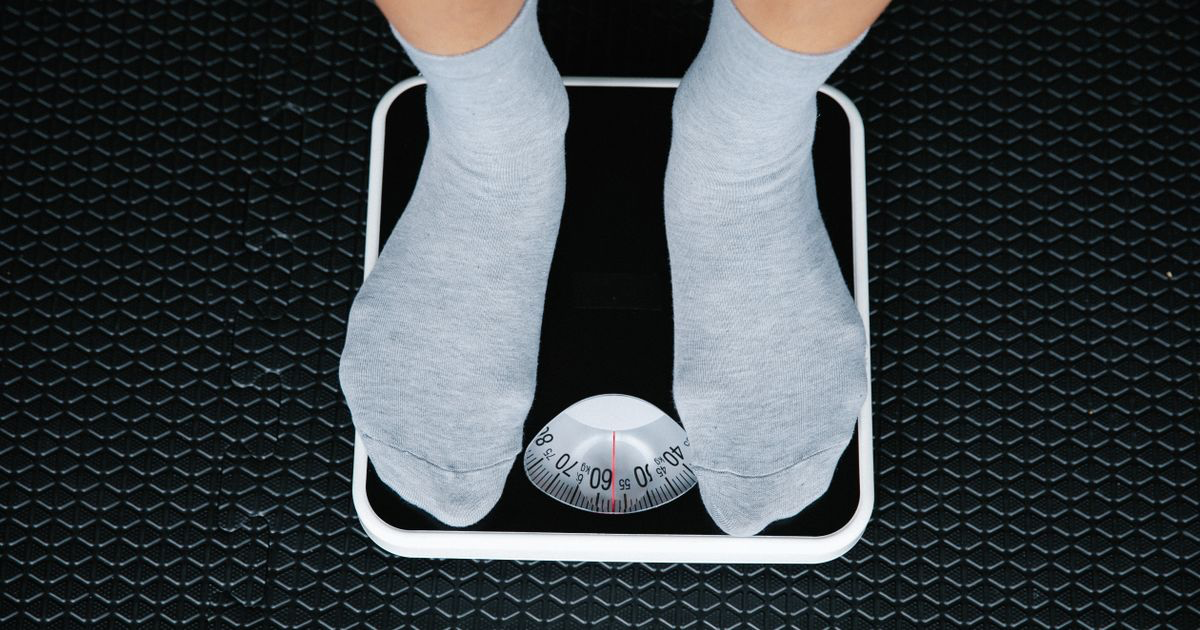
Same time, same conditions, every day. Consistency matters more than the specific protocol you pick.
- Weigh first thing in the morning, after using the bathroom.
- Before eating or drinking anything.
- Wearing the same amount of clothing, or none.
- On the same scale, on a hard floor. Carpet throws readings off.
- Record the number and move on. Do not reweigh to get a better answer.
That last point matters. Stepping on twice, shifting your feet, and taking the lower reading is how you turn a measurement into a wish.
Judge the average, not the day
Take your seven daily readings and average them, then compare this week's average to last week's. That single habit removes almost all of the emotional volatility from weighing.
A worked example:
| Day | Weight |
|---|---|
| Mon | 82.4 kg |
| Tue | 83.7 kg |
| Wed | 82.9 kg |
| Thu | 82.6 kg |
| Fri | 82.2 kg |
| Sat | 83.1 kg |
| Sun | 82.5 kg |
The daily spread is 1.5 kg and looks chaotic. The average is 82.8 kg. Next week's average is the only number worth reacting to.
For most people, a loss of roughly 0.5 to 1% of bodyweight per week is a sustainable rate when cutting, and a gain of around 0.25 to 0.5% per month is a reasonable target when building. To set the calorie target underneath that, run your numbers through the free TDEE calculator.
Should you weigh yourself daily if you have a difficult relationship with the scale?
No, and this is the honest limit of the research. Daily weighing works well on average. Averages do not describe everyone.
If a bad reading derails your eating for the day, or you find yourself weighing three times before breakfast, daily weighing is not a neutral measurement for you. It is a stressor.
Reasonable alternatives:
- Weigh weekly, same day and conditions, and accept noisier data.
- Weigh daily but only look at the weekly average, which some apps and scales can show without displaying the daily number.
- Stop weighing entirely and use waist measurements, how clothes fit, and progress photos instead.
- Track training performance instead. Strength going up while the tape stays flat is real progress.
The scale is one input. It is a cheap, high-frequency signal, and it is also the one most likely to lie to you on any individual day.
What should you track alongside weight?
At least one measurement that does not care about water. Weight alone cannot distinguish a good week from a dehydrated one.
- Waist circumference, measured at the navel, weekly.
- Progress photos, monthly, same lighting and pose.
- Training performance, logged every session.
That last one is the most underrated. If your bodyweight is flat but your working sets have climbed over eight weeks, you are almost certainly recomposing, and only a training log can tell you that.
Keeping bodyweight and training in one place
| Physical Notebook | Notes App | Traditional Gym App | Gym Note Plus | |
|---|---|---|---|---|
| Logging speed | Slow, needs a pen | Fast, free typing | Slow, tap through menus | Fast, free typing |
| Bodyweight alongside sets | Manual | Manual | Separate screen | Same plain-text entry |
| Data visualization | None | None | Charts | Charts from your text |
| Flexibility | Total | Total | Rigid templates | Total |
| Searchability | None | Text search only | Structured search | Structured search |
Most people end up with weight in one app, training in another, and no way to see them together. That is the exact comparison that answers the question you actually care about: is the weight coming off while the lifts hold?
If you already type your sessions into your phone's notes app, Gym Note Plus keeps that habit and turns it into charts. Write your bodyweight on the same line as your session and it lives beside your training data instead of in a separate silo.
- One plain-text entry for the whole session.
- Per-exercise progress charts so you can see whether strength held through a cut.
- No template to maintain, which is why the habit survives.
Try it with a real session in the free notes to workout translator.
One weigh-in is a rumour. Seven weigh-ins averaged together are data.
Frequently Asked Questions
How often should you weigh yourself?
Weigh yourself daily, at the same time and under the same conditions, and compare weekly averages rather than individual readings. A six-month randomised trial found daily weighers lost 9.2 kg versus 3.1 kg for those weighing less frequently. If daily weighing causes anxiety, weekly weighing or waist measurements are reasonable substitutes.
What is the best time of day to weigh yourself?
First thing in the morning, after using the bathroom and before eating or drinking, is the best time to weigh yourself. That point in the day has the least variation from food, fluid, and digestion, which makes consecutive readings comparable. Consistency of timing matters more than the specific hour chosen.
Why does my weight go up overnight?
Overnight increases come from water, glycogen, and undigested food rather than fat gain. Carbohydrates are stored with water, sodium increases fluid retention, and hard training draws water into muscle tissue. Gaining a kilogram of body fat requires a very large calorie surplus that a single evening cannot produce.
Should you weigh yourself while bulking?
Yes, and daily weighing is arguably more useful while bulking than cutting. Weekly averages let you confirm a gain of roughly 0.25 to 0.5% of bodyweight per month, which is fast enough to build muscle without excess fat. Without frequent data, a bulk drifts too fast or stalls unnoticed for weeks.
Is weighing yourself every day bad for you?
For most people daily weighing is a neutral measurement habit with clear behavioural benefits. For people with a history of disordered eating or strong scale anxiety, it can become harmful. If a reading changes how you eat that day, switch to weekly weighing, average-only views, or non-scale measures such as waist circumference.
Final takeaways
- Weigh daily, same time, same conditions. Frequency beats precision.
- React to weekly averages only. Single readings are mostly water.
- Expect 1 to 2 kg of daily swing. That is normal physiology, not failure.
- Pair the scale with waist measurements, photos, and a training log.
- Skip daily weighing if it harms you. The data is a means, not the goal.

Josh Ibbotson
Josh is the creator of Gym Note Plus, building tools that make workout tracking as simple as taking notes.
Ready to try it out?
Download Gym Note Plus and start tracking your workouts the way you want.
Download on App Store