
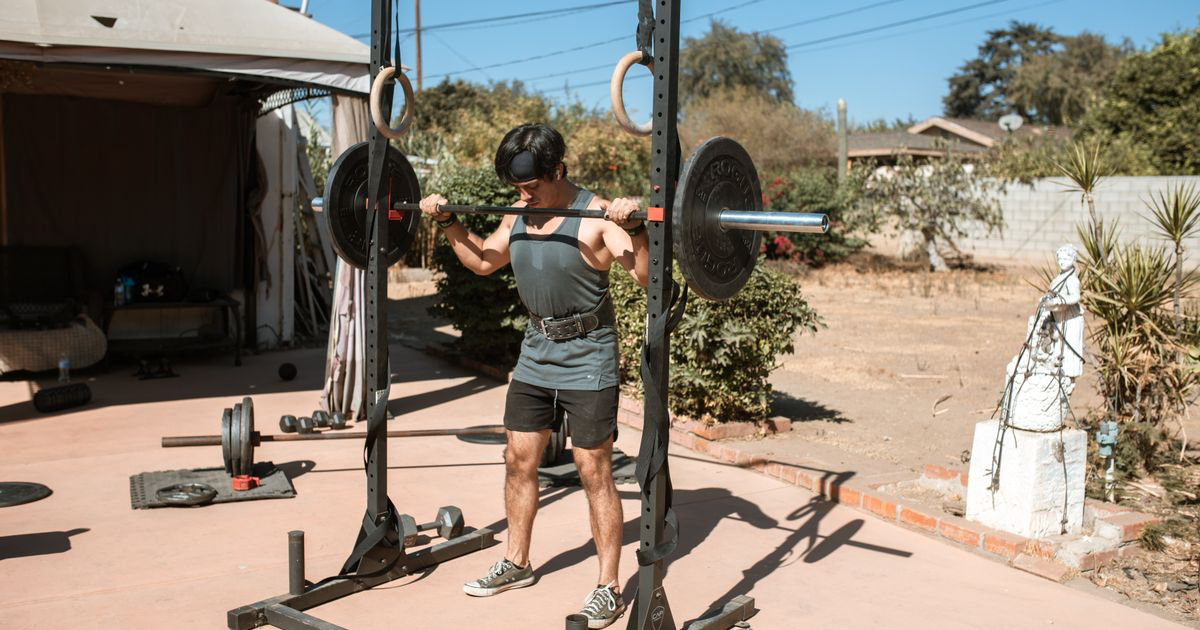
When Should You Use a Lifting Belt?
Quick answer: Use a belt on heavy sets of squats, deadlifts and overhead press, roughly your top one or two sets above 80% of your one rep max. Leave it off for warm-ups, accessories and anything above twelve reps. A 2026 trial found lifters squatted 8.1 reps with a belt against 6.5 without, so it earns its place.
The belt argument has two settled camps. One says a belt is a crutch that weakens your core. The other says you should have worn one for your first ever squat.
Both are wrong, and the interesting part is that the mechanism people cite most often is not the one that shows up in the data.
What does a lifting belt actually do?
It gives your abdominals something to push against. When you brace, you contract your diaphragm and abdominal wall to raise the pressure inside your abdomen. That pressure stiffens your torso from the inside, so the load travels through a rigid trunk instead of bending your spine.
A belt does not create that pressure. It gives your abs a wall, so the same effort produces more of it.
McGill, Norman and Sharratt measured exactly this in Ergonomics. Six subjects lifted loads between 72.7kg and 90.9kg with and without a weightlifter's belt. Every subject showed higher intra-abdominal pressure with the belt on: 120 mmHg wearing it against 99 mmHg without.
The same study found something else worth knowing. Holding your breath raised pressure significantly too, belt or no belt. Erector spinae activity tended to be lower with the breath held, and wearing a belt did not add to that reduction.
So the belt raises pressure. What it does with that pressure is a separate question.
Does a lifting belt make you lift more?
Yes, and there is a new trial that put a number on it.
Veltzke and colleagues published a study in the Journal of Strength and Conditioning Research in August 2026. Twenty-nine men and twenty women, split by whether they had used belts before, squatted to exhaustion with their beltless six rep max, with and without a belt, in randomised order across two sessions.
With the belt: 8.1 reps on average. Without: 6.5. The concentric phase was also faster, 1.99 seconds against 2.09.
That held regardless of sex and regardless of whether the lifter had belt experience, which undercuts the common claim that belts only help people who have trained with them.
Now the part that complicates the folk explanation. Wearing the belt made lifters feel more stable, and the effect was strong. It did not make them measurably more stable. Postural sway was not reduced. In experienced lifters the sway path length was actually slightly higher with the belt.
The authors' conclusion is unusually blunt: performance improved, but the improvement cannot be attributed to increased postural stability.
When should you wear a belt?
On your top sets of the big three. Squat, deadlift, overhead press, at roughly 80% of your one rep max and above. That is where the spinal load is highest and where the extra pressure has something to do.
On low-rep work rather than high-rep work. A set of three heavy squats is the case. A set of fifteen is not, and you will hate the belt long before the fifteenth rep.
When your lower back is the thing that fails first. If your legs have plenty left and your torso folds, the belt addresses the actual limiter.
In competition, if your federation allows it. Not a training question, but worth stating.
When should you leave the belt off?
Warm-ups and ramp-up sets. Every set below your top two is a chance to brace without help.
Accessory work. Leg press, lunges, rows, curls, machines. The spinal load is not the limiter and the belt does nothing.
High-rep hypertrophy sets. Twelve or more reps means the load is moderate by definition.
When you have not learned to brace yet. A belt amplifies a brace. If there is no brace, there is nothing to amplify, and you will learn to lean on the belt instead of your abdominal wall. Spend a training block bracing properly first, and read how to breathe when lifting weights before you buy one.
All the time. Wearing it from the first warm-up set to the last accessory is the actual mistake, not belts in general.
Does wearing a belt weaken your core?
No study has shown that it does. The claim gets repeated constantly and rests on an assumption rather than evidence.
What is true is that a belt lets you handle loads your unbelted torso could not, which means the unbelted version does not get trained at that intensity. That is not weakening. That is just not training something.
The fix is straightforward: use a belt for the sets that need it and lift the rest of your training beltless. Most people's programmes are already 90% beltless by that rule.
How should you wear a lifting belt?
- Position it over your navel, roughly across the middle of your abdomen. Not on your ribs, not on your hips.
- Tighten it so a flat hand fits between belt and stomach. Too tight and you cannot expand into it, which is the whole point.
- Breathe into your belly first, then brace against the belt. Air in, ribs down, push out in all directions.
- Hold that pressure for the rep, then exhale at the top or between reps.
- Loosen it between sets. Ninety seconds in a tight belt is unpleasant and unnecessary.
A 10mm leather belt of uniform width suits almost everyone. Tapered belts that narrow at the front give your abs less to push against, which is exactly backwards.
Why does a belt wreck your training log?
Because a belted set and an unbelted set are different exercises, and most logs record both as "squat".
The 2026 trial found a 1.6-rep difference at the same load. Six weeks later, "squat 140kg 6" and "squat 140kg 8" looks like clear progress. If the second one was belted and the first was not, it might be no progress at all.
This is the same problem as forgetting to note which gym's machine you used, and it produces the same result: a chart that trends upward for a reason that has nothing to do with getting stronger.
Write one letter. squat 140kg 5,5,5 belt costs you nothing and saves the record.
| Physical notebook | Notes app | Traditional gym app | Gym Note Plus | |
|---|---|---|---|---|
| Logging speed | Fast | Fast | Slow, many taps | Fast, plain text |
| Room for equipment notes | Total | Total | Rarely | Total, free text |
| Keeps belted and beltless apart | If you write it | If you write it | Usually not | Yes, from your own wording |
| Turns loads into a trend | No | No | Yes | Yes, automatic |
| Searchable months later | Manual flip-back | Manual scroll | Sometimes | Yes |
A simple starting plan
- Spend four weeks bracing without one. Learn what a hard brace feels like before you add a wall to push against.
- Introduce the belt on top sets only. Your heaviest one or two sets of squat, deadlift or overhead press, and nothing else.
- Keep the same load for the first belted session. You want to feel the difference, not chase it.
- Write "belt" next to every belted set. One word. It is the only way your history stays comparable.
- Review at four weeks. Compare belted top sets to belted top sets only. Feed them into the one rep max calculator so a rep change does not read as a strength change.
Keep logging the way you already do
If you log in Apple Notes or a notebook, you already have the one thing this needs: room to write "belt" without hunting for a settings toggle.
The problem is that free text never becomes a line on a chart.
Gym Note Plus keeps the typing and adds the memory.
- Type
squat 140kg 5,5,5 beltand it becomes structured, charted sets. - The equipment note stays attached to the session, so belted and beltless history stays honest.
- Volume and estimated one rep max are tracked per exercise automatically.
- Old notes import, so your existing squat history comes with you.
Want to see it on your own text first? Paste your last heavy session into the free notes to workout translator.
A belt is worth about 1.6 extra reps and no extra stability. Both of those facts should change how you use it.
Frequently Asked Questions
Does a lifting belt actually help you lift more?
Yes. A 2026 trial in the Journal of Strength and Conditioning Research had 49 lifters squat to exhaustion at their beltless six rep max. With a belt they averaged 8.1 repetitions against 6.5 without, and the concentric phase was faster. The benefit appeared regardless of sex or previous belt experience.
At what weight should you start using a lifting belt?
There is no fixed number, but roughly 80% of your one rep max on squats, deadlifts and overhead press is a sensible threshold. Below that the spinal load is not usually the limiting factor. Learn to brace properly without a belt first, since a belt amplifies a brace rather than replacing one.
Does a lifting belt make your core weaker?
No evidence supports that claim. A belt lets you handle loads your unbelted torso could not, so those loads never get trained beltless, but that is a training-distribution issue rather than weakening. Using a belt only on top sets leaves the rest of your programme unbelted, which resolves it.
Does a lifting belt improve your balance under the bar?
It feels like it does, but measurement says otherwise. The 2026 Journal of Strength and Conditioning Research trial found wearing a belt significantly increased subjectively perceived stability while objectively measured postural sway did not improve. In experienced lifters, sway path length was slightly higher with the belt.
How tight should a lifting belt be?
Tight enough that you cannot slide more than a flat hand between the belt and your stomach, and loose enough that you can still expand your abdomen into it when you breathe in. A belt cinched so tight you cannot brace against it removes the mechanism that makes it work.
Final Takeaways
- A belt raises intra-abdominal pressure, roughly 120 mmHg against 99 mmHg beltless in one measurement study.
- It buys real reps. 8.1 against 6.5 at the same load in a 2026 trial, in men and women, experienced or not.
- It does not make you more stable. The perceived stability was strong. The measured stability was not there.
- Top sets only. Heavy squats, deadlifts and overhead press. Not warm-ups, not accessories, not high-rep work.
- Write "belt" in the log. A belted set and an unbelted set at the same load are not the same data point.

Josh Ibbotson
Josh is the creator of Gym Note Plus, building tools that make workout tracking as simple as taking notes.
Ready to try it out?
Download Gym Note Plus and start tracking your workouts the way you want.
Download on App Store