
How to Train Abs: Exercises, Sets and Why Reps Alone Won't Show Them
Quick answer: Train abs like any other muscle. Pick two or three exercises, load them enough that ten to twenty reps is genuinely hard, and run six to twelve hard sets a week across two or three sessions. Add resistance over time. Visible abs come from body fat, not from ab exercises.
Nobody logs their ab work. It goes at the end of the session, unwritten, in whatever quantity is left in the tank.
Then six months later the question arrives: has any of it done anything? And there is no way to answer, because "abs" was never a number.
What muscles are you actually training?
Four, and they do different jobs.
- Rectus abdominis. The long sheet down the front that gives the six-pack look. It bends your spine forward.
- External and internal obliques. The sides. They rotate and side-bend the torso, and they resist rotation when something tries to twist you.
- Transverse abdominis. The deepest layer, wrapping around like a belt. It stiffens the trunk rather than moving it.
The rectus abdominis is one muscle, not an upper and a lower one. It has one nerve supply and it contracts along its whole length. But the tendon bands crossing it mean different segments can bulge at different times, and that is where the "upper and lower abs" folklore comes from.
The folklore turns out to be half right. Gomirato and Grenier, publishing in the International Journal of Exercise Science, used ultrasound to watch four segments of the rectus abdominis in 15 people during a crunch, a sit-up and a leg raise. The crunch produced the biggest thickness change in the top segment. The leg raise produced its biggest change in the bottom segment. The interaction between segment and exercise was statistically significant, meaning the pattern was unlikely to be chance.
So it is one muscle, and where you feel it does depend on the exercise. Both things are true.
Which ab exercises are worth doing?
Pick one from each of three jobs and you have covered it.
Spine flexion (bringing ribs to hips)
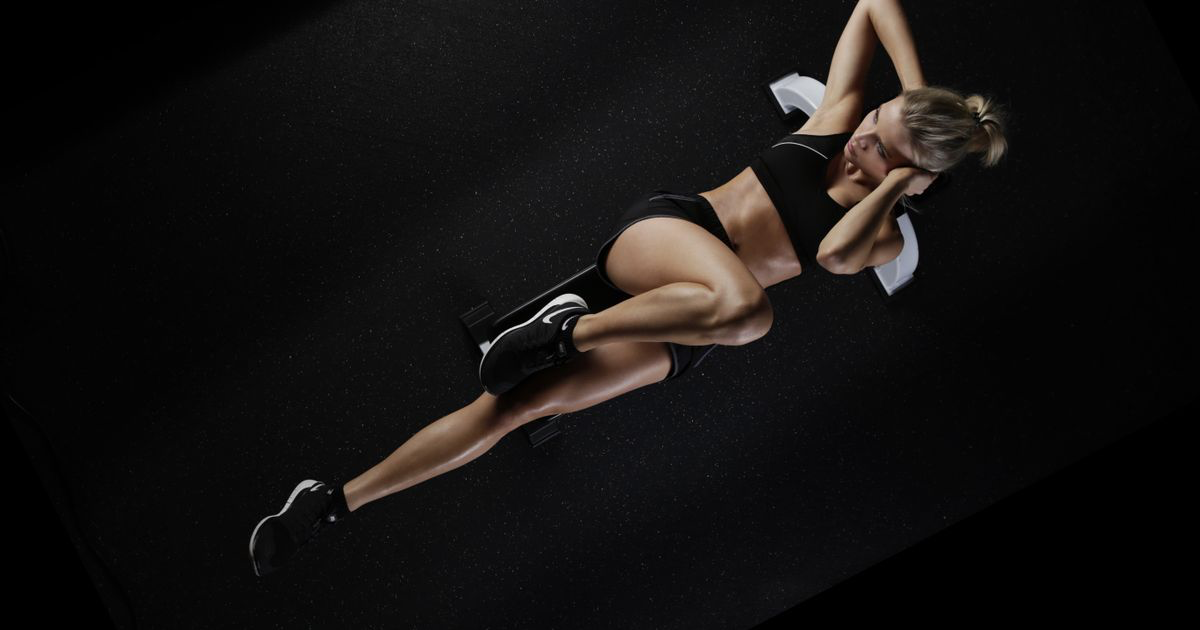
Cable crunches, machine crunches, weighted decline sit-ups. These are the ones you can load properly, which is why they matter. A crunch you can add 2.5kg to every few weeks is a real exercise. A crunch you do fifty of on the floor is a warm-up.
Hip flexion with a braced trunk (bringing hips to ribs)
Hanging leg raises, hanging knee raises, captain's chair raises. Harder to load, easier to progress by changing leverage: knees bent, then knees straight, then a dumbbell between the feet.
Anti-movement (resisting instead of producing)
Planks, ab wheel rollouts, Pallof presses, suitcase carries. The ab wheel is the standout here because it loads the abs in a lengthened position and progresses cleanly from knees to standing.
Two or three exercises is plenty. More than that and you are collecting movements instead of progressing any of them.
How often should you train abs?
Two or three times a week, six to twelve hard sets total.
Abs are a small muscle group that recovers quickly, but they are not immune to fatigue. If they are still sore three days later, you did too much.
The bigger mistake is the opposite: three sets of unloaded crunches tacked onto the end of a session, at an effort level you would never accept on a bench press. Take the last set close to failure or it is not training.
Direct ab work is not optional if you want them bigger. Squats and deadlifts brace the trunk, but bracing is an isometric job at a fraction of the load your abs can handle in flexion. Our post on compound vs isolation exercises covers where that logic applies and where it does not.
Do ab exercises burn belly fat?
No. This one has been tested directly and the answer was clear.
Vispute and colleagues, in the Journal of Strength and Conditioning Research, had 24 sedentary adults do seven abdominal exercises, two sets of ten reps, five days a week for six weeks, on a calorie-matched diet. Compared with a control group that did nothing, the training group showed no change in body fat percentage, android fat, abdominal circumference or abdominal skinfold. Their abdominal muscular endurance improved a lot. Their waistlines did not move.
Six weeks of ab work built ab endurance and changed nothing about the fat over the top of it.
Which means the answer to "why can't I see my abs" is almost never "do more ab work". It is body fat, and body fat responds to a calorie deficit. Our TDEE calculator gives you the maintenance number to work down from.
How do you progressively overload abs?
Same as everything else, but you have to be deliberate about it because reps are the lazy default.
- Load what can be loaded. Cable and machine crunches take plates. Use them, and write the weight down.
- Change leverage when you cannot add weight. Bent knees to straight legs on a hanging raise. Knees to standing on the ab wheel. Short lever to long lever on a plank.
- Add reps within a range, then add resistance. Three sets of twelve at 25kg becomes three sets of twenty at 25kg becomes three sets of twelve at 30kg.
- Slow the eccentric before you add anything. A three-second lower on a leg raise turns a swinging set into a hard one at the same weight.
If you already track your main lifts, plugging one loaded ab exercise into the same progression logic you use for progressive overload is the whole trick.
What are the most common ab training mistakes?
Doing them last, at zero effort. By the time you get there, the tank is empty and the sets become a ritual.
Never adding load. Endless bodyweight crunches make abs that are good at endless bodyweight crunches.
Chasing the burn. The burn is metabolite accumulation, not a growth signal. A hard set of five weighted crunches builds more than a hundred floor crunches.
Pulling on your neck. If your hands are dragging your head forward, the set is too hard or the position is wrong.
Training them daily. They recover fast, not instantly.
Not logging them. This is the one that costs the most, because it makes every other mistake invisible.
How do the ways to track ab work compare?
| Physical notebook | Notes app | Traditional gym app | Gym Note Plus | |
|---|---|---|---|---|
| Logging speed at set's end | Fast | Fast | Slow, many taps | Fast, plain text |
| Handles bodyweight and loaded sets together | Manual | Manual | Often awkward | Yes, free text |
| Records leverage changes (bent vs straight leg) | If you write it | If you write it | Rarely a field | Yes, in your own words |
| Turns cable crunch loads into a trend | No | No | Yes | Yes, automatic |
| Shows weekly ab set count | Manual count | Manual count | Sometimes | Yes |
A simple starting plan
- Pick three exercises: one loaded crunch, one hanging raise, one anti-movement exercise. That is your ab session for the next eight weeks.
- Run them twice a week, three sets each, at the start or middle of a session rather than the very end.
- Take the last set to two reps from failure. If you could have done six more, the weight is wrong.
- Write every set down with its load or leverage.
cable crunch 30kg 12,12,10andhanging leg raise straight-leg 10,9,8. - Reassess at eight weeks. If the numbers went up and the abs still are not visible, the problem is body fat, not the training.
If you already log your workouts as text
You probably write your bench and your squat and then stop. Ab work never makes it in, because "abs" does not feel like it has a number attached.
It does. cable crunch 30kg 12,12,10 is a number.
Gym Note Plus takes lines like that out of your notes and turns them into a per-exercise trend.
- Type it the way you already type everything else and it becomes structured sets.
- Loaded and bodyweight ab work sit side by side in the same log.
- Leverage notes ("straight leg", "knees bent") stay attached to the set.
- Old notes import, so the ab work you did write down still counts.
Want to see how your own shorthand parses? Paste a session into the free notes to workout translator.
Ab training that never gets written down is the only training you can do for a year and still not know whether it worked.
Frequently Asked Questions
How do you train abs for muscle growth?
Train abs like any other muscle: two or three loaded exercises, six to twelve hard sets per week across two or three sessions, taken close to failure. Add resistance or change leverage as you get stronger. Cable crunches, hanging leg raises and ab wheel rollouts all progress cleanly and can be logged with a real number.
Do ab exercises burn belly fat?
No. A Journal of Strength and Conditioning Research trial had 24 adults perform seven abdominal exercises five days a week for six weeks on a calorie-matched diet, and found no change in body fat percentage, abdominal circumference or abdominal skinfold. Ab training builds the muscle underneath. Visible abs come from a calorie deficit.
Is there such a thing as upper and lower abs?
The rectus abdominis is a single muscle with one nerve supply, so it cannot be split into two muscles. However, ultrasound research in the International Journal of Exercise Science found that crunches produced the greatest thickness change in the upper segment and leg raises in the lower segment, so the regional feeling is real.
How often should you train abs per week?
Two or three sessions a week suits most lifters, totalling six to twelve hard sets. Abs recover quickly, but training them daily leaves no room for the effort that actually drives growth. If they are still sore three days after a session, cut the volume rather than the frequency.
Do squats and deadlifts train your abs enough?
Not for growth. Heavy compound lifts require the abs to brace isometrically, which builds stiffness and some strength, but the load is far below what the abs can handle in spinal flexion. If you want the rectus abdominis to grow, add two or three direct exercises you can progressively load.
Final Takeaways
- Load them or you are not training them. Cable crunches and weighted raises beat unlimited bodyweight reps.
- Two or three exercises, six to twelve hard sets a week. More movements is not more progress.
- Ab exercises do not burn belly fat. Six weeks of it changed nothing about waistlines in a controlled trial.
- Upper and lower are one muscle with two feelings. Crunches bias the top segment, leg raises the bottom.
- Write the sets down. An unlogged ab exercise is one you cannot progress and cannot audit.

Josh Ibbotson
Josh is the creator of Gym Note Plus, building tools that make workout tracking as simple as taking notes.
Ready to try it out?
Download Gym Note Plus and start tracking your workouts the way you want.
Download on App Store