
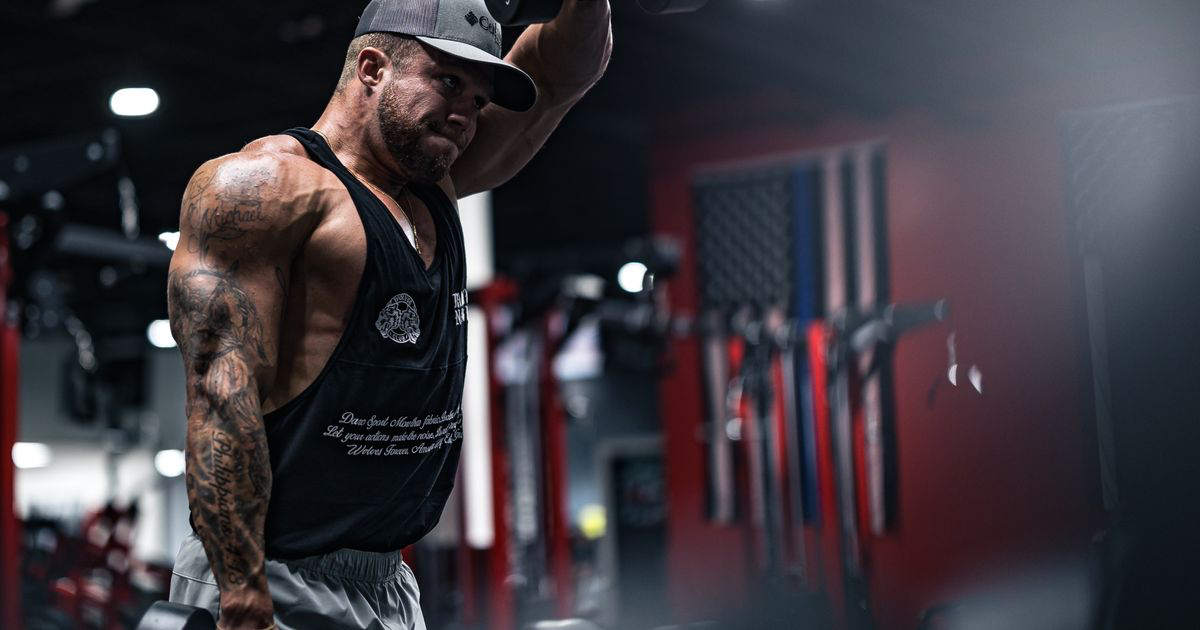
How to Do a Reverse Fly: Form, Muscles Worked and Rear Delts
Quick answer: Hinge forward until your torso is close to parallel with the floor, let the dumbbells hang under your shoulders, then sweep your arms out and back in a wide arc with a slight elbow bend. Stop when your upper arms reach shoulder height. The reverse fly trains the posterior deltoid, and it only works light.
The reverse fly is the exercise people do at the end of shoulder day with whatever dumbbells are left, using a weight chosen by ego and a range of motion chosen by momentum.
It is also the only exercise most lifters do that directly loads the rear delt. Worth doing properly.
What muscles does the reverse fly work?
The posterior deltoid, primarily, with the rhomboids, middle trapezius and infraspinatus assisting.
The posterior deltoid horizontally abducts the shoulder, meaning it pulls the upper arm backward away from the midline. That is precisely the movement a reverse fly asks for and almost nothing else in a normal program isolates.
Rows train the rear delt too, but a row bends the elbow and drags the lats and biceps into the job. The reverse fly keeps the elbow near-locked, so the shoulder joint does the work alone.
The rhomboids and middle traps come along for the ride. They retract the shoulder blades, which happens naturally at the top of the movement. That is fine, until you turn the exercise into a shoulder-blade squeeze and the delts stop doing anything.
How do you do a reverse fly with good form?
Hinge forward, hang the weights under your shoulders, then sweep your arms out and back with a fixed slight elbow bend until your upper arms are level with your torso.
- Hinge at the hips until your chest is close to parallel with the floor. Seated on the end of a bench with your chest on your thighs also works and removes the lower back from the equation.
- Let the dumbbells hang straight down under your shoulders. Palms facing each other.
- Set a small, fixed elbow bend, around 10 to 20 degrees, and keep it there for the whole set. If the angle changes, you are rowing.
- Sweep your arms out and back in a wide arc. Lead with the elbows, not the hands.
- Stop when your upper arms are level with your torso. Going higher shifts the work to the traps and the rotator cuff.
- Lower slowly under control and let the dumbbells come all the way back under your shoulders before the next rep.
Do not swing the torso. Rocking upright as you lift turns the exercise into a partial row using your hips as the engine. If your chest lifts, the weight is too heavy.
Does grip position change the reverse fly?
Yes, and the effect is measurable.
Schoenfeld and colleagues tested this directly in the Journal of Strength and Conditioning Research. Nineteen resistance-trained men performed reverse fly machine repetitions to failure with either a pronated grip (palms down) or a neutral grip (palms facing each other), at roughly 75% of body weight.
Mean EMG activity of the posterior deltoid was significantly greater with the neutral grip than the pronated grip. Infraspinatus activity was significantly higher on the neutral grip as well.
The practical version: thumbs up, palms facing each other. On the reverse pec deck, that means taking the vertical handles rather than the horizontal ones.
| Neutral grip | Pronated grip | |
|---|---|---|
| Posterior deltoid EMG | Higher | Lower |
| Infraspinatus EMG | Higher | Lower |
| Feels natural at the top | Usually | Often pinches |
| Available on most pec deck machines | Vertical handles | Horizontal handles |
Dumbbell, cable or reverse pec deck?
All three train the same muscle. They differ in where the resistance is hardest.
Dumbbells. Hardest at the top, nothing at the bottom, because gravity pulls straight down and the arms start pointing straight down. Cheapest and always available.
Cables. Even tension through the whole range, since the cable pulls horizontally. Cross the cables in front of you at chest height and pull outward. The best version if your gym has a working cable station.
Reverse pec deck. Easiest to load and to progress, no balancing, no hinge to hold. The one that suits heavy sets and the one the research above was run on.
Pick whichever one you can add weight to reliably and stay on it. Rotating between all three every few weeks makes progression impossible to read.
Why does the reverse fly feel like nothing?
Because you are probably using too much weight and finishing the rep with your traps.
The posterior deltoid is small. A working set for most people sits somewhere between 4kg and 10kg per hand, which feels insulting to pick up and brutal by rep twelve if the form holds.
Go lighter and slow the eccentric. Three seconds down, pause at the bottom with the arms fully hanging, then sweep. The set will end well before your ego expects it to.
If you still cannot feel the rear delt working, our post on the mind muscle connection covers the cueing side, and face pulls hit the same region with a movement many people find easier to feel.
How do the ways to track reverse flies compare?
| Physical notebook | Notes app | Traditional gym app | Gym Note Plus | |
|---|---|---|---|---|
| Logging speed | Fast | Fast | Slow, many taps | Fast, plain text |
| Keeps dumbbell, cable and machine versions apart | If you remember | If you remember | Yes, if you pick the right entry | Yes, from your wording |
| Records the tempo you used | Free text | Free text | Rarely a field | Yes, free text |
| Turns 6kg to 8kg into a visible trend | No | No | Yes | Yes, automatic |
| Findable six months later | No | Partly | Yes | Yes |
A simple starting plan
- Pick one version and commit to it for eight weeks. Dumbbell, cable or reverse pec deck.
- Use a neutral grip, palms facing each other, thumbs up.
- Start lighter than you think. Three sets of 12 to 15, with the last two reps genuinely hard and the torso still.
- Run it twice a week on the days you already train back or shoulders. Rear delts recover fast.
- Add reps before weight, and log every set as something like
db reverse fly 6kg 15,14,12, 3s down.
Keep logging the way you already do
Rear delt work is the first thing to disappear from a training log. It comes last, the weights are small, and writing down "6kg" feels barely worth the effort.
Which is exactly why so many people have been doing 6kg reverse flies for two years without noticing.
Gym Note Plus takes the line you would have typed anyway and turns it into a tracked exercise.
- Type
cable reverse fly 7kg 15,15,12and it becomes structured, charted sets. - Dumbbell, cable and machine versions stay separate, tracked separately.
- Notes on tempo and grip stay attached to the session.
- Old notes import, so the accessory work you already recorded still counts.
Paste your last shoulder session into the free notes to workout translator and see what your shorthand becomes.
Nobody plateaus on the reverse fly. They just never wrote the weight down, so they never noticed it had not moved.
Frequently Asked Questions
What muscles does the reverse fly work?
The reverse fly primarily trains the posterior deltoid, the rear head of the shoulder, which horizontally abducts the upper arm. The rhomboids, middle trapezius and infraspinatus assist by retracting and externally rotating the shoulder blade. Unlike a row, the reverse fly keeps the elbow near-straight, so the lats and biceps contribute very little.
Should you use a neutral or pronated grip on the reverse fly?
Use a neutral grip with the palms facing each other. Schoenfeld and colleagues, testing nineteen resistance-trained men in the Journal of Strength and Conditioning Research, found mean posterior deltoid EMG activity was significantly greater with a neutral hand position than a pronated one on the reverse fly machine, with infraspinatus activity significantly higher too.
How much weight should you use on a reverse fly?
Most lifters need between 4kg and 10kg per hand for sets of twelve to fifteen. The posterior deltoid is a small muscle and the lever is long, so the correct weight looks embarrassing on the rack. If your torso rocks upright to complete a rep, the dumbbells are too heavy.
Is the reverse fly the same as the reverse pec deck?
The reverse pec deck is a machine version of the reverse fly. Both train the posterior deltoid through horizontal shoulder abduction. The machine holds your torso in position and keeps tension more even through the range, while dumbbell reverse flies are hardest at the top and offer no resistance at the bottom.
How often should you train rear delts?
Two to three sessions a week suits the posterior deltoid, since it is small, recovers quickly, and gets little direct work elsewhere in most programs. Six to twelve hard sets across the week is a reasonable target, spread across reverse flies, face pulls and any rowing you already do.
Final Takeaways
- Elbows lead, torso stays still. If your chest rises during the rep, drop the weight.
- Neutral grip, thumbs up. The EMG evidence favours it over palms-down on both the rear delt and the infraspinatus.
- Stop at torso height. Higher recruits traps instead of rear delts.
- Light weight, slow eccentric, twelve to fifteen reps. This is not a heavy exercise.
- Write down the weight. 6kg forever is the default outcome for anyone who does not.

Josh Ibbotson
Josh is the creator of Gym Note Plus, building tools that make workout tracking as simple as taking notes.
Ready to try it out?
Download Gym Note Plus and start tracking your workouts the way you want.
Download on App Store