
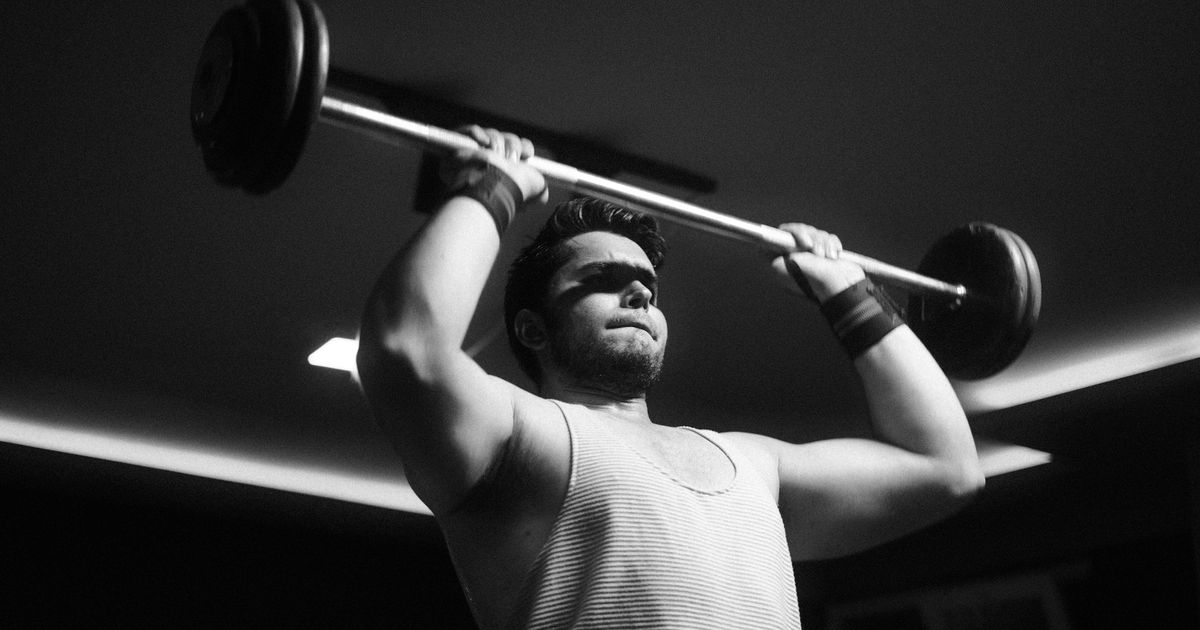
How to Overhead Press: Muscles, Form & Progression
Quick answer: To overhead press, set the bar on your front shoulders with hands just outside shoulder width, brace your abs and glutes, then press straight up while moving your head slightly back out of the way. Finish with the bar over your mid-foot and your biceps beside your ears. It mainly works the shoulders, triceps, and upper chest.
The overhead press is the lift where ego goes to die. You bench a respectable number, then unrack a bar overhead and suddenly 40kg feels ambitious.
That is normal. There is no bench to push against and no leg drive to borrow. It is just you, a bar, and everything between your hands and your feet holding the line.
What muscles does the overhead press work?
The overhead press is a compound push built around the shoulders, with the triceps and upper chest doing real work. It also quietly trains your core, because keeping a loaded bar from tipping you backwards is an abdominal job.
The primary movers are the anterior deltoid (front shoulder), the medial deltoid (side shoulder), the triceps, and the clavicular head of the pec (upper chest). Your abs, glutes, and upper back stabilise the whole thing.
Variation changes the emphasis more than people expect. An electromyographic analysis in Frontiers in Physiology compared front and behind-the-neck presses with barbells and machines.
The barbell beat the machine on overall muscle excitation, because a free bar has to be stabilised rather than guided. Front variations produced greater pectoralis major activation, and behind-the-neck variations hit the posterior and medial deltoids harder.
Standing costs more and gives more. A study on body position and loading in shoulder presses, published in the Journal of Strength and Conditioning Research, compared seated and standing presses with both barbells and dumbbells.
The variations demanding the most stability produced the most deltoid activation, meaning standing beat seated and dumbbells beat the barbell. The seated barbell press, the most supported version of all, allowed the heaviest absolute loads.
Translation: press standing for the training effect, sit down when you want to isolate the shoulders and move more weight.
How do you set up for an overhead press?
A good press is won at the shoulders and the ribcage before the bar moves.
- Grip just outside shoulder width. Forearms roughly vertical when the bar is racked on your shoulders. Too wide and you lose leverage, too narrow and your elbows flare forward.
- Bar on your front delts. Not floating in front of your chest. It should rest on the shelf your shoulders make.
- Elbows slightly in front of the bar. This points your force upward instead of backwards.
- Feet hip to shoulder width. Squeeze your glutes and brace your abs like someone is about to poke you.
- Wrists stacked. Bar over the meat of your palm, wrist straight, not bent back under the load.
That glute squeeze is not a detail. It is what stops your lower back turning into the world's least stable incline bench.
How do you perform the overhead press with good form?
Press the bar in a straight vertical line, moving your head out of the way rather than pressing around it.
The pressing phase
Take a big breath and brace. Drive the bar up, and as it passes your forehead, pull your head back slightly so the bar can travel straight past your face. Once it clears, push your head and chest forward through the "window" so you finish with the bar directly over your mid-foot.
Lock out with your biceps beside your ears and your shoulders shrugged up slightly at the top. That shrug is a real part of the movement, not cheating.
The lowering phase
Bring the bar back down to your front delts under control, reversing the same path: head back as the bar passes, then neutral. Reset your brace on the shoulders before the next rep, or keep tension and go again if you are training touch-and-go.
Do not lean back to make it easier. A small hip shift is natural under heavy load. Turning the lift into a standing incline press is how backs get angry.
What are the most common overhead press mistakes?
Four habits account for almost every stalled press.
- Pressing around your face. The bar drifts forward, your shoulder does the work at a bad angle, and the lift feels twice as heavy. Move your head, not the bar.
- Ribs flared and back arched. If your ribcage is pointing at the ceiling, your core is not braced. Tuck the ribs down, squeeze the glutes.
- Bent wrists. A bar resting behind a broken wrist is painful and weak. Stack the wrist over the forearm.
- Stopping short of lockout. Reps that stop at eyebrow height are not reps. Get to biceps by ears every time.
If your sticking point is right off the shoulders, the issue is usually the brace. If it is at the top, that is triceps.
How do you progress the overhead press?
Expect the overhead press to move slower than every other lift you own. It uses the least muscle mass of the big four, so 2.5kg jumps that feel routine on squats can stall for weeks up here.
That is not failure, it is the lift's nature. Plan for it.
- Use small plates. 1kg or 1.25kg microplates turn an impossible jump into an easy one.
- Add reps before weight. If your program says 3x5, work up to 3x6 or 3x7 at the same load, then add the smallest jump available. That is double progression, and it suits the press better than pure linear loading.
- Press twice a week. Once heavy, once lighter for reps, or paired with the bench press on separate days.
- Train the triceps directly. Close-grip work and pushdowns feed the top half of the press.
To see where your numbers actually sit, run your best set through the one rep max calculator and compare it against last month rather than against the person next to you.
Good overhead press variations
Seated dumbbell press removes the standing stability demand and lets each arm work independently. Push press uses a leg drive to move heavier loads and overload the lockout. Landmine press is the gentlest on cranky shoulders. Behind-the-neck press hits the rear and side delts harder, but demands shoulder mobility most people do not have.
Why does the overhead press need a written log more than most lifts?
Because progress here is measured in kilos per month, not per week. With slow lifts, memory is worthless. "I think it was 45 last time, or maybe 42.5" is how a press sits still for a year.
You do not need a complicated system. One line per session is enough:
ohp 45kg 5,5,4 (last rep grindy)
Most lifters already write something like that in Apple Notes or a notebook. The problem is that plain text never adds up into a trend.
Here is the trade-off between the usual options:
| Feature | Physical Notebook | Notes App | Traditional Gym App | Gym Note Plus |
|---|---|---|---|---|
| Shows month-over-month trend | No | No | Yes | Yes |
| Handles 1.25kg jumps | Yes | Yes | Yes | Yes |
| Finding last month's top set | Flick back pages | Endless scrolling | Yes | Yes |
| Logging speed | Fast | Very fast | Slow (menus and taps) | Very fast (plain text) |
| Works offline | Always | Always | Varies | Yes |
Gym Note Plus is built for the notes-app lifter. Type the workout as you always have, and it does the structuring:
- Small gains made visible. A 1.25kg jump disappears in memory but shows up clearly on a chart built from months of entries.
- Last press session on screen before you unrack, so you are never guessing between 42.5 and 45.
- One line per session.
ohp 45kg 5,5,4is the whole entry, typed in the time it takes to strip a plate. - Works with no signal, which matters in the basement corners where most racks live.
Curious what your own notes would look like as tracked data? Try the free notes to workout translator.
The overhead press moves too slowly to trust your memory. Write it down and the progress you cannot feel becomes progress you can see.
A simple starting plan
- Start light and standing. An empty barbell or 20kg for 3 sets of 8, prioritising a straight bar path.
- Add 2.5kg per session while the reps stay clean, then switch to 1.25kg jumps the moment one grinds.
- Press twice a week, one heavier day of 3x5 and one lighter day of 3x8 to 10.
- Log every set the same day, including how the last rep felt.
- Review monthly, not weekly. Compare this month's top set to last month's. That is the timescale this lift lives on.
Frequently Asked Questions
What muscles does the overhead press work?
The overhead press primarily works the anterior and medial deltoids, the triceps, and the upper (clavicular) portion of the pectoralis major. The abs, glutes, and upper back work isometrically to stabilise the torso, which is why the standing barbell overhead press is often described as a full-body lift disguised as a shoulder exercise.
Is the overhead press better standing or seated?
Standing and seated overhead presses serve different goals. Research in the Journal of Strength and Conditioning Research found the most stability-demanding variations, standing and dumbbell based, produced greater deltoid activation, while the seated barbell press allowed the heaviest absolute loads. Press the overhead press standing for whole-body carryover, or seated when you want maximum shoulder loading.
Why is my overhead press so much weaker than my bench press?
The overhead press is weaker than the bench press because it uses less total muscle mass, offers no bench to brace against, and has no leg drive. Most lifters press a good deal less overhead than they bench, and the gap tends to widen as both lifts get heavier. Slow progress on the overhead press is normal rather than a sign of a weak point.
How often should you overhead press?
Most lifters press overhead once or twice per week. Two sessions, one heavy in the 3 to 5 rep range and one lighter in the 8 to 12 range, gives enough practice for a technically demanding lift without overloading the shoulders, especially if you also bench press on separate days.
Should you press behind the neck?
Behind-the-neck pressing activates the posterior and medial deltoids more than the front press, according to EMG research in Frontiers in Physiology, but behind-the-neck pressing requires substantial shoulder mobility. Lifters who cannot reach the behind-the-neck rack position comfortably without flaring the ribs should stick to the front press and use rear delt isolation work instead.
Final Takeaways
- Press the bar straight up, and move your head out of the way. Bar paths that curve around your face cost you reps.
- Brace your abs and squeeze your glutes. The overhead press is a core lift with a shoulder finish.
- Stand for stability and carryover, sit for maximum load.
- Use microplates. This lift progresses in 1.25kg steps, not 2.5kg ones.
- Add reps before weight when a jump stalls.
- Log every session. On a lift this slow, written records are the only reliable proof you are improving.

Josh Ibbotson
Josh is the creator of Gym Note Plus, building tools that make workout tracking as simple as taking notes.
Ready to try it out?
Download Gym Note Plus and start tracking your workouts the way you want.
Download on App Store