
How to Front Squat: Rack Position, Form, and Progression
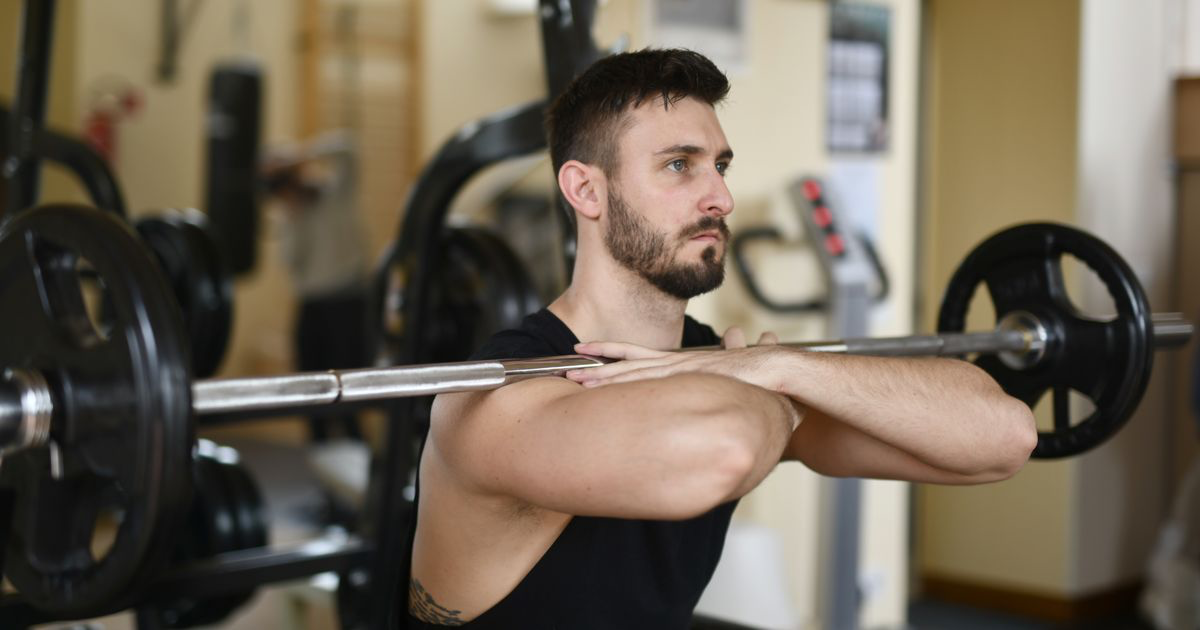
Quick answer: To front squat, rest the bar across your front delts and collarbone, hold your elbows high so your upper arms stay parallel to the floor, and unrack with the bar sitting on your shoulders rather than in your hands. Squat straight down with a vertical torso, then drive up while keeping the elbows lifted.
You watch someone unrack a front squat, elbows pointing at the ceiling, spine stacked like a column, and it looks easy.
Then you try it. The bar chokes you, your wrists scream, and by rep four your elbows have dropped and the barbell is rolling toward the floor.
What muscles does the front squat work?
The quadriceps do the bulk of the work, and the upper back does more than you expect. Holding a loaded bar in front of your body forces the torso upright, which shifts load away from the hips and onto the knees.
The supporting cast is long: the glutes extend the hip out of the bottom, the spinal erectors and the mid-back fight the bar's constant attempt to tip you forward, and the core braces against a load sitting in front of your centre of mass.
That anti-collapse demand is the real difference. In a back squat, a weak upper back means a slightly ugly rep. In a front squat, it means the bar leaves you.
Front squat vs back squat: what actually changes?
Muscle recruitment barely changes. Joint load does. This is the most useful research finding on the lift and the one most people get backwards.
Researchers compared both squats in 15 trained lifters using video, force plates, and EMG. The back squat produced significantly higher knee compressive forces and knee extensor moments, while the front squat matched it for overall muscle recruitment, according to Gullett and colleagues in the Journal of Strength and Conditioning Research. Shear force at the knee was small in both and no different between them.
So the front squat is not a lighter, easier stand-in for the back squat. It trains the same muscles with less compressive load at the knee, which is why it survives in programs where knees are cranky.
The trade is that the ceiling is lower. Your limiting factor stops being your legs and becomes your ability to hold the bar in place.
Which one should you actually do?
Do both, if the rack position does not hurt. If you only want one, pick the back squat for maximum load and the front squat for quad emphasis and an upright position that carries over to cleans, lunges, and split squats. Our how to squat guide covers the back squat setup in detail.
How do you hold the bar in a front squat?
The bar sits on your shoulders, not in your hands. Every grip below is just a way to stop it rolling forward. If your fingers are carrying the weight, the grip is wrong before you even squat.
Clean grip (front rack)
Hands just outside shoulder width, bar resting across the front delts and collarbone, fingertips under the bar, elbows driven up until the upper arms are roughly parallel to the floor. Two or three fingers under the bar is normal and plenty. This is the strongest position and the one worth learning if you do any Olympic lifting.
Cross-arm grip
Arms crossed over the chest, each hand pressing down on the opposite side of the bar. Far kinder to tight wrists and shoulders, and easier on day one. The downside is that it is less stable under heavy loads and awkward to bail out of.
Strap grip
Loop two lifting straps over the bar and hold the free ends with straight arms. This gives you the clean grip's elbow height without needing the wrist mobility. It is the best fix for lifters whose wrists, not whose legs, are the bottleneck.
Pick one and stay with it for a training block. Switching grips changes where the bar sits, which changes the whole lift.
How do you perform a front squat?
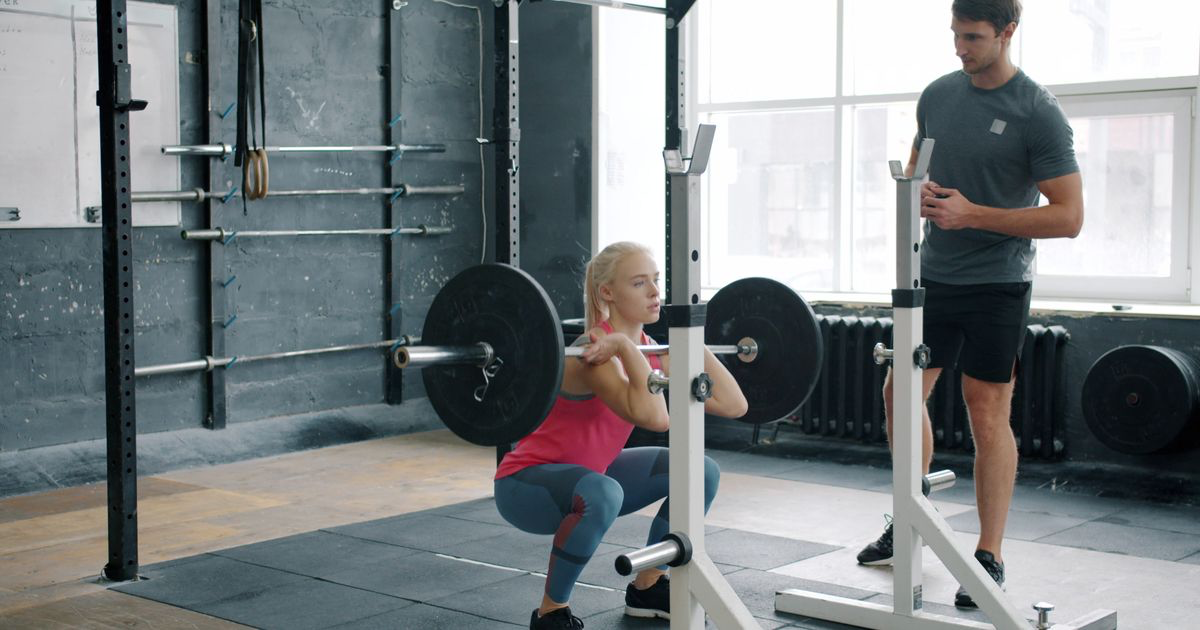
- Set the rack at mid-chest height, lower than you would for a back squat, so you can walk under the bar.
- Take your grip and drive the elbows up until the bar is locked against your shoulders and throat, not floating in your palms.
- Stand it up and take two steps back. Feet roughly shoulder width, toes turned out 15 to 30 degrees.
- Brace hard, then squat straight down, keeping your torso vertical and letting the knees travel forward over the toes.
- Descend until your hip crease passes your knee, or as deep as you can hold the elbows up.
- Drive up through the mid-foot, thinking "elbows to the ceiling" the entire way out of the bottom.
Keep your gaze forward rather than up. Craning the neck to look at the ceiling pushes the bar path forward, which is the one direction it cannot afford to go.
Why do people fall forward in the front squat?
Almost always because the elbows dropped. When the upper arms angle down, the shelf your shoulders make disappears and the bar starts rolling toward your fingertips. The torso then folds forward to chase it.
There are three usual causes. Wrist or lat tightness that stops you reaching elbow height in the first place, an upper back that fatigues before the legs do, and a load that was too heavy to hold that position for the full set.
Test which one it is. If rep one already has low elbows, it is mobility, so switch to straps or the cross-arm grip. If rep one is clean and rep six is not, it is either upper-back endurance or too much weight. Cut the load and the elbows usually fix themselves.
How much should you front squat compared to your back squat?
Expect roughly 70% to 85% of your back squat, and treat anything in that band as normal rather than a diagnosis.
The ratio moves with training history more than anatomy. Lifters who almost never front squat often sit near the bottom of that range, while weightlifters who live in the front rack can push toward 90%. The spread is wide enough that comparing yours to someone else's tells you very little.
What matters is your own ratio over time. If your back squat climbs for six months and your front squat does not budge, your upper back or rack position is the limiter, not your legs. Plug your best set into the one rep max calculator for each lift and check the gap every couple of months.
Related reading: when to increase weight lifting covers how to judge a jump on either lift.
Why is the front squat easy to log badly?
Because the number on the bar hides the thing that actually limited the set. A front squat can fail for reasons that never touch a back squat, and "Front squat 80kg 3x5" records none of them.
The set where your elbows collapsed at rep four and the set where your legs genuinely gave out look identical in a log. So do a clean-grip session and a strap-grip session, even though they are different lifts in practice.
| Physical Notebook | Notes App | Traditional Gym App | Gym Note Plus | |
|---|---|---|---|---|
| Recording grip used | Free text | Free text | Rarely a field | Free text, kept |
| Noting why a set failed | Margin scribble | Free text | Fixed notes field | Free text, kept |
| Charting the trend | None | None | Charts | Charts from your text |
| Comparing to back squat | Manual | Manual | Per-exercise view | Per-exercise view |
| Finding last session | Flip pages | Text search | Structured search | Structured search |
The fix costs you four words. Write the grip and the failure reason in the same line: "Front squat straps 80x5,5,4 elbows dropped". Three months later that is the difference between a chart you can read and one you cannot.
A simple front squat starting plan
- Test the rack position empty. Hold the bar for 30 seconds in each grip and pick the one that does not hurt your wrists.
- Start at half your back squat, even if it feels insultingly light. The lift is a skill before it is a strength exercise.
- Run 4 sets of 5 for four weeks, once a week, placed first in a session while you are fresh.
- Add weight only when all four sets hold elbow height. A rep with dropped elbows does not count as a rep.
- Log the grip every time, so a stalled month can be traced to the right cause.
Keep logging the way you already do
If you type your sessions into your phone's notes app, you already handle the messy part well. Plain text takes "cross grip, elbows died set 3" without asking you to pick from a dropdown that does not have it.
Gym Note Plus is built for that habit. You write the line the way you always have, and it groups every set by exercise and date, so your front squat turns into a chart instead of a scroll.
- Type the set in plain text, grip notes and all.
- See the trend per exercise, so you can watch the front-to-back squat gap close.
- Pull up last session in a tap, before you load the bar.
Paste an old leg session into the free notes to workout translator and see what your squat numbers have actually been doing.
The front squat is not a weaker back squat. It is the same leg work with less load through the knee, held together entirely by your elbows.
Frequently Asked Questions
Is the front squat better than the back squat for your knees?
The front squat places less compressive force through the knee than the back squat at a given effort. Gullett and colleagues found significantly lower knee compressive forces and extensor moments in the front squat, with equal overall muscle recruitment, which is why coaches often use it for lifters with meniscus problems or knee pain.
Why do my wrists hurt during front squats?
Wrist pain in a front squat almost always means you are gripping the bar instead of resting it on your shoulders. The bar should sit on the front delts and collarbone with the fingers acting only as a hook. If elbow height is limited by wrist or lat tightness, use lifting straps or the cross-arm grip instead.
How much weight should you front squat as a beginner?
A beginner should start the front squat at roughly half their back squat, or with an empty barbell if the rack position is new. The limiting factor early on is holding the bar and keeping the elbows high, not leg strength, so load should only rise once every set of a session holds position.
Do front squats build bigger quads than back squats?
Front squats and back squats produce similar overall muscle recruitment, so neither is clearly better for quad size. The front squat's upright torso keeps more of the work at the knee rather than the hip, which many lifters feel as more quad emphasis, but total weekly hard sets still drives growth more than the variation you pick.
Can you front squat without a rack?
Yes, but only at light loads. You can clean the bar into the front rack from the floor, which caps the weight at what you can clean rather than what you can squat. For anything heavy, use a rack set at mid-chest height so the front squat itself is the hard part.
Final Takeaways
- The bar rides on your shoulders, not in your hands. Fingers are a hook, nothing more.
- Elbows up is the whole lift. Once they drop, the bar rolls and the torso folds.
- Less knee compression, same recruitment. The research favours it for knee-sensitive lifters.
- Expect 70% to 85% of your back squat, and track your own ratio rather than someone else's.
- Write down which grip you used. A stalled front squat usually has a grip problem, not a leg problem.

Josh Ibbotson
Josh is the creator of Gym Note Plus, building tools that make workout tracking as simple as taking notes.
Ready to try it out?
Download Gym Note Plus and start tracking your workouts the way you want.
Download on App Store