
Farmer's Walk: How to Do It, How Much to Carry, How to Log It
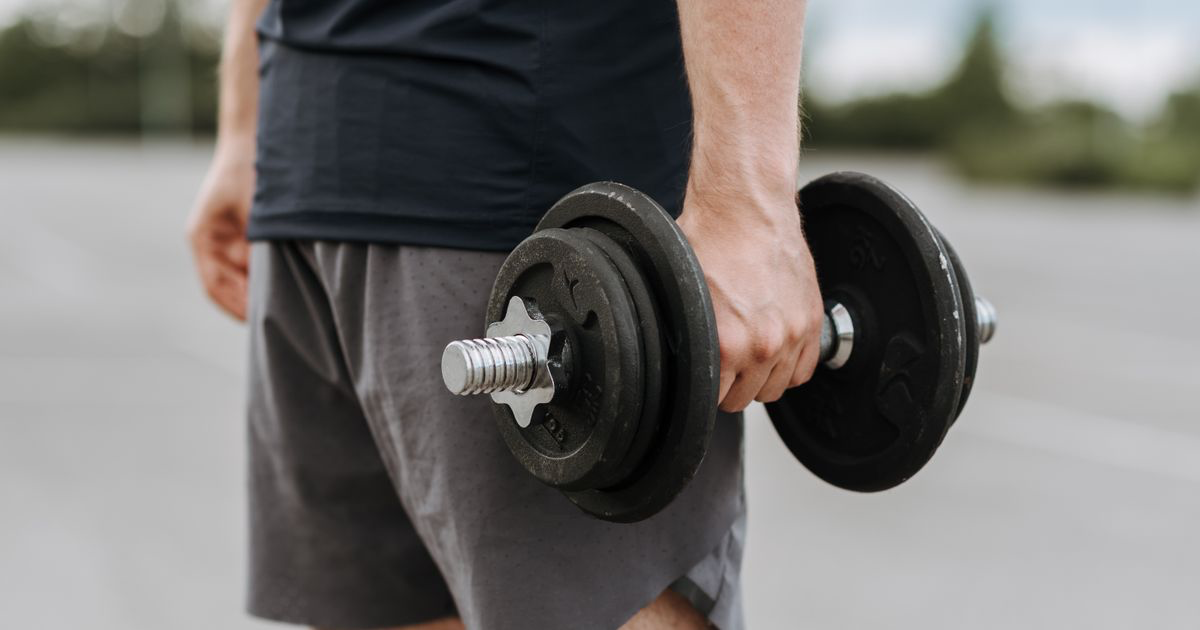
Quick answer: Pick up a heavy weight in each hand like a deadlift, stand tall with your shoulders packed down and abs braced, then walk in short controlled steps without leaning or looking down. Set them down the same way you picked them up. Two to four sets of 20 to 40 seconds is a normal dose.
Every other exercise in your log has a number that goes up. Sets, reps, weight, done.
Then you add farmer's walks, and your log says "farmers walk 3 sets" for four months. No reps to count, two weights instead of one, and a distance you never measured. So the one exercise that most obviously either got easier or did not is the one you have no record of.
Worth fixing, because the carry earns its place.
What muscles does the farmer's walk work?
Almost everything that resists collapse. The load wants to fold you forward and sideways, and the muscles that stop it are the ones getting trained.
The most detailed measurements come from a 2009 study in the Journal of Strength and Conditioning Research that wired up experienced strongmen carrying 75kg in each hand. Peak activation, as a percentage of maximum voluntary contraction:
- Latissimus dorsi: 152 to 169 percent
- Lumbar erector spinae: 106 to 144 percent
- Gluteus maximus: 114 percent
- Gluteus medius: 108 percent
- Internal oblique: 111 percent
Two cautions on those numbers. The study used only three participants at loads most people will never touch, so treat them as directional. And the peaks occurred during the pick-up, not the walk.
That last point is the one nearly every guide skips. The heaviest moment of a farmer's walk is picking the weights up, and it is the moment most people treat as an afterthought.
Walking is what makes it a core exercise
Standing still holding heavy things is not the same exercise. A 2024 study in the International Journal of Exercise Science compared a carry against a static hold in 18 participants and found walking roughly tripled trunk activation: longissimus went from 5.6 to 16.4 percent of maximum, multifidus from 5.1 to 16.3 percent.
The absolute numbers are modest. The ratio is the point. Each step briefly unloads one leg, and your trunk has to stop the whole system tipping.
Is grip strength really worth training?
Grip strength tracks with health outcomes better than most things you can measure in a gym.
The PURE study, published in The Lancet in 2015, followed 139,691 people across 17 countries for a median of four years. Every 5kg drop in grip strength was associated with a 16 percent higher risk of death from any cause, and a 17 percent higher risk of cardiovascular death. Grip strength predicted both better than systolic blood pressure did.
Be careful with what that means. PURE is observational, and grip strength is standing in for whole-body strength rather than acting as the cause. The authors themselves called for research on whether improving strength changes the outcome. Nobody has shown that training your grip extends your life.
What it does support is treating grip as a real fitness marker rather than a novelty. If you use straps on everything, our guide to when to use lifting straps covers the tradeoff.
How do you perform a farmer's walk correctly?
The pick-up
Treat it as a deadlift. Weights beside your feet, hip-width stance, hips back, knees bent, back flat. Grip the handles deep in the palm rather than the fingers and squeeze hard, then stand.
Do not bend at the waist and scoop them up. This is where the spine loading peaks.
The walk
Stand tall with your shoulders back and down, ribs pulled down, abs braced, eyes forward. Keep your arms slightly away from your body so the implements clear your thighs.
Take short, controlled steps. Guidance from the National Strength and Conditioning Association (NSCA) is to keep an upright torso, walk slowly, and avoid any lateral bending.
Keep breathing. A carry lasts 20 to 40 seconds, so the long breath hold you would use on a heavy single is not an option. Brace and breathe shallowly behind the brace.
The set-down
Hips back, knees bend, controlled to the floor. Dropping them is how you find out your gym has a weight-drop policy.
What are the most common farmer's walk mistakes?
- Looking down. The most-cited error across coaching sources. Your upper back rounds to follow your eyes.
- Leaning forward as you fatigue. The set has ended, whether or not you have stopped walking.
- Going too heavy. If your walking mechanics fall apart in the first five steps, you are training a drop, not a carry.
- Shrugging the traps up. Hold the load with packed shoulders instead of hanging off your upper traps.
- Rushing the pick-up and set-down. The highest spine compression in the whole exercise happens here.
How much weight should you carry?
This is the question every guide dodges, so here are two sourced answers.
Benchmarks by goal. The NSCA cite functional-strength standards for a two-handed carry held for 30 seconds: about 50 percent of bodyweight total for rehabilitation, 100 percent for general fitness, and 200 percent for elite sport. General fitness therefore means roughly half your bodyweight in each hand.
Measured reality for one hand. A 2018 study in Sports took 51 recreationally active adults up to technical failure on a 20-second single-hand carry. Women averaged 32.5kg, about 53 percent of bodyweight. Men averaged 52.0kg, about 64 percent of bodyweight.
Start well under those numbers. They are ceilings measured to failure, not training loads.
One hand or two?
Two hands, if your back is the concern.
A 2013 study in Ergonomics found that carrying 30kg in one hand produced low-back compression above 2,800 newtons, while splitting the same 30kg between both hands cut it to 1,570 newtons, a 44 percent reduction. Carrying 30kg in each hand, double the total load, still loaded the spine less than 30kg in one hand.
Single-hand suitcase carries have their place for training anti-lateral-flexion. Just know you are buying that with disproportionate spine load, and log the sides separately.
Where should farmer's walks go in your session?
There is a genuine fork here, and it depends on why you are doing them.
Heavy and short goes early. The NSCA note that loaded carries can be used at the start of a session to potentiate the nervous system.
Long and light goes last. As conditioning, they belong at the end.
The constraint everyone learns the hard way: carries destroy your grip. Putting them before deadlifts or rows will cost you on those lifts. If you deadlift on the same day, carry afterwards.
Reasonable starting doses from NSCA-aligned guidance: 2 to 4 rounds of 10 to 20 seconds with a challenging weight, or 3 to 6 sets over 30 metres, or 4 to 8 sets of 30 to 45 seconds. The NSCA are candid that the research base here is thin, so most of these numbers are practitioner consensus rather than trial data.
Do farmer's walks replace deadlifts?
No. A 2015 Journal of Strength and Conditioning Research trial says so plainly.
A 2015 trial in the Journal of Strength and Conditioning Research randomised 30 trained rugby players to seven weeks of strongman training or traditional resistance training, matched for load and biomechanics. Everything improved in both groups, with no significant differences between them on functional performance.
The between-group effects split sensibly. Strongman training favoured muscle mass, acceleration and bent-over row strength. Traditional training favoured squat and deadlift one rep maxes, horizontal jump and change of direction.
Carries are additive. They are not a barbell substitute.
Similarly, a 2016 study comparing a strongman session against a duration-matched traditional session in 10 healthy men found both elevated heart rate, lactate and caloric expenditure significantly, and concluded the strongman session was an equivalent physiological stimulus. Not a superior one, despite what most articles claim.
How do you actually log a farmer's walk?
Sets, reps and weight cannot describe this exercise. You need a different set of variables, and once you write them down consistently the exercise becomes as trackable as a squat.
Record these:
- Load per hand, and make it unambiguous. "70kg" could mean 70 per hand or 70 total.
- The implement. Dumbbells, kettlebells, trap bar and dedicated handles are not interchangeable; handle thickness and height change the grip demand enough that the loads do not compare.
- Distance or time, and pick one. Mixing metres one week and seconds the next makes the history unreadable.
- Turns and lap length. Forty metres as one straight run is a different exercise from four 10 metre shuttles.
- Why the set ended. Grip failure, posture breakdown, or you hit the target. This is the carry's version of reps in reserve, and it tells you what to change.
- Straps or no straps. Strapped carries still train the trunk and legs but remove the grip stimulus completely.
A line that captures all of it stays short:
Farmers walk 40kg/hand, 30m x3, no straps, grip failed set 3
| Where your log lives | Handles non-rep exercises | Keeps load and distance together | Progress over time | Searchable later |
|---|---|---|---|---|
| Physical notebook | Yes, write anything | Yes, if you are consistent | Manual, you do the maths | No |
| Notes app | Yes, it is just text | Yes, format is up to you | None, it is just text | Text search only |
| Traditional gym app | Often forces sets and reps | Frequently not, distance may be missing | Charts only if fields fit | Within the app |
| Gym Note Plus | Type it as you would write it | Yes, one line, one session | Automatic per-exercise trends | Yes, whole history |
The structured-app problem is real here. Many trackers demand a rep count for every set, so people type "1 rep" and lose the distance entirely, which makes the chart meaningless.
One progression rule matters more than the rest: hold distance constant and add load, or hold load constant and add distance. Change both and you cannot tell what improved.
A simple starting plan
- Start at about 25 percent of bodyweight per hand for 20 seconds. Well below the measured ceilings, and you will still feel it.
- Pick your unit and commit. Either metres or seconds, for the next three months.
- Run 3 sets at the end of a session, resting a full minute or two between them.
- Add distance first, then load. Work up to 40 seconds or 40 metres at a given weight, then add weight and drop back to your starting distance.
- Write the failure mode every time. If grip fails first for three sessions running, that is your signal to train grip directly rather than add load.
Keeping an odd exercise in an ordinary log
If you already write your sessions into a notes app, a carry is easy to record. One line, in whatever format you like, no fields to fight.
The trouble starts later, when you want to know whether 40kg for 30 metres in August beat 35kg for 40 metres in May. The answer is in your notes. Getting it out means scrolling.
Gym Note Plus reads the plain text you already write, so exercises that do not fit a sets-and-reps grid still get a history:
- No forced fields. Nothing demands a rep count for an exercise that has no reps.
- Per-exercise trends built from what you actually typed.
- Everything in one session entry, so the carry sits under the deadlifts it followed.
Paste a week of your notes into the free notes to workout translator and see what comes back.
The farmer's walk is the easiest exercise in the gym to perform and the easiest to lose track of. Load per hand, distance, and why the set ended. Three numbers and it becomes a lift like any other.
Frequently Asked Questions
What muscles does the farmer's walk work?
The farmer's walk trains the grip and forearms, the lats and upper back, the spinal erectors, the glutes and the obliques. EMG measurements in a 2009 Journal of Strength and Conditioning Research study recorded latissimus dorsi activation between 152 and 169 percent of maximum voluntary contraction, peaking during the pick-up rather than the walk.
How much weight should you use for farmer's walks?
For general fitness, NSCA-cited standards suggest carrying about 100 percent of bodyweight in total for 30 seconds, meaning roughly half your bodyweight in each hand. Measured single-hand maximums in recreationally active adults were 53 percent of bodyweight for women and 64 percent for men, but those were tested to technical failure and are ceilings rather than training loads.
How long should you do a farmer's walk for?
Published guidance clusters around 20 to 45 seconds per set for 2 to 8 sets, or roughly 30 metres per set. Keep the unit consistent between sessions so progress stays readable. The NSCA note openly that there is little trial data on carry programming, so these numbers reflect practitioner consensus rather than established dose-response research.
What is the difference between a farmer's walk and a suitcase carry?
A farmer's walk carries equal load in both hands, while a suitcase carry loads one side only. A 2013 Ergonomics study found 30kg in one hand produced low-back compression above 2,800 newtons, against 1,570 newtons when the same weight was split between both hands. Suitcase carries train resistance to sideways bending at a higher spine cost.
Can farmer's walks replace deadlifts?
Farmer's walks do not replace deadlifts. A 2015 trial randomising 30 trained athletes to strongman or traditional training for seven weeks found traditional training produced better squat and deadlift one rep max gains, while strongman training favoured muscle mass, acceleration and bent-over row strength. Carries complement barbell work rather than substituting for it.
Final Takeaways
- The pick-up is the hardest part. Peak spine loading and peak lat activation happen there, so deadlift the weights up rather than scooping them.
- Two hands beats one for spine load. Splitting a load between both hands cut low-back compression by 44 percent in the research.
- Half your bodyweight per hand for 30 seconds is a reasonable general-fitness target. Build toward it, do not start there.
- Carry after you deadlift, not before, unless you want grip failure to end your pulling.
- Log load per hand, distance or time, and why the set ended. Without those three, a carry leaves no trace in your training history.

Josh Ibbotson
Josh is the creator of Gym Note Plus, building tools that make workout tracking as simple as taking notes.
Ready to try it out?
Download Gym Note Plus and start tracking your workouts the way you want.
Download on App Store