
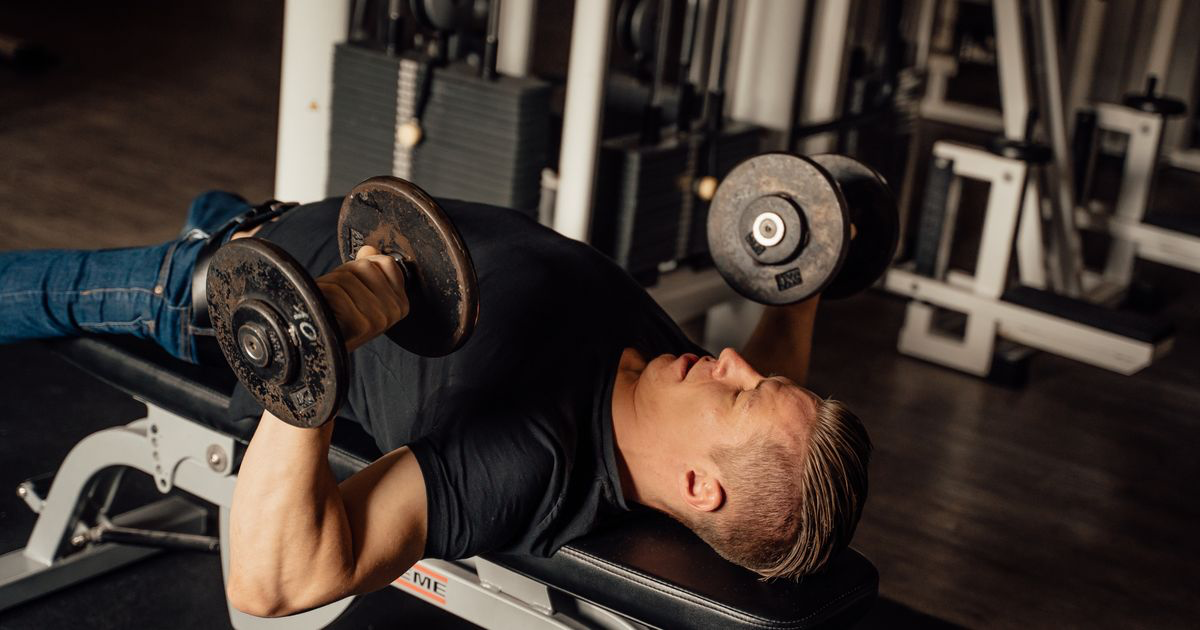
How to Do a Dumbbell Pullover: Muscles Worked, Form, and Progression
Quick answer: The dumbbell pullover is a chest exercise more than a back exercise. Lie across or along a bench, hold one dumbbell over your chest with slightly bent elbows, and lower it behind your head until you feel a stretch, then pull it back over your chest. EMG research found the pullover works the pectoralis major more than the latissimus dorsi.
Ask ten people what the pullover trains and you will get chest, lats, serratus, and "it's a rib cage expander" from someone who read a 1970s magazine.
Two EMG studies have actually measured it, and the answer is less mysterious than the folklore.
What muscles does the dumbbell pullover work?
Mostly the chest. Marchetti and Uchida put eight trained men through barbell pullovers at 30% of body weight in the Journal of Applied Biomechanics and found the exercise "emphasized the muscle action of the pectoralis major more than that of the latissimus dorsi", with the higher activation depending on the lever arm of the load at each point in the movement.
A larger study by Muyor, López-Miñarro and Alacid in Applied Sciences compared the barbell pullover with the straight arm pulldown in 20 physically active adults, again at 30% of body mass. The pullover produced higher activity than the pulldown in every muscle measured except two: the latissimus dorsi and the triceps brachii, which were both higher in the straight arm pulldown.
Their conclusion was that the pullover highlights the pectoralis major, particularly its sternal and lower portions, along with the triceps and the rectus abdominis, while the straight arm pulldown is the better choice for hitting the lats.
So the practical summary is:
- Pectoralis major, especially the lower and sternal fibres, in a stretched position most chest work never reaches
- Latissimus dorsi, worked but not maximally, and not as much as a pulldown would
- Triceps long head, which crosses the shoulder and is loaded by the overhead position
- Abdominals, holding your ribcage down against the pull
If you want the lats specifically, the lat pulldown is the more direct tool.
How do you do a dumbbell pullover with good form?
Setting up
Lie along the bench, not across it, if you are new to the movement. The classic version has you lying perpendicular across the bench with only your upper back supported and your hips dropped. It gives a bigger range of motion and asks a lot more of your lower back and hips. Lying flat along the bench with your whole spine supported is the version to learn on.
Hold one dumbbell with both palms flat against the underside of the top plate, thumbs and index fingers making a diamond around the handle. Press it straight up over your chest.
The movement
- Set your elbows. Bend them slightly, maybe 10 to 20 degrees, and keep that angle fixed for the whole set. The elbows do not open and close; the shoulders do the work.
- Lower under control. Take the dumbbell back over and behind your head in an arc, breathing in, until you feel a firm stretch across your chest and under your armpits. Stop there.
- Do not chase depth. For most people the dumbbell ends roughly level with the bench or a little below. Going further usually means the ribcage has lifted, which does nothing but stress the shoulder.
- Pull back over your chest. Same arc, elbows still fixed, until the dumbbell sits over your upper chest. Stop before your arms are vertical, or the tension disappears at the top.
- Keep your ribs down. Your lower back should not arch off the bench as the weight goes overhead. If it does, the weight is too heavy or your range is too big.
What are the most common dumbbell pullover mistakes?
Turning it into a triceps extension. If your elbows bend and straighten during the rep, you are doing a bad skullcrusher. Fix the elbow angle and forget about it.
Going too heavy. This is a long lever with a shoulder at full flexion at the bottom. The weight that feels reasonable on a dumbbell press is not the weight for this. Most people should start with something they could do for 15 clean reps.
Flaring the ribcage. The lower back arches, the range of motion looks bigger, and nothing extra gets trained. Keep the ribs pulled down toward the hips.
Cross-bench setup on day one. Hips dropped, spine unsupported, and a heavy dumbbell behind your head is not a beginner's position. Earn it.
Shrugging at the bottom. The shoulders should not travel up toward the ears in the stretched position. That is the point where most pullover shoulder complaints come from.
Should you do dumbbell pullovers at all?
They are a good accessory, not a main lift. No pullover study shows it beating a press for chest or a pulldown for back. What it offers is a stretched chest position that flat presses and cable flyes do not reach, which is a genuine reason to include it if your chest work is otherwise all pressing.
Training a muscle in a lengthened position has become one of the more interesting areas of hypertrophy research; our guide on stretch-mediated hypertrophy covers what is and is not established there.
Where it fits: two or three sets of 10 to 15 at the end of a chest or upper body day, or as the second exercise in a pair with a press.
Where it does not: as your only chest exercise, as a back exercise, or anywhere near the start of a session when you are fresh enough to load a real press.
| Exercise | Best for | Position of peak tension | Load tolerated |
|---|---|---|---|
| Dumbbell pullover | Stretched chest work, rib cage control | Bottom, arms overhead | Low |
| Straight arm pulldown | Latissimus dorsi | Mid-range | Moderate |
| Dumbbell fly | Stretched chest work at chest height | Bottom, arms wide | Low |
| Barbell bench press | Overall chest and triceps strength | Mid-range | High |
How do you progress the dumbbell pullover?
Progression on a stretch-position accessory is not the same as progression on a bench press. Jumping the dumbbell 5kg at a time puts you into a position your shoulders did not agree to.
- Start where 15 reps is comfortable. For many people that is a 10 to 15 kg dumbbell, and there is no prize for starting heavier.
- Add reps before you add weight. Work from 10 up to 15 at the same dumbbell across a few weeks, then take the next dumbbell up and drop back to 10. Our guide to double progression explains why this suits accessory work.
- Take the range before the load. Getting a full, controlled stretch at a given weight is worth more here than moving the next dumbbell badly.
- Log the setup alongside the weight. Flat along the bench and across the bench are different exercises. So are 12 controlled reps and 12 bounced ones.
- Reassess every four weeks. If the weight has climbed but the stretch has shrunk, you went backwards.
Where to keep the details that matter
The pullover is a perfect example of an exercise where the weight on its own tells you almost nothing. Pullover 20kg 12 could be a full-range set along the bench or a half-range set with a lifted ribcage.
Which is why most people who take it seriously end up writing a few words next to the number, usually in a note on their phone, because that is the only place a few words fit.
Gym Note Plus is built for exactly that habit:
- Type the set and the note in one line,
Pullover 20kg 12,12,10 flat bench full ROM - Every exercise gets its own trend line, so the pullover has a history instead of a vague feeling
- Volume and estimated 1RM calculated from your text
- Photograph a handwritten page and have it read into the log
Paste your last session into the free notes to workout translator and see what comes back.
| Physical Notebook | Notes App | Traditional Gym App | Gym Note Plus | |
|---|---|---|---|---|
| Logging speed | Fast | Fast | Slow at first | Fast |
| Records setup notes | Yes | Yes, free text | Rarely | Yes, in the same line |
| Data visualization | None | None | Charts | Charts from your text |
| Flexibility | Total | Total | Fixed fields | Total |
| Searchability | Flip pages | Text search | Structured search | Structured search |
The dumbbell pullover is not a lat exercise that also does chest. It is a chest exercise that also does a little back, and the sooner you program it that way the more useful it becomes.
Frequently Asked Questions
What muscles does the dumbbell pullover work?
The dumbbell pullover works the pectoralis major most, particularly its sternal and lower portions, along with the latissimus dorsi, the long head of the triceps and the abdominals. EMG research by Marchetti and Uchida found the pullover emphasised the pectoralis major more than the latissimus dorsi.
Is the dumbbell pullover a chest or back exercise?
Treat the dumbbell pullover as a chest exercise. In a 2022 Applied Sciences study, the barbell pullover produced higher activity than the straight arm pulldown in every muscle measured except the latissimus dorsi and triceps brachii, which were higher in the pulldown. For lats, use a pulldown instead.
Should you do dumbbell pullovers across the bench or along it?
Lie along the bench with your whole spine supported while you are learning the movement. The classic cross-bench position, with only the upper back on the bench and the hips dropped, adds range of motion but demands far more from the lower back and shoulders.
How heavy should a dumbbell pullover be?
Start with a dumbbell you could control for 15 clean reps, which for many lifters is 10 to 15 kg. The pullover loads the shoulder at full flexion on a long lever, so it tolerates far less weight than a dumbbell press, and adding load too quickly is the usual cause of shoulder complaints.
Do dumbbell pullovers expand your rib cage?
No. The idea that pullovers expand the rib cage comes from mid-century bodybuilding writing rather than evidence, and adult rib cage dimensions are not meaningfully changed by an exercise. The pullover is worth doing for stretched-position chest work, not for skeletal changes.
How many sets and reps of dumbbell pullovers should you do?
Two or three sets of 10 to 15 repetitions, placed near the end of a chest or upper body session. The pullover is an accessory exercise that works best at moderate reps and controlled tempo, rather than a heavy low-rep movement.
Final Takeaways
- The pullover is a chest exercise first. Two EMG studies point the same way.
- Fix your elbow angle and forget it. The moment elbows bend and straighten, it stops being a pullover.
- Stop the stretch where the ribs start to lift. Extra depth from an arched back trains nothing.
- Learn it lying along the bench, and only move to the cross-bench version once the movement is grooved.
- Progress by reps first, weight second, because this is a long lever in a vulnerable position.
- Log the setup alongside the weight, or your pullover history will be unreadable in a month.

Josh Ibbotson
Josh is the creator of Gym Note Plus, building tools that make workout tracking as simple as taking notes.
Ready to try it out?
Download Gym Note Plus and start tracking your workouts the way you want.
Download on App Store