
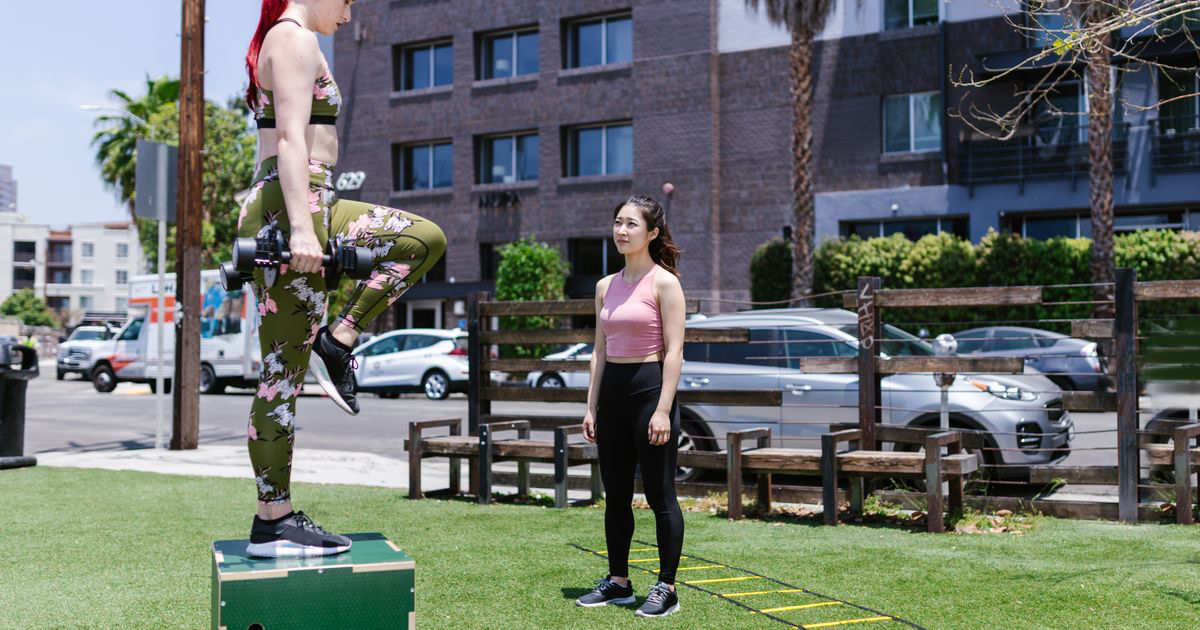
How to Do Step-Ups: Muscles Worked, Form, and Box Height
Quick answer: To do step-ups, plant your whole working foot on a box around knee height, lean your chest slightly forward, and drive through that heel until you stand tall on the box. Keep the back foot passive. Lower under control. Step-ups train the glutes and quads one leg at a time.
Step-ups look like the easiest exercise in the gym. Most people make them easier still by bouncing off the floor with the back foot.
Done properly, the step-up is one of the hardest single-leg lifts you can load. It needs no rack and very little setup, and it tells you quickly if one leg is doing more of the work than the other.
What muscles do step-ups work?
The gluteus maximus and the quadriceps do most of the work. The glutes extend the hip as you rise, and the quads straighten the knee. The hamstrings, gluteus medius, adductors and calves help with hip extension and keep the knee and pelvis steady on one leg.
Step-ups rank near the top for glute activation. A systematic review by Neto and colleagues in the Journal of Sports Science and Medicine sorted loaded exercises by gluteus maximus EMG. The step-up and its lateral, diagonal and crossover versions all reached the very high band (above 60 percent of maximal voluntary contraction). The authors concluded that step-up variations showed the highest glute activation, ahead of deadlifts, hip thrusts, lunges and squats.
Activation is not the same as growth. Read it as a sign the glutes are working hard, and leave the question of whether step-ups build more muscle than a hip thrust open.
The quads still do a large share. When Muyor and colleagues measured the lateral step-up, forward lunge and single-leg squat in 20 active adults, the vastus lateralis and vastus medialis showed the highest EMG activity in all three, followed by the gluteus medius and gluteus maximus.
How high should the box be for step-ups?
Start with a box that puts your working thigh roughly parallel to the floor. For most people that is around knee height, or a standard bench. From there, adjust for what you want to train.
A lower box shifts the work toward the quads. Less hip flexion at the bottom means the knee does more of the lifting and the hip has less range to cover.
A higher box gives the glutes more to do. Starting deeper in hip flexion puts the glutes under load at a longer length and asks for more hip extension to finish the rep. The 6RM study by Simenz and colleagues used an 18 inch (45.72 cm) box, and the standard forward step-up gave the highest glute and hamstring activation of the four variations tested.
A taller step makes the thigh muscles work harder. In an older lateral step-up EMG study by Brask and colleagues, 29 participants stepped onto 4 inch and 8 inch steps. All four thigh muscles they measured were significantly more active at 8 inches.
Hip mobility sets the upper limit.
How do you do a step-up with proper form?
- Set the box and stand close to it. You want your working foot to land flat on the box without reaching. A gap between you and the box turns the step-up into a lunge.
- Plant the whole foot. Put your working foot fully on the box, heel included. A foot hanging off the edge shifts the load onto your toes and the knee.
- Lean your chest forward slightly. A small forward lean over the front foot loads the hip. Staying bolt upright makes the rep more quad dominant.
- Drive through the front heel. Push down into the box and stand up until the hip and knee are both straight. The back foot rises passively and can finish beside the front one or stay hovering.
- Lower for two to three seconds. Reverse the path under control and let the back toes touch the floor lightly. Do not drop off the box.
- Finish every rep on one side before switching. Alternating legs gives each leg a rest between reps and makes the set easier than it looks on paper.
Hold dumbbells at your sides for most sets. A barbell on your back allows heavier loads but makes balance and bailing out harder, so earn it with dumbbells first.
What are the most common step-up mistakes?
Pushing off the back foot. This is the big one. A hop from the trailing leg supplies momentum, and the working leg skips the hardest part of the rep. Lift the back toes slightly or keep that foot relaxed so it cannot help.
Letting the knee cave in. The working knee should track over the middle of the foot. If it collapses inward, lower the box or the load. Stepping up is not hard on the knee in itself: Chinkulprasert and colleagues found forward and lateral step-ups produced lower patellofemoral joint stress than forward step-downs at the same step height.
Using a box that is too high. If your pelvis tucks and your back rounds at the bottom, lower the box.
Crashing down on the way back. The lowering phase is half the exercise. Dropping off the box wastes it and jars the knee on landing.
What step-up variations should you try?
Lateral step-up. Stand side-on to the box and step up sideways. In a study of older adults by Wang and colleagues, the lateral step-up put more demand on the knee extensors and ankle plantar flexors, while the forward step-up produced greater peak hip power and total work.
Crossover step-up. Start beside the box and cross the working leg over your body to step up. Simenz and colleagues found it gave the highest concentric gluteus medius activation of the four versions.
Barbell step-up. A barbell on the upper back lets you load heavier than dumbbells allow. Use a lower box than you would with dumbbells, because stepping off safely is harder with a bar.
How many sets and reps of step-ups should you do?
Two to four sets of 6 to 12 reps per leg, one to two times a week. Lower reps suit barbell step-ups; higher reps suit dumbbells and bodyweight work, where grip and balance run out first.
Choosing a starting weight. Ebben and colleagues tested 21 college students and derived a 6RM step-up load of roughly half their 6RM squat load plus 3.32 kg. Treat that as a rough ceiling, and start well below it while you learn the balance.
Progress in this order. Add reps per leg first, then add load, then add box height. Raising the box and the weight in the same week makes it impossible to know which change stalled you.
What are the best step-up alternatives?
Bulgarian split squats load one leg with the back foot elevated and are easier to load heavy because you are not lifting your bodyweight onto a box. Our Bulgarian split squat guide covers the setup.
Walking or reverse lunges train the same muscles with a moving stance. The lunge guide explains which version fits which goal.
Whichever you pick, single-leg work earns a place alongside squats rather than replacing them. Our breakdown of unilateral vs bilateral training covers why.
How should you log step-ups?
"Step-ups 3x10 20kg" leaves out most of what matters. Was that 10 per leg or 10 total? Was the 20kg per dumbbell? Which box?
A useful step-up entry records the load per hand, reps per leg, box height, and a note if one side lagged. Without the box height, a jump from bench to plyo box looks like a strength drop.
| Logging method | Speed per set | Tracks each leg | Shows progress over months | Searchable later |
|---|---|---|---|---|
| Physical notebook | Fast | Only if you write L and R | Flick back through pages | No |
| Notes app | Fastest | Only if you write L and R | Plain text, no trend | Text search only |
| Traditional gym app | Slow, menus per set | Sometimes, often as one entry | Charts | Inside the app |
| Gym Note Plus | Fastest, plain text | Yes, from what you typed | Automatic per-exercise trends | Whole history |
A four-week starting plan
- Week one: learn the pattern. Bodyweight or light dumbbells on a knee-height box, three sets of 10 per leg. Write down the box height and which leg felt weaker.
- Week two: slow the negative. Same load, three sets of 10 per leg with a three second lowering and no push from the back foot. Expect it to feel far harder.
- Week three: add load. Increase the dumbbells by the smallest jump available and drop to 8 reps per leg. Note any side-to-side difference in reps.
- Week four: build reps. Same load, work back up toward 10 per leg. If the weaker side still lags, start sets on that leg and match its reps with the other.
Where Gym Note Plus fits
If you already type your sets into a notes app between rounds, you have the habit. What the notes can't do is show you a trend.
Gym Note Plus reads plain text the way you already write it and turns it into tracked data.
- Type
db step up 18in 20kg L 10,10,9 R 10,9,8and it becomes structured sets for each side. - Forward, lateral and barbell step-ups stay separate because you typed different names.
- Box height and per-leg notes stay attached to the exercise.
- Weekly glute and quad volume is calculated for you.
Paste a recent leg day into the free notes to workout translator to see what your own shorthand turns into.
A step-up only counts if the front leg lifts you. The back foot is along for the ride.
Frequently Asked Questions
What muscles do step-ups work?
Step-ups mainly work the gluteus maximus and quadriceps, with the hamstrings, gluteus medius, adductors and calves assisting. A 2020 systematic review ranked step-up variations among the highest gluteus maximus activation of any loaded exercise, above 60 percent of maximal voluntary contraction, ahead of squats, lunges and hip thrusts.
How high should a step-up box be?
A step-up box around knee height, where your working thigh sits roughly parallel to the floor, suits most lifters. A lower box biases the quads and is easier to balance on, while a higher box lengthens the glutes at the bottom and increases their workload. Go no higher than you can reach without rounding your back.
Are step-ups better for glutes or quads?
Step-ups train both, and how you perform them decides the bias. A higher box, a slight forward lean and driving through the heel shift work toward the glutes. A lower box and an upright torso make the step-up more quad dominant. The forward step-up generally loads the hip more than the lateral step-up.
Are step-ups bad for your knees?
Step-ups are generally knee friendly when the knee tracks over the foot. Chinkulprasert and colleagues found forward and lateral step-ups produced lower patellofemoral joint stress than forward step-downs at the same step height. Start with a low box and move up only if the knee stays comfortable.
Should you alternate legs on step-ups?
Finish all your step-up reps on one leg before switching for strength and muscle. Alternating gives each leg a brief rest every rep, which lowers the effort per set and makes it harder to spot a weaker side. Alternating works well for conditioning circuits, where heart rate matters more than per-leg load.
Final Takeaways
- The front leg does the lifting. Pushing off the back foot is the most common way to make step-ups easier and less useful.
- Box height sets the emphasis. Lower boxes lean toward the quads; higher boxes load the glutes through a longer range.
- Step-ups are a top glute exercise by EMG, with variations above 60 percent of maximal voluntary contraction in a systematic review.
- Progress reps, then load, then height, one change at a time.
- Log the box height and each leg separately, or you will never know whether your weaker side is catching up.

Josh Ibbotson
Josh is the creator of Gym Note Plus, building tools that make workout tracking as simple as taking notes.
Ready to try it out?
Download Gym Note Plus and start tracking your workouts the way you want.
Download on App Store