

7 Best Workout Apps for Beginners in 2026 (Ranked & Compared)
Quick answer: The best workout apps for beginners in 2026 are Hevy, StrongLifts 5x5, Fitbod, Boostcamp, Gym Note Plus, Strong and JEFIT. Hevy is the best free starting point, StrongLifts gives you an actual barbell plan, and Fitbod picks the session for you when you have no idea what to do.
Most gym apps are built for someone who already knows what they are doing. You open one on day three, and it asks you to build a routine, name a mesocycle, and choose between eleven variations of a row.
You do not need any of that yet. You need something that tells you what to do, or gets out of the way while you write down what you did.
The seven below do one of those two jobs well. Prices are US App Store listings as of August 2026, and they shift, so check the listing before you pay.
What actually matters in a beginner's first app
A plan, or no plan at all. The worst option is an app that half-suggests things. Either it hands you a programme with the weights filled in, or it stays a blank page you fill in yourself. The middle ground is where people quit.
Form demos you can see mid-set. You will forget what a Romanian deadlift looks like between Monday and Thursday. An app that makes you leave for YouTube loses you.
A free tier that is not a trial. Three days is not enough time to know whether you will still be training in March.
Fast logging. If entering a set takes more than a few seconds, you will stop entering sets, and then the app is just a folder of good intentions.
Which workout apps are best for beginners?
1. Hevy: best free tier to start with
Platform: iOS App Store and Android · Price: Free, Hevy Pro from $2.99 a month or $74.99 lifetime
The safe default. Hevy's free tier lets you log unlimited workouts, save a handful of routines, and follow along set by set, which is everything a first-year lifter needs. It is the app most people end up on, at 4.9 stars across roughly 87,000 ratings, and the interface is clean enough that nothing needs explaining.
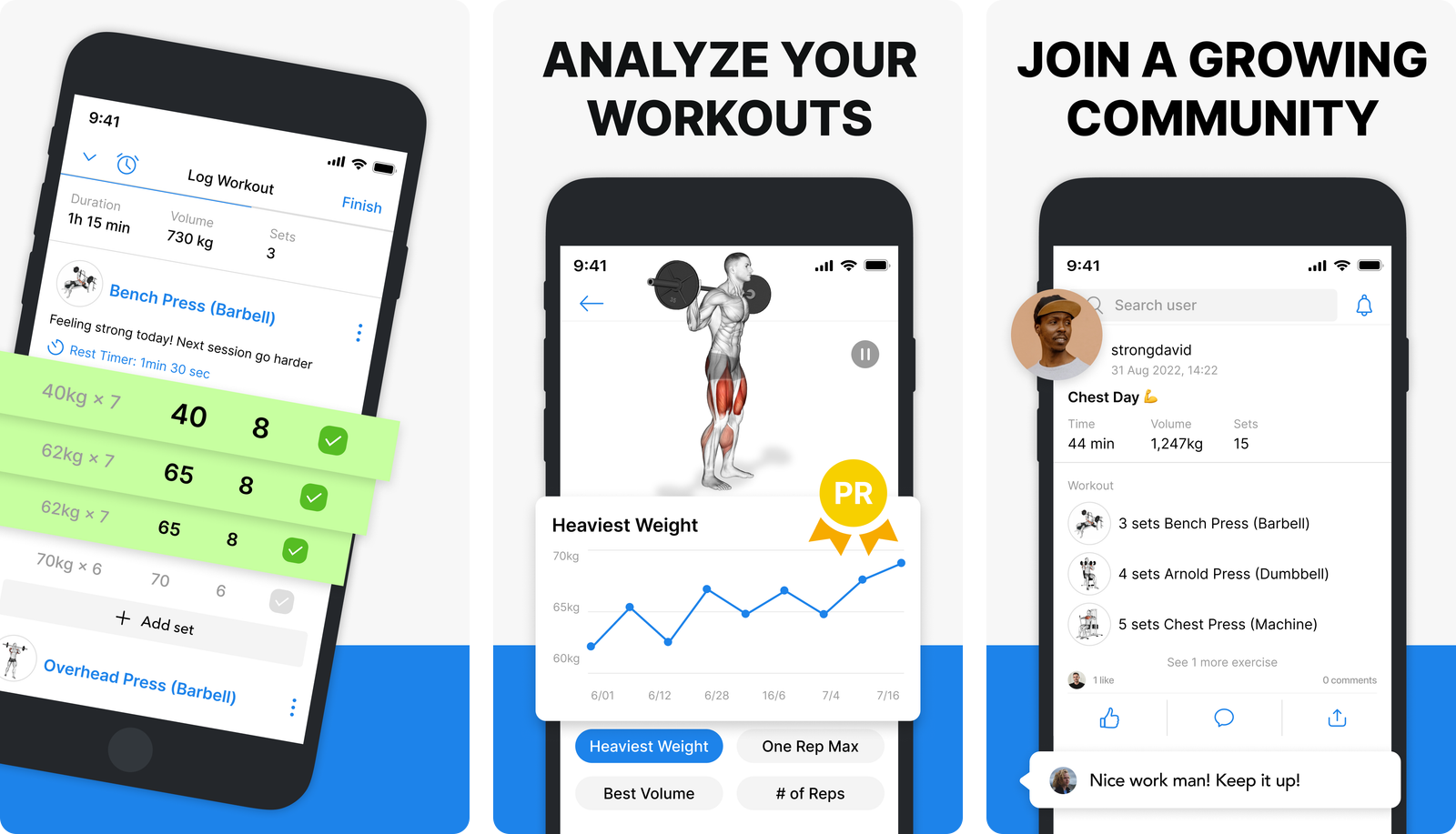
The catch for a beginner is that Hevy gives you a container, not a programme. You still have to decide what to do. Pair it with a written plan and it is close to perfect; open it cold on day one and you are staring at an empty routine screen.
2. StrongLifts 5x5: best for barbell beginners who want a plan
Platform: iOS App Store and Android · Price: Free for the core 5x5 programme, Pro from $59.99 a year
The plan in an app. StrongLifts runs one thing: a three-day-a-week barbell programme built on squat, bench, row, overhead press and deadlift. It tells you the exact weight for every set, adds a small jump when you finish all your reps, and drops the weight when you stall. The decisions are gone.
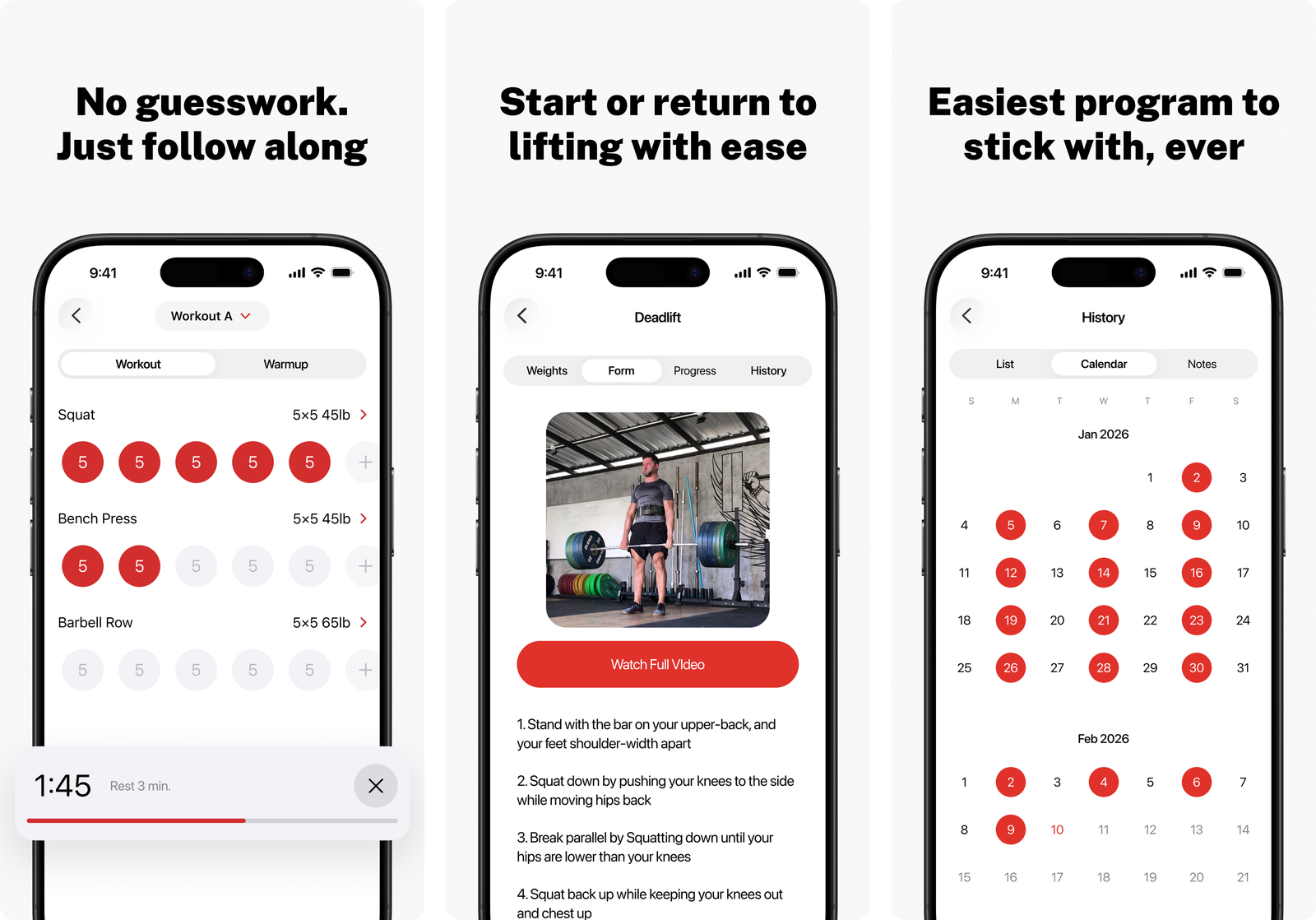
That narrowness is the point and the limit. If you want dumbbells, machines or anything resembling a bodybuilding split, this is the wrong app. If you want to get strong on five barbell lifts without thinking, nothing is simpler. Our 5x5 workout program guide covers how the progression works.
3. Fitbod: best if you do not know what to do today
Platform: iOS App Store, Android and web · Price: No free tier. Seven-day trial, then monthly plans from $12.99, or a year from $79.99
The decision remover. Fitbod asks what equipment you have and what you trained recently, then builds today's session for you: exercises, sets, reps and a starting weight. Every movement has a demo animation. For someone whose real problem is walking into a gym with no plan, that is worth a lot.
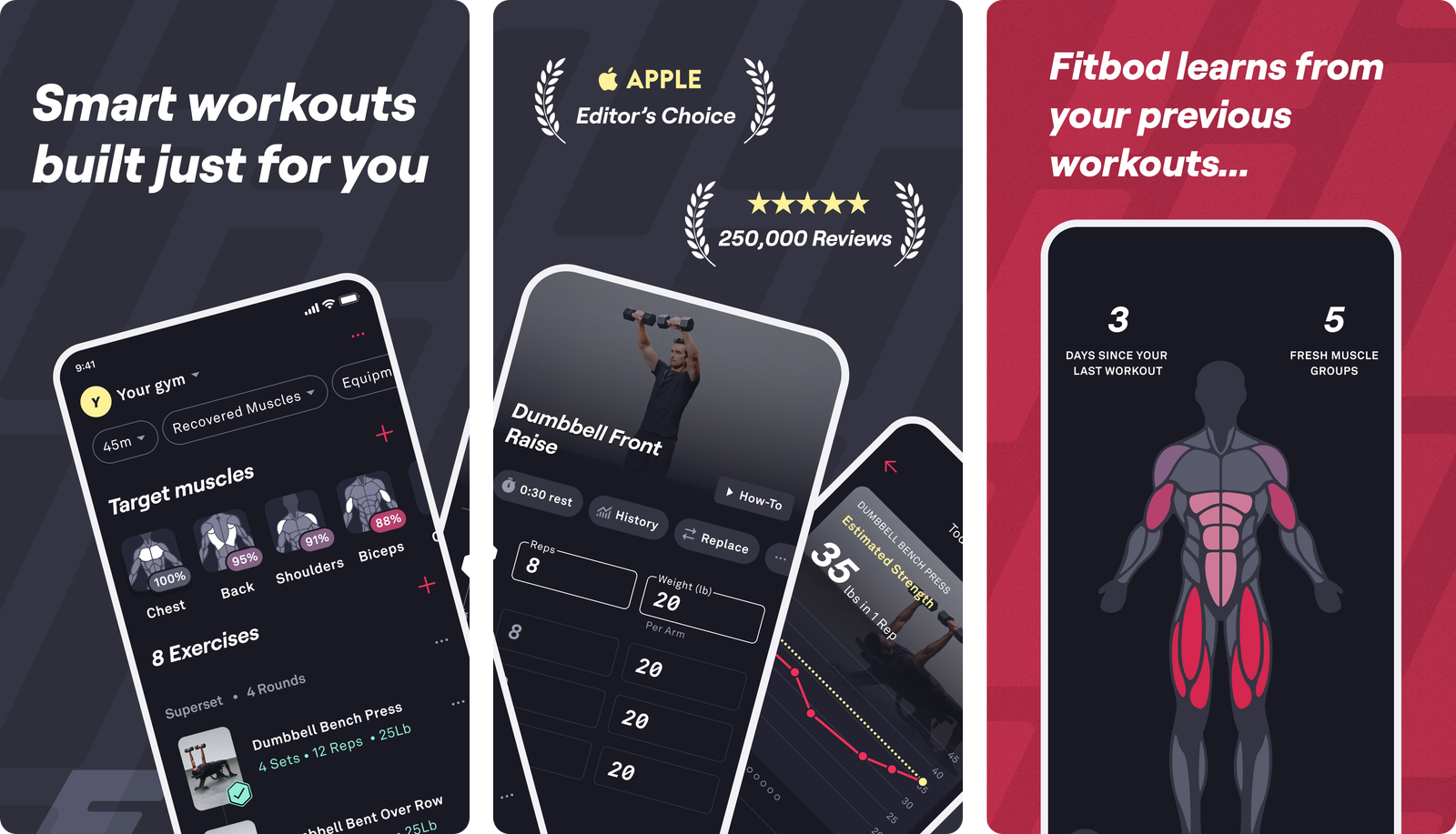
The cost is the cost. There is no free tier, and it is the most expensive app on this list. It also changes your exercises often, which is fine for variety and awkward for tracking whether you are actually getting stronger at anything.
4. Boostcamp: best free programme library
Platform: iOS App Store and Android · Price: Free tier includes the full programme library, Pro is subscription only
The programme shop. Boostcamp's free tier hands you dozens of complete, named programmes from real coaches, including the standard beginner routines, and then runs them for you with the weights calculated. You pick a plan, it tells you what to lift.
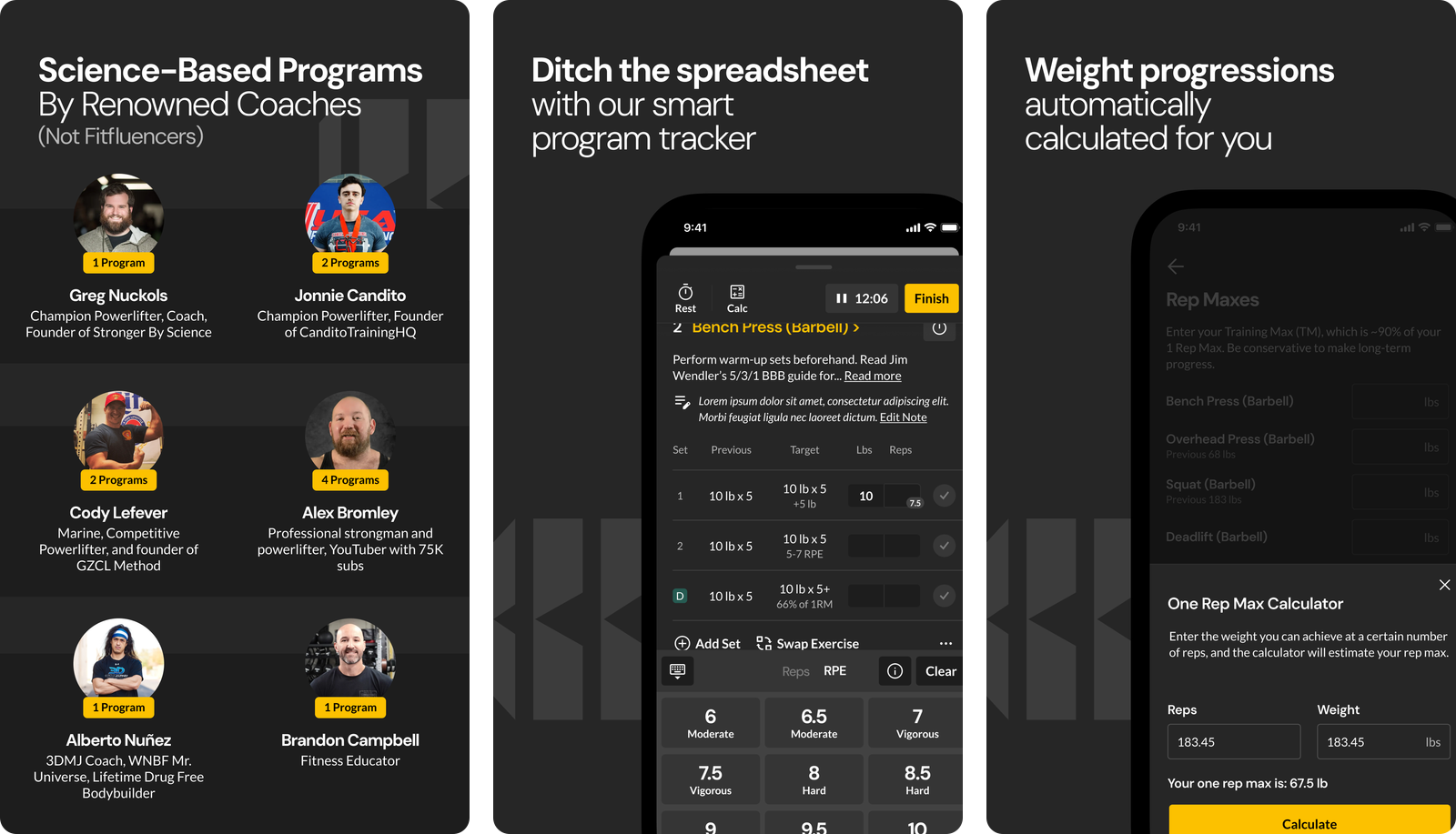
For a beginner, this is the cheapest route to a structured plan that is not just 5x5. The trade is that the logger itself is more basic than Hevy's or Strong's, and freestyle sessions feel like an afterthought.
5. Gym Note Plus: best for people who already log in their notes app
Platform: iOS App Store · Price: Free, Lifetime $99.99 (monthly $4.99, annual $39.99)
The notes-app upgrade. If you have already started jotting sessions into Apple Notes, this is the shortest path to charts. You type the session as a line of text, Bench Press 40kg - 8, 8, 6, and it becomes structured data with per-exercise history behind it. It also reads a photo of a handwritten page, which matters if your log currently lives in a notebook.
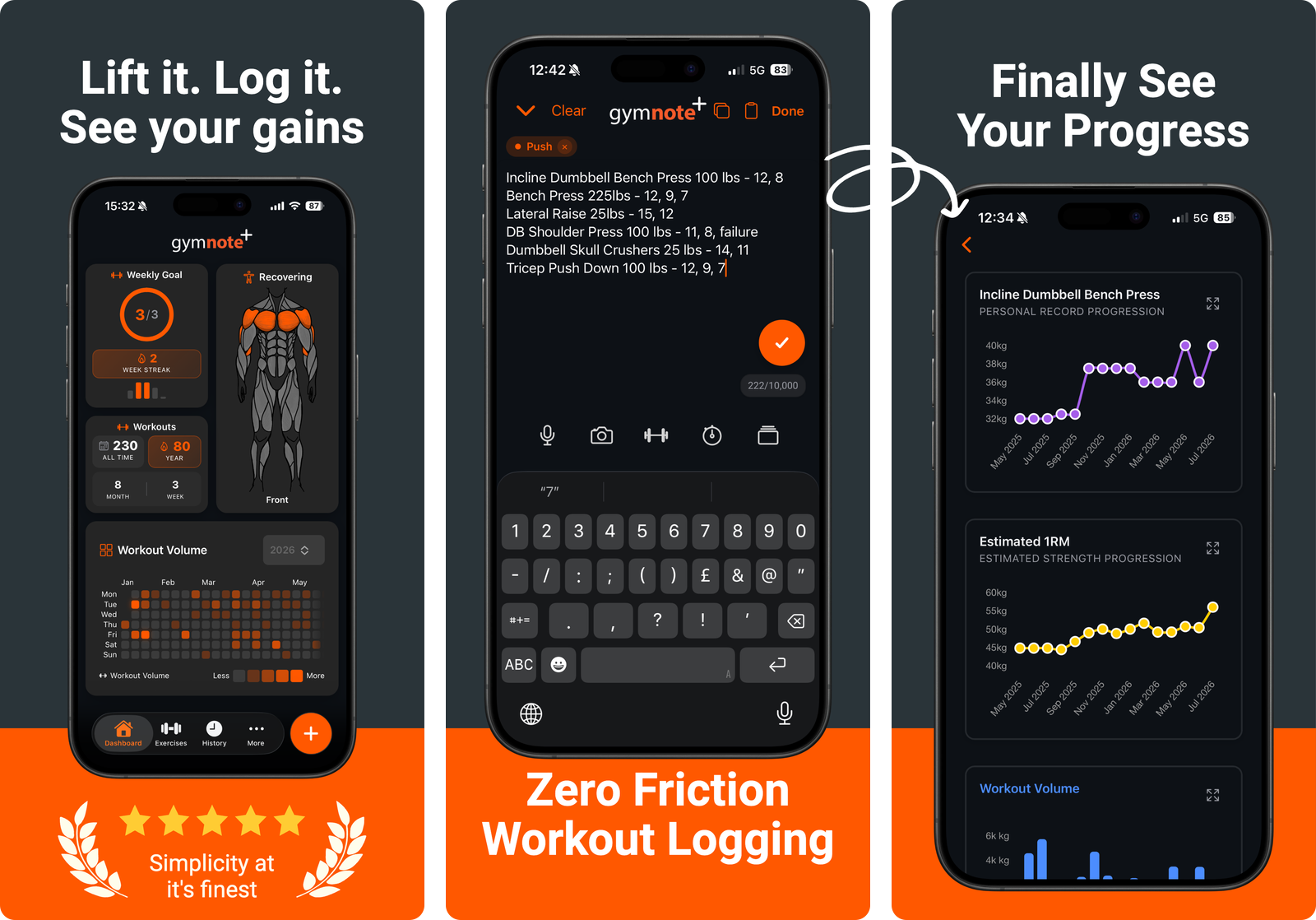
It does not hand you a programme, so it belongs in the same bucket as Hevy: bring a plan. What it removes is the friction of learning an app's data model in your first month.
6. Strong: best minimal logger
Platform: iOS App Store and Android · Price: Free with a routine cap, PRO from $4.99 a month
The old reliable. Strong has been around longer than almost everything else here, sitting at 4.9 stars across roughly 108,000 ratings. The free tier logs unlimited workouts and keeps a small number of routines, which is plenty when you are running one split. Set entry is about as fast as tapping gets, and the plate calculator saves beginners a lot of maths at the rack.
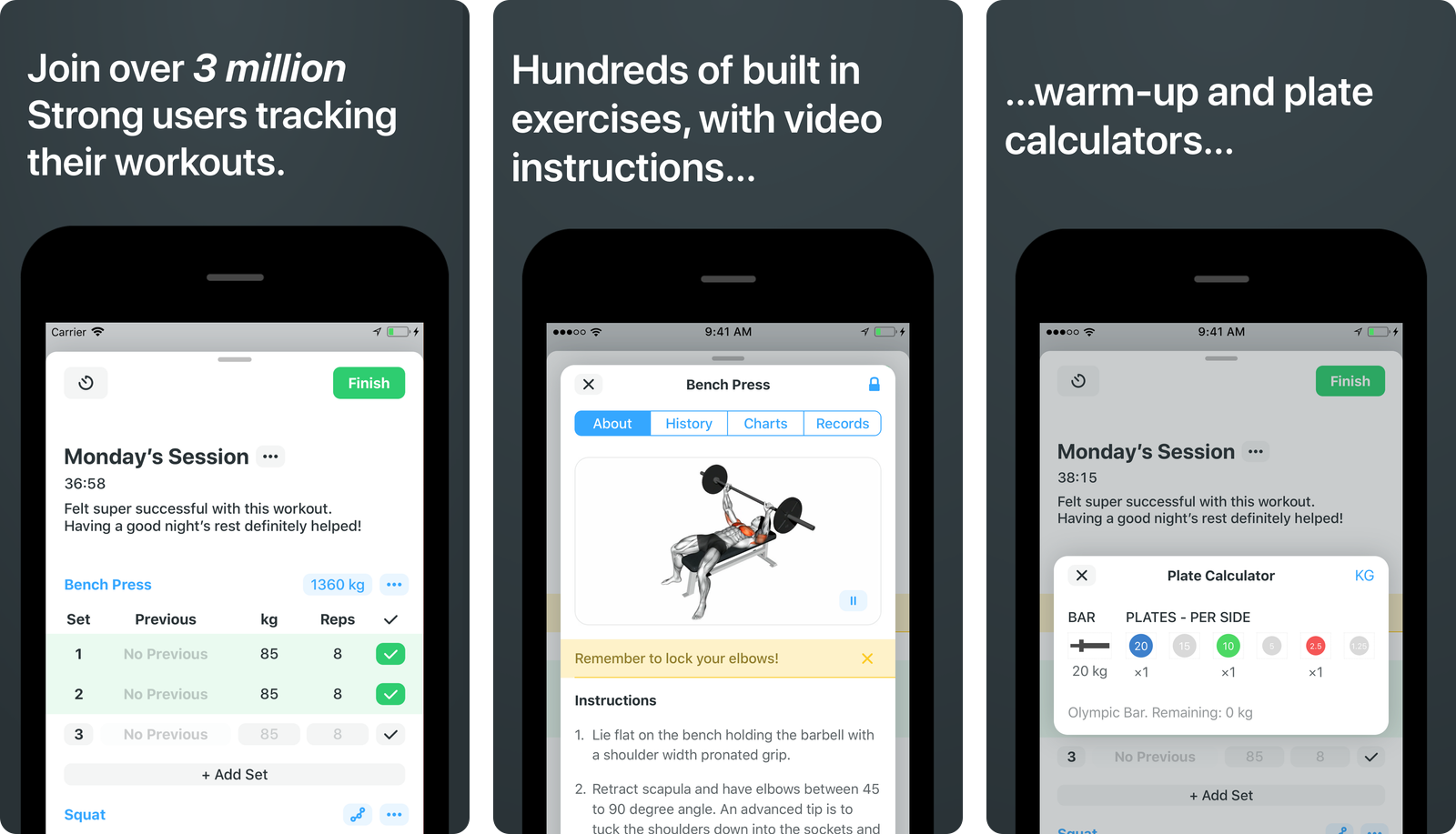
Like Hevy, it assumes you know what you are doing. It is a very good notebook with a timer, not a coach.
7. JEFIT: best exercise demo library
Platform: iOS App Store and Android · Price: Free with ads, Elite from $12.99 a month or $69.99 a year
The exercise encyclopedia. JEFIT's pitch for a beginner is the library: more than 1,400 exercises with instructions and video demos, which makes it useful as a reference even when you log somewhere else. Walked up to a machine you have never seen? It is in there.
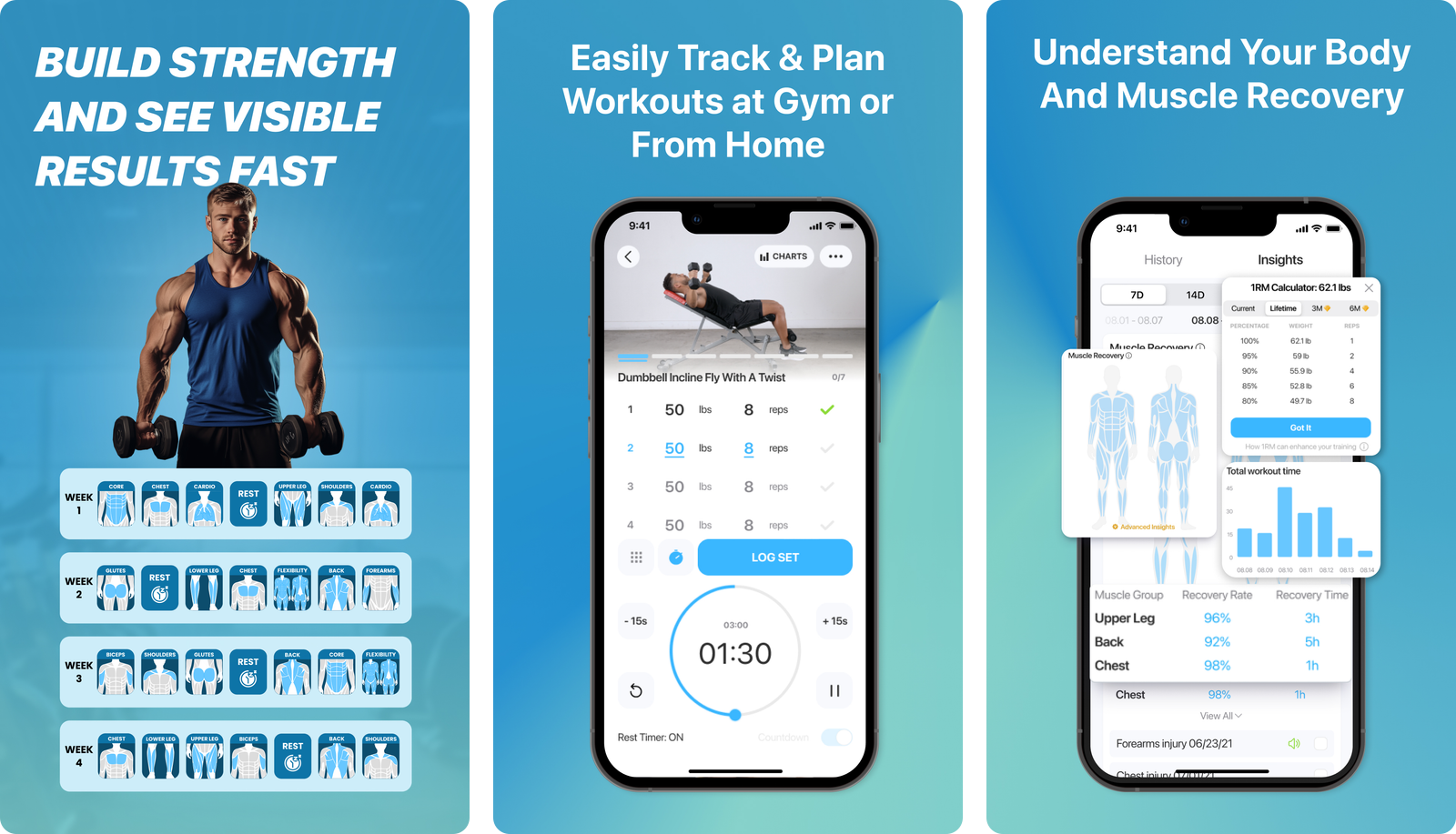
The free tier carries ads and the interface is busier than anything else here. Worth installing for the library, less obviously worth paying for.
How do the beginner apps compare?
| Hevy | StrongLifts | Fitbod | Boostcamp | Gym Note Plus | |
|---|---|---|---|---|---|
| Standout feature | Generous free tier | One barbell plan, done for you | Builds today's session | Free programme library | Plain-text logging |
| Tells you what to lift | No | Yes | Yes | Yes | No |
| Usable free tier | Yes | Yes | No | Yes | Yes |
| Form demos | Yes | Yes | Yes | Limited | No |
| Best for | A first tracker | Barbell beginners | No plan at all | Following a named plan | Notes-app loggers |
Prices and features shift over time, so check the current listings before you commit to anything.
Which should you pick?
- Pick StrongLifts if you want to start with a barbell and stop deciding. Three days a week, five lifts, weights chosen for you.
- Pick Fitbod if your real problem is standing in the gym with no plan and you would rather pay than plan.
- Pick Boostcamp if you want a proper programme without a subscription and are happy with a simpler logger.
- Pick Hevy or Strong if you already have a plan from a coach, a friend, or an article, and just need somewhere to record it.
- Pick Gym Note Plus if you have already been typing sessions into your notes app and want charts without changing how you write them.
Do you even need an app to start?
No, and pretending otherwise is how apps lose beginners. A notebook works. So does the notes app already on your phone, which is where a surprising number of experienced lifters still log.
The difference shows up in month three, when you want to know whether your squat has moved and the answer is buried in forty pages of text.
| Physical Notebook | Notes App | Traditional Gym App | Gym Note Plus | |
|---|---|---|---|---|
| Logging speed | Fast | Fast | Slow at first | Fast |
| Data visualization | None | None | Charts | Charts from your text |
| Flexibility | Total | Total | Fixed fields | Total |
| Searchability | Flip pages | Text search | Structured search | Structured search |
| Learning curve | None | None | Real | None |
A simple starting plan
- Pick a programme before you pick an app. Three days a week, full body, five to seven exercises. Our beginner workout plan is a fine starting point.
- Install one app and delete the others. Comparing four trackers in week one is procrastination with extra steps.
- Log every set, including the bad ones. A missed rep is data. A skipped entry is a hole.
- Add weight only when every set hits the target reps. When to increase weight covers how to judge the jump.
- Review your log at week 8, not week 2. Two weeks of numbers is noise.
If you have already started logging in your notes
You do not have a bad system. You have a system with no memory. Plain text takes anything you throw at it, including "shoulder felt off, dropped to 15s", which no dropdown will ever have.
Gym Note Plus keeps that habit and adds the missing half. You type the session the way you always have, and it groups every set by exercise and date.
- Type sets in plain text, no picker to fight
- See each exercise as a trend, so progress is a line rather than a memory
- Photograph a handwritten page and get it read into the log
- Pull up last session before you load the bar
Try it before you install anything: paste your last workout into the free notes to workout translator and see what comes back.
The best app for a beginner is the one still open in month six. Pick for friction, not features.
Frequently Asked Questions
What is the best workout app for beginners in 2026?
Hevy is the best all-round starting point for beginners in 2026 because its free tier logs unlimited workouts with no time limit. If you also need the programme itself, StrongLifts 5x5 supplies a complete barbell plan for free, and Fitbod builds each session for you at a subscription price.
Is there a free workout app for beginners?
Yes. Hevy, StrongLifts 5x5, Boostcamp, Strong and Gym Note Plus all have free tiers you can use indefinitely rather than short trials. Boostcamp's free tier includes its full programme library, which makes it the cheapest way for a beginner to follow a structured plan.
Should a beginner use Fitbod or Hevy?
Choose Fitbod if you do not have a training plan and want the app to pick each session's exercises, sets and weights. Choose Hevy if you already have a plan and need somewhere fast and free to record it. Fitbod has no free tier; Hevy does. Our Fitbod vs Hevy comparison covers price, logging speed and data export side by side.
Do beginners need a workout tracking app at all?
No. A notebook or a phone notes app records the same information and costs nothing. An app earns its place around month three, when you want to see whether a lift is actually progressing rather than scrolling back through pages of text to guess.
What should a beginner record in a workout log?
Record the exercise, the weight, the reps you completed for each set, and one short note about anything unusual. That is enough to decide whether to add weight next session. Our guide on what to write down in a workout log covers the format.
Is StrongLifts 5x5 good for beginners?
StrongLifts 5x5 suits beginners who want to train with a barbell three days a week and would rather not design anything. It prescribes exact weights and adds load automatically. It is a poor fit if you plan to train mostly with dumbbells or machines, since the programme only covers five barbell lifts.
Final Takeaways
- Decide whether you want a plan or a notebook first. That single question sorts all seven apps into two piles.
- Hevy is the best free tracker to start on, with StrongLifts the best free plan.
- Fitbod is worth its price only if planning is your bottleneck. It is the most expensive option here.
- Boostcamp gives you real programmes for free, at the cost of a plainer logger.
- If you already log in your notes app, keep doing that and add charts rather than starting over.

Josh Ibbotson
Josh is the creator of Gym Note Plus, building tools that make workout tracking as simple as taking notes.
Ready to try it out?
Download Gym Note Plus and start tracking your workouts the way you want.
Download on App Store