

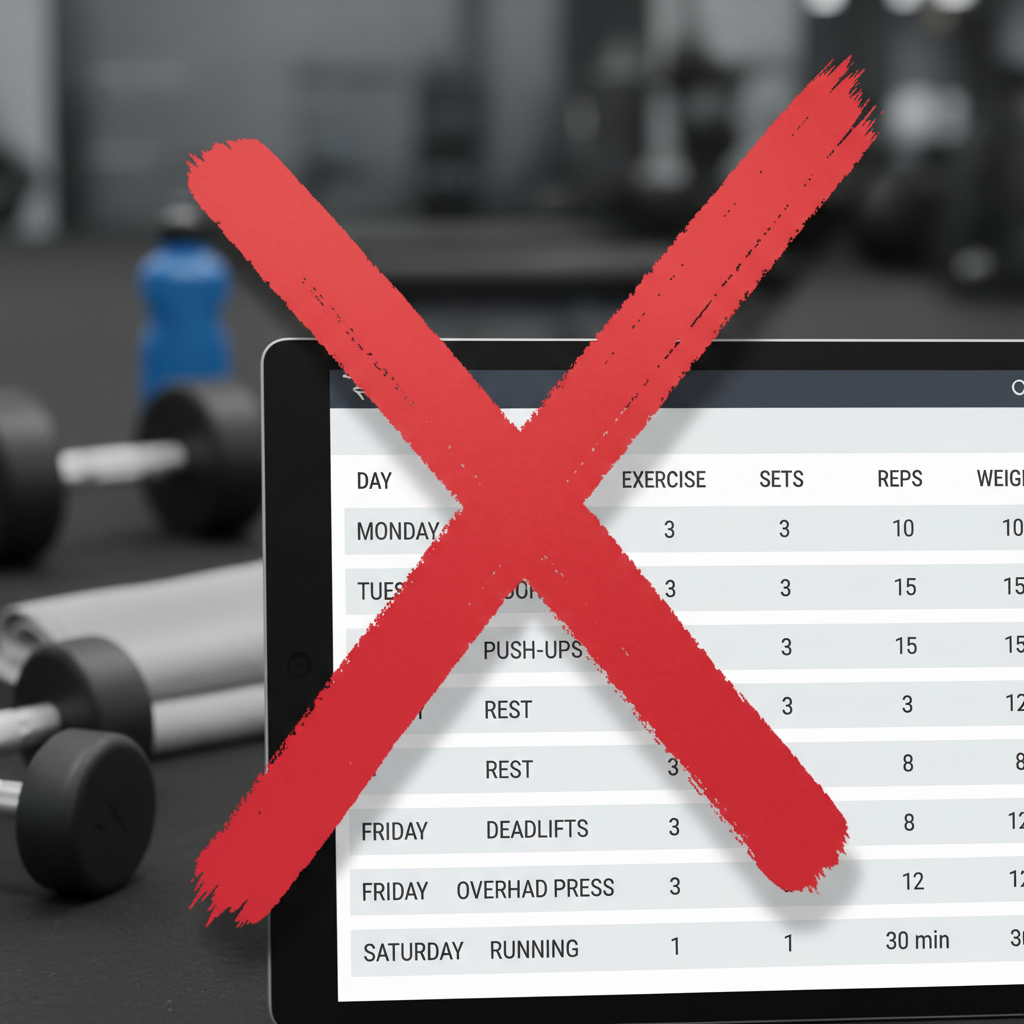
Track Progressive Overload Without Complex Spreadsheets
Quick answer: You can track progressive overload without a spreadsheet by logging weight, sets and reps as plain text after each session, then letting an app parse that text into charts. Write the line, keep the format consistent, and beat one number from last week every session.
Progressive overload tracking is the systematic recording of your training data (specifically sets, reps, and weight) to ensure you are constantly increasing the stimulus on your muscles over time. It matters because your body is an adaptive machine; if you don't provide a reason for it to grow by lifting more than you did last time, it simply won't. Many lifters feel forced into using clunky Excel files, but you can successfully track progressive overload without spreadsheets by using natural language methods that feel like texting a friend.
You've likely been there. Standing in the squat rack, fumbling with a Google Sheet that won't load because the gym basement has no signal. Or worse, you spend ten minutes trying to select a tiny cell on your screen with chalk-covered fingers. It's a mess. We know we need the data to get stronger, but the tools we use often make the workout feel like an administrative chore.
What is Progressive Overload Tracking?
To understand why we need to track, we have to look at how muscle is built. According to research published in ResearchGate (2026), mechanical tension is widely considered the primary driver of muscle hypertrophy. This means that if you want bigger muscles, you must subject them to a load that exceeds their current capacity. If the stimulus remains static, say lifting 135 lbs for 10 reps every week for a year, your body achieves homeostasis. It becomes efficient at that specific task and stops building new contractile protein.
This is where tracking comes in. For a novice lifter, progress is often felt in the mirror. However, for an intermediate lifter, the margin for error shrinks. Industry research indicates that an intermediate trainee might need to increase total volume load by precisely 2-5% over a training block to trigger new adaptation. Without a log, you're just guessing.
As Dr. Mike Israetel, a renowned expert in exercise science at Renaissance Periodization, notes: "Track your workouts and commit to adding a small amount of weight or an extra rep each week." It sounds simple. But doing it without a headache is the real challenge.
TL;DR: Progressive overload is the biological requirement for growth. You need to track weight and reps to ensure you're beating your past self, even by just 2%.
The Mobile Failure of Manual Strength Spreadsheets
Spreadsheets are amazing tools for planning. They allow for complex formulas that can calculate your 1-rep max (1RM) or plan a 12-week Sheiko cycle. But they are fundamentally desktop tools that have been forced into a mobile world.
On a 27-inch monitor, a spreadsheet is a dashboard. On a 6-inch phone, it's a keyhole. You're constantly scrolling horizontally and vertically, often losing track of which exercise row you're even looking at. This micro-frustration adds up.
| Method | Flexibility | Input Speed | Analysis Power |
|---|---|---|---|
| Pen & Paper | Unlimited | Fast | Zero |
| Spreadsheets | High | Very Slow | High |
| Rigid Apps | Low | Medium | High |
| GymNote+ | Unlimited | Instant | High |
Furthermore, spreadsheets are fragile. If the squat rack is taken and you decide to do leg presses instead, inserting a new row in a mobile spreadsheet often breaks the very formulas you rely on. This rigidity is why so many people abandon them. (If you still want to try the spreadsheet route properly, here is a workout tracker spreadsheet template with the columns and formulas already worked out.) Data from the Journal of Medical Internet Research (2024) shows that 69% of health and lifestyle apps are abandoned within just 90 days. People don't quit because they don't want to get fit; they quit because the data entry is too burdensome.
TL;DR: Spreadsheets fail in the gym because they require high precision in a high-intensity environment. They are great for planning, but terrible for execution.
The Notes App Paradox: Why Blank Screens Win
If spreadsheets are too complex and dedicated apps are too rigid, where does everyone go? They go to the native Notes app on their phone. It's the "Notes App Gym Logger" phenomenon.
Why? Because it's a blank canvas. It opens instantly. It works without internet. You can type whatever you want. If you felt dizzy on set two, you just type it. If you did a beltless squat instead of a regular one, you just type it. There's zero friction.
However, the Notes app has a "black hole" problem. The data goes in easily, but it's hard to get out. You can't easily see a graph of your progress. You can't ask the Notes app, "Show me my bench press volume over the last six months." The math remains manual.
This is where many lifters get stuck in a "Double Log" workflow. They use a notebook or phone note in the gym and then manually transcribe it into a master spreadsheet at home. It's double the work. Like a part-time job you never applied for.
TL;DR: Notes apps win on speed but fail on insights. They offer freedom but hide your progress in a wall of unorganized text.
Invisible Analytics: Tracking Your Way in 2026
There is a different approach that bridges this gap. It's called "invisible analytics." Instead of forcing you into dropdown menus and scroll wheels, new tools like GymNote+ use natural language processing (NLP) to understand what you're typing.
Imagine typing: Bench 225 5,5,5.
That’s it. In seconds, the system parses that string. It recognizes "Bench" as the exercise and "225" as the weight. It sees "5,5,5" as three sets of five. You get the speed of a note with the power of a database. This is a massive shift for lifters who want to track progressive overload without spreadsheets.
This method follows the advice of Dan John, the legendary strength coach, who famously said: "The goal is to keep the goal the goal." If your goal is to get strong, your tracker shouldn't be a social media platform or a complex data entry task. It should just work.
By using a text-first interface, you keep your shorthand. You keep your context. But you also get automated graphs and volume calculations. It provides a "nudge" toward progress. If you type Bench 220, the system might subtly remind you that you hit 220 last week and suggest 225. It's algorithmic coaching that stays out of your way.
TL;DR: Invisible analytics transforms your shorthand notes into structured data automatically. You type like you always have, and the tech handles the math.
3 Critical Strength Metrics to Monitor This Year
If you're moving away from complex spreadsheets, you don't need to track fifty different variables. In 2026, focus on these three core metrics to ensure your training is on the right path.
- Total Volume Load: This is your Sets x Reps x Weight. While mechanical tension is king, total volume is a primary determinant of hypertrophy, provided you are training close to failure.
- Estimated 1-Rep Max (e1RM): You don't need to max out every week (which is taxing on the nervous system). Instead, use formulas to estimate your max based on your sub-maximal sets, or just plug any set into our free one rep max calculator. Seeing this number tick up weekly is the ultimate proof of progressive overload.
- Rate of Perceived Exertion (RPE): This is a subjective measure of how hard a set felt on a scale of 1-10. As Dr. Eric Helms suggests, monitoring your proximity to failure ensures your volume is "effective volume" and not just junk reps.
According to Lucid.Now (2026), retention for fitness tools increases significantly when users see clear, visual proof of progress in these three areas. A text-based logger that automatically calculates these for you is the holy grail for the sophisticated minimalist lifter.
TL;DR: Focus on Volume, e1RM, and RPE. These three numbers tell the entire story of your strength journey.
Moving Beyond the Grid
You don't need to be a data scientist to get jacked. The era of the desktop-mobile disconnect is ending. For years, we've been told we have to choose between the freedom of a notebook and the analytical power of a spreadsheet.
But that choice is a false one. By embracing tools that understand natural language, you can keep your workout flow exactly as it is. No more scroll wheels. No more tiny cells. Just your notes, made smarter.
If you're ready to see if you're actually getting stronger without the administrative headache, it's time to try a different approach. Keep your shorthand. Keep your speed. Just let the technology do the heavy lifting behind the scenes. Your future self, the stronger and more muscular version, will thank you for the consistency that simplicity provides.
After all, the best workout log is the one you actually use every single session.

Josh Ibbotson
Josh is the creator of Gym Note Plus, building tools that make workout tracking as simple as taking notes.
Ready to try it out?
Download Gym Note Plus and start tracking your workouts the way you want.
Download on App Store